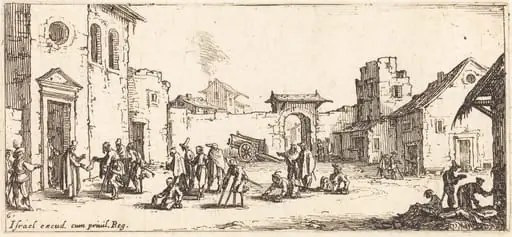
Artwork
Almshouse
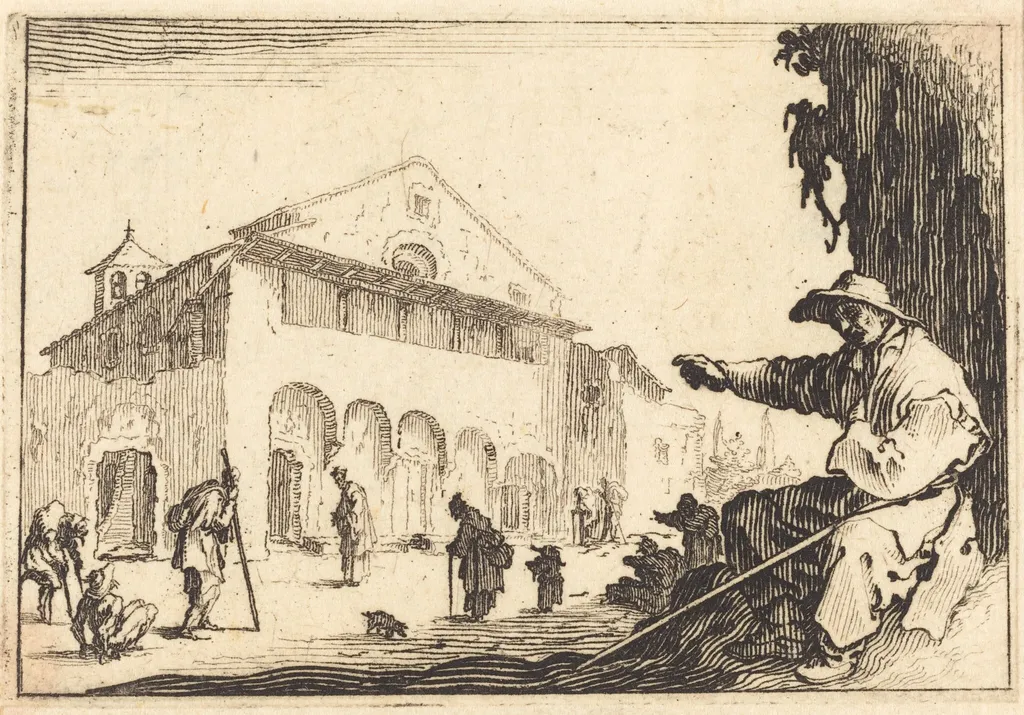
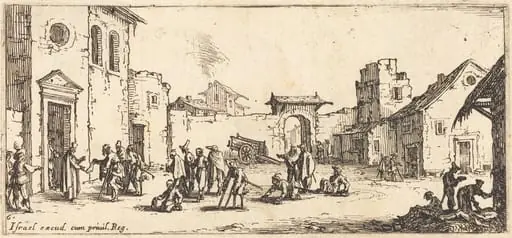
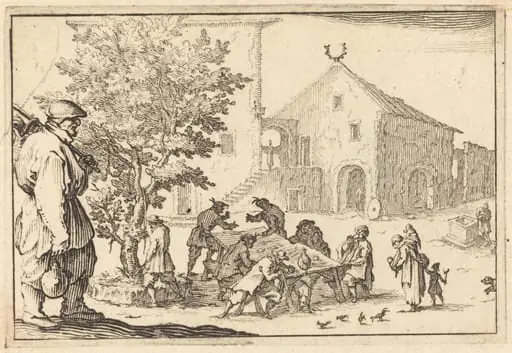
Almshouse is an ink print by the Baroque artist Jacques Callot. It dates from 1617 and is held in the collection of the National Gallery of Art.
About this work
Overview
Part of a vast oeuvre exceeding 1,400 prints, this work belongs to a series documenting everyday life in early 17th-century Europe.
Jacques Callot, a printmaker from the Duchy of Lorraine, produced *Almshouse* around 1617 as an etching on laid paper. Part of a vast oeuvre exceeding 1,400 prints, this work belongs to a series documenting everyday life in early 17th-century Europe. Callot focused on social environments, often portraying institutions and individuals on the margins of society. The print captures a charitable establishment, revealing his interest in the structures that supported the poor.
Subject & Meaning
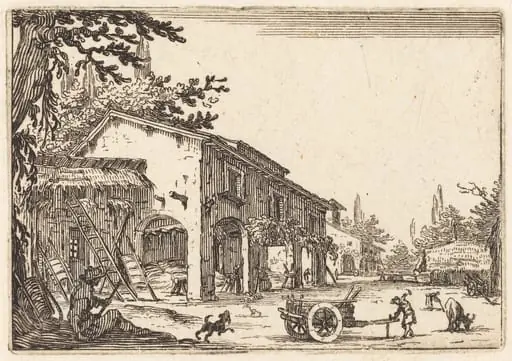
The scene shows a group of individuals gathered outside a long, columned building, likely an almshouse providing shelter for the destitute. Figures are arranged in varied postures—some seated, others leaning on staffs, one gesturing toward the entrance. A dog near the center adds a quiet, observational detail. The composition suggests the daily rhythm of institutional care, emphasizing the quiet dignity and hardship of those dependent on such places without overt sentimentality.
Technique & Style
Callot employed fine, controlled lines to model form and depth, using cross-hatching and varied line weight to suggest volume and texture. The uneven ground, the play of light and shadow on the building’s facade, and the subtle rendering of fabric and posture demonstrate his mastery of etching’s potential for narrative detail. Unlike broad brushwork, his precision allowed for intimate observation, turning a simple scene into a layered record of social reality.
History & Provenance
Created during Callot’s early career in Nancy, the print reflects his engagement with local institutions and the social conditions of Lorraine. It was likely produced for a private or scholarly audience interested in contemporary life. The work survives in multiple impressions, indicating modest circulation among collectors and artists. Its preservation in museum collections today underscores its value as a documentary record rather than a decorative object.
Context
In early 17th-century Europe, almshouses were common responses to poverty, often run by religious or civic bodies. Callot’s depiction aligns with a growing interest in social realism among Northern European artists. While religious themes dominated high art, Callot turned his lens to the mundane and the marginalized, capturing the quiet dignity of institutional life amid broader political and economic instability in the region.
Legacy
Callot’s *Almshouse* exemplifies how etching could serve as a tool for social observation, influencing later generations of printmakers who sought to document everyday life. His technical innovations in line control and composition set a precedent for narrative printmaking. Though not widely known to the public today, the work remains a key reference in studies of early modern social history and the evolution of print as a medium of record.
Artist & collection

Artist
Jacques Callot was a baroque printmaker and draftsman from the Duchy of Lorraine.

 Holy Family at supper
 Restoration of the Aqueduct at Pisa
 Restoration of the Aqueduct at Pisa
 Square in Paris with Many Figures
 Square in Paris with Many Figures
 Horsemen Attacked by Robbers
 HOW WILL A COVERED PART BE CORRECTED?HOW WIKA A COVERED HEART DEED CORRECTED?
![Christ Walking on the Water [second plate], by Jacques Callot](https://artifactworldgallery.com/img/jacques-callot--christ-walking-on-the-water-second-plate--2069f3bfe4cb2126-w320.webp) Christ Walking on the Water [second plate]
Christ Walking on the Water [second plate]