Artwork
Plundering a Large Farmhouse
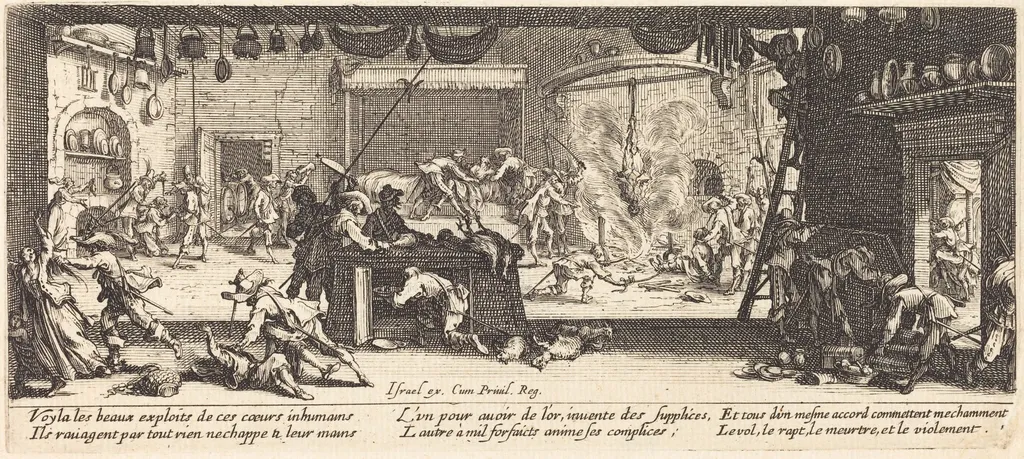
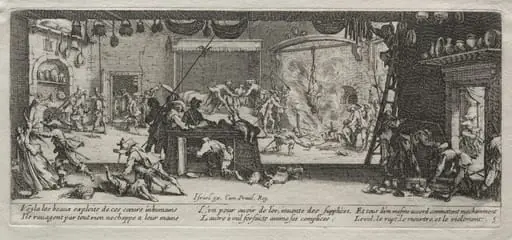
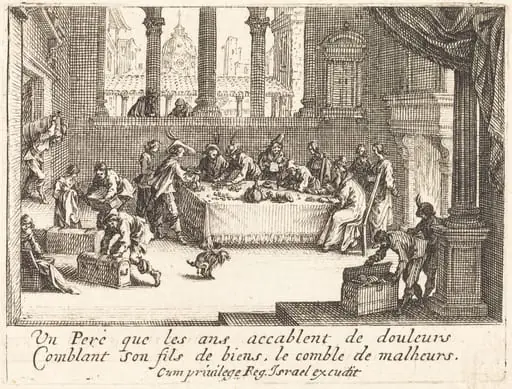
Plundering a Large Farmhouse is an ink print by the Baroque artist Jacques Callot. It dates from 1633 and is held in the collection of the National Gallery of Art. Created circa 1633, this etching on laid paper depicts a violent raid on a farmhouse.
About this work
Overview
Created circa 1633, this etching on laid paper depicts a violent raid on a farmhouse. The composition is densely populated with soldiers, civilians, and animals, all rendered in tightly packed, dark lines that convey a sense of disorder and urgency. The image is signed by Jacques Callot, a French printmaker active in the early seventeenth century.
Subject & Meaning
The work illustrates a group of armed men forcefully entering a rural dwelling, scattering occupants, overturning furniture and pilfering belongings. Small narrative details—a dog crouched beneath a table, a soldier peering through a window—enhance the chaotic atmosphere. A French caption beneath the scene warns of cruelty, underscoring the moral commentary on wartime brutality.
Technique & Style
Callot employed the etching process, incising intricate figures and expansive landscape elements into a copper plate before printing on laid paper.
Callot employed the etching process, incising intricate figures and expansive landscape elements into a copper plate before printing on laid paper. His characteristic use of fine, overlapping lines creates depth and texture, allowing both the crowded interior and the surrounding exterior to be rendered with equal precision. The contrast between dense foreground action and broader background space typifies his baroque sensibility.
History & Provenance
Part of Callot’s prolific output of more than 1,400 prints, this piece belongs to his series of military subjects that documented contemporary conflicts. Though specific ownership records are sparse, the print has circulated among European collections since the mid‑seventeenth century, reflecting its role as both documentary evidence and artistic study.
Context
The etching emerges from a period of intense warfare in Europe, notably the Thirty Years’ War, which devastated many regions of the Holy Roman Empire and neighboring territories. Callot, hailing from the Duchy of Lorraine, witnessed the impact of such campaigns, and his work often served to record the human cost of armed incursions on civilian life.
Artist & collection

Artist
Jacques Callot was a baroque printmaker and draftsman from the Duchy of Lorraine.

 Holy Family at supper
 Restoration of the Aqueduct at Pisa
 Restoration of the Aqueduct at Pisa
 Square in Paris with Many Figures
 Square in Paris with Many Figures
 Horsemen Attacked by Robbers
 HOW WILL A COVERED PART BE CORRECTED?HOW WIKA A COVERED HEART DEED CORRECTED?
![Christ Walking on the Water [second plate], by Jacques Callot](https://artifactworldgallery.com/img/jacques-callot--christ-walking-on-the-water-second-plate--2069f3bfe4cb2126-w320.webp) Christ Walking on the Water [second plate]
Christ Walking on the Water [second plate]