Artwork
Pulliciniello and Siga. Lucretia
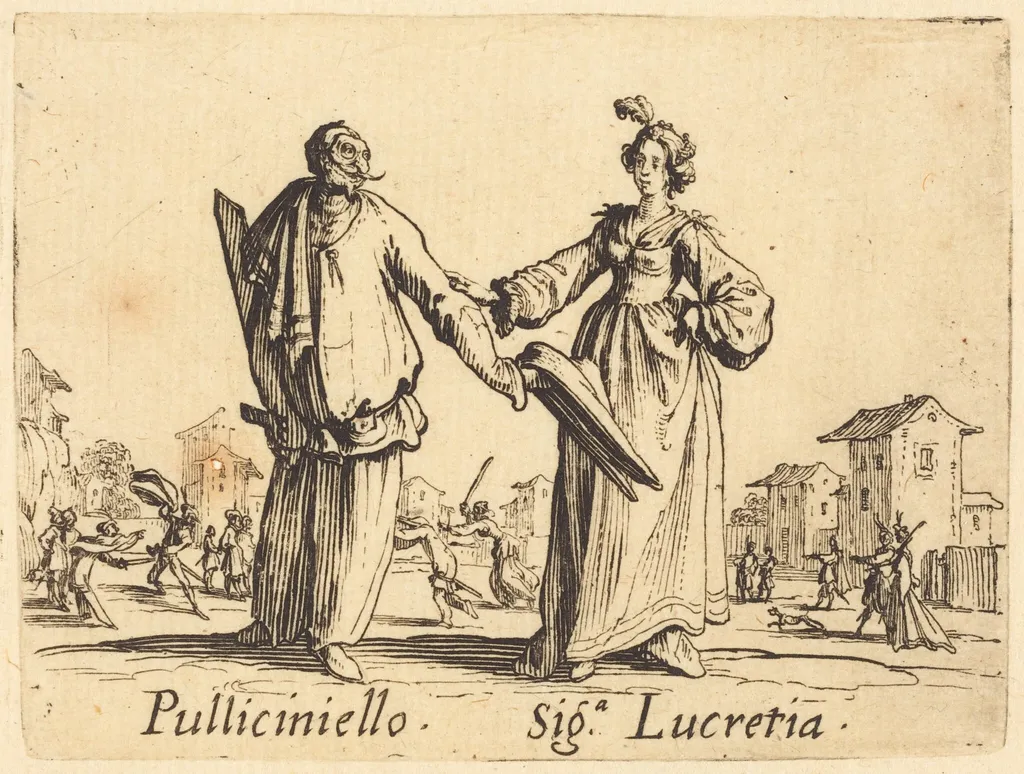
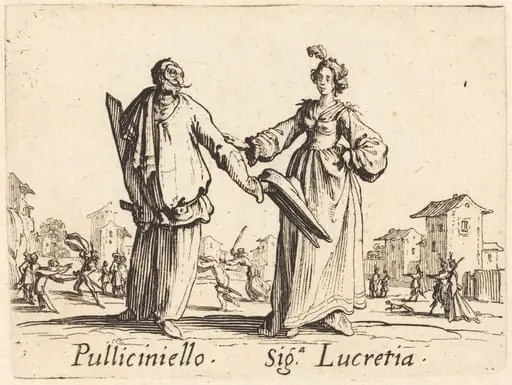
Pulliciniello and Siga. Lucretia is an ink print by the Baroque artist Jacques Callot. It dates from 1622 and is held in the collection of the National Gallery of Art. Pulliciniello and Siga.
About this work
Overview
Pulliciniello and Siga. Lucretia is an etching on laid paper created by Jacques Callot around 1622. Characteristic of the Baroque style, the work showcases Callot's mastery of detailed realism and dramatic composition.
Subject & Meaning
The etching depicts a masked man in a long robe and a woman in a flowing gown, hand in hand, set against a bustling backdrop of buildings and figures. The specific narrative or symbolic intent behind the couple's portrayal remains implicit, inviting interpretation.
Technique & Style
Callot's etching technique is marked by fine lines, intricate textures, and strategic contrast between light and dark, lending the scene depth and dimensionality. These elements align with the dramatic and realistic tendencies of Baroque art.
History & Provenance
Created circa 1622 by Jacques Callot, a prolific French Baroque printmaker, this work is one of over 1,400 etchings in his oeuvre, which spanned military, religious, and everyday life themes.
Context
This etching reflects Callot's interest in documenting contemporary life and varied human types within complex, narratively rich scenes, typical of his contributions to Baroque printmaking.
Legacy
As a representative of Callot's work, *Pulliciniello and Siga. Lucretia* contributes to the broader appreciation of Baroque printmaking's technical sophistication and thematic depth, influencing subsequent generations of artists.
Artist & collection

Artist
Jacques Callot was a baroque printmaker and draftsman from the Duchy of Lorraine.

 Holy Family at supper
 Restoration of the Aqueduct at Pisa
 Restoration of the Aqueduct at Pisa
 Square in Paris with Many Figures
 Square in Paris with Many Figures
 Horsemen Attacked by Robbers
 HOW WILL A COVERED PART BE CORRECTED?HOW WIKA A COVERED HEART DEED CORRECTED?
![Christ Walking on the Water [second plate], by Jacques Callot](https://artifactworldgallery.com/img/jacques-callot--christ-walking-on-the-water-second-plate--2069f3bfe4cb2126-w320.webp) Christ Walking on the Water [second plate]
Christ Walking on the Water [second plate]