Artwork
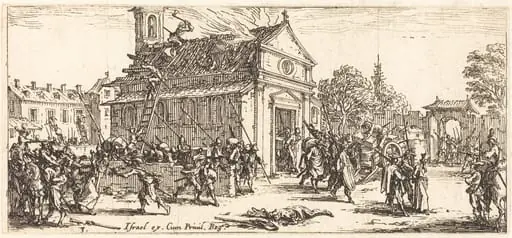
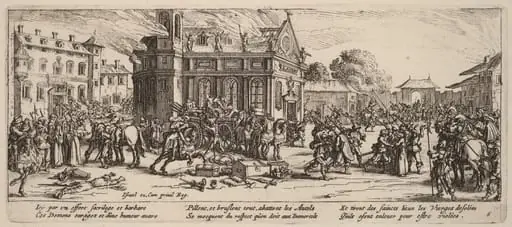
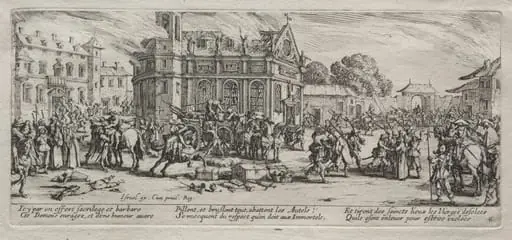
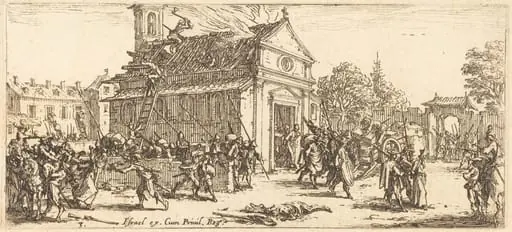
Ravaging and Burning a Village
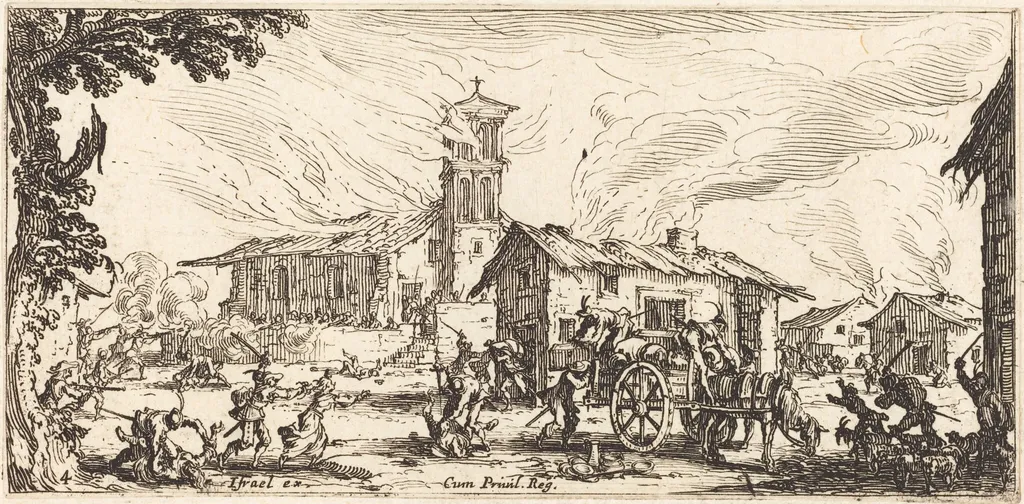
Ravaging and Burning a Village is an ink print by the Baroque artist Jacques Callot. It dates from 1633 and is held in the collection of the National Gallery of Art.
About this work
Overview
Created around 1633 by Jacques Callot, this etching on laid paper is part of a larger series depicting the violence of war in early 17th-century Europe.
Created around 1633 by Jacques Callot, this etching on laid paper is part of a larger series depicting the violence of war in early 17th-century Europe. Callot, a printmaker from Lorraine, produced over a thousand etchings, many focused on military life. This work captures a moment of civilian suffering during conflict, rendered with precision and emotional intensity through the technical possibilities of etching.
Subject & Meaning
The scene portrays soldiers attacking a rural village, with figures fleeing, buildings engulfed in flames, and livestock scattered amid the chaos. The presence of a church tower suggests the desecration of sacred space. Callot does not glorify war but records its human cost—civilians caught in the violence, their possessions abandoned, their lives upended. The image functions as a sober witness to the brutality of troop movements during the Thirty Years' War.
Technique & Style
Callot employed fine, incised lines to convey motion and disorder, using the etching process to achieve remarkable detail. The dense composition, with overlapping figures and smoky horizons, creates a sense of claustrophobic urgency. His use of sharp contours and varied line weights enhances the drama, aligning with Baroque sensibilities that favored emotional intensity and dynamic composition over idealized form.
History & Provenance
The print was made during a period when Callot was documenting the campaigns of the Spanish and Imperial armies in the Rhineland and Lorraine. Though the exact provenance of this specific impression is undocumented, it belongs to a known series circulated among collectors and military observers. Its survival in multiple copies suggests it was widely reproduced and distributed, reflecting contemporary interest in war imagery.
Context
Produced during the height of the Thirty Years' War, the image reflects the widespread devastation inflicted on Central European villages by mercenary forces. Callot’s work was informed by firsthand observation and reports from the region. Unlike idealized battle scenes, his etchings rejected heroism, instead emphasizing the vulnerability of noncombatants—a perspective uncommon in contemporary visual culture.
Legacy
Callot’s series, including this etching, influenced later artists such as Goya, who adopted similar unflinching depictions of war’s horrors. The technical mastery of his etching method raised the status of printmaking as a medium for social commentary. His work remains a key reference for understanding how visual art documented the realities of early modern conflict beyond official narratives.
Artist & collection

Artist
Jacques Callot was a baroque printmaker and draftsman from the Duchy of Lorraine.

 Holy Family at supper
 Restoration of the Aqueduct at Pisa
 Restoration of the Aqueduct at Pisa
 Square in Paris with Many Figures
 Square in Paris with Many Figures
 Horsemen Attacked by Robbers
 HOW WILL A COVERED PART BE CORRECTED?HOW WIKA A COVERED HEART DEED CORRECTED?
![Christ Walking on the Water [second plate], by Jacques Callot](https://artifactworldgallery.com/img/jacques-callot--christ-walking-on-the-water-second-plate--2069f3bfe4cb2126-w320.webp) Christ Walking on the Water [second plate]
Christ Walking on the Water [second plate]