Artwork
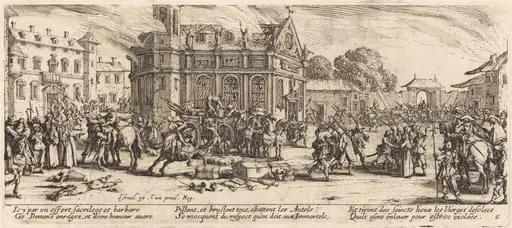
Pillaging a Monastery
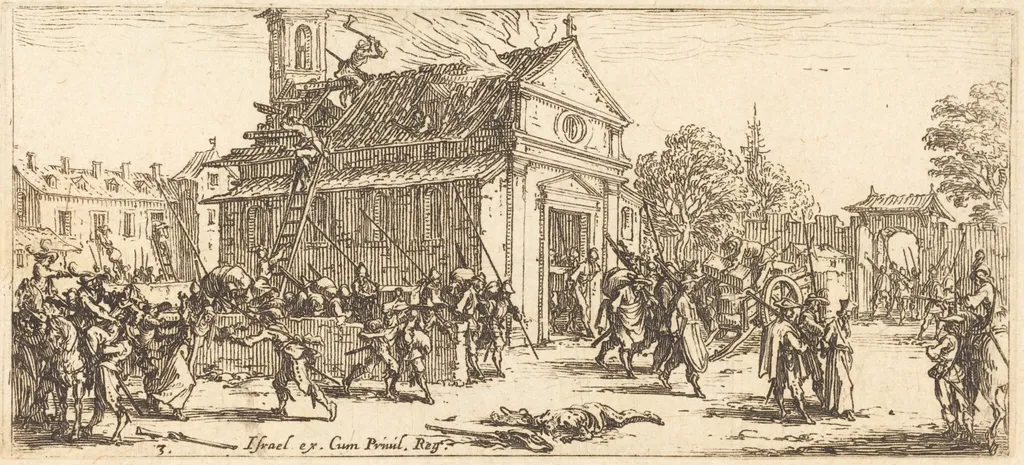
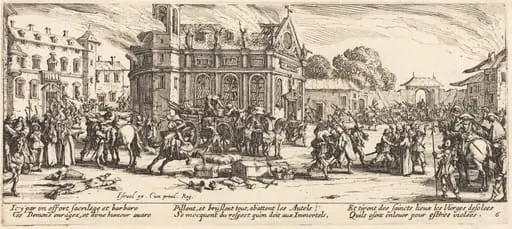
Pillaging a Monastery is an ink print by the Baroque artist Jacques Callot. It dates from 1633 and is held in the collection of the National Gallery of Art.
About this work
Overview
Jacques Callot, a French printmaker active in the early seventeenth century, produced the etching *Pillaging a Monastery* around 1633. Executed on laid paper, the work measures roughly a typical size for his prints and presents a densely populated scene of armed men invading a religious complex. The composition is rendered in black ink, emphasizing line and contrast rather than tonal shading.
Subject & Meaning
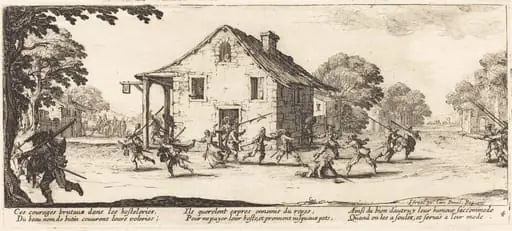
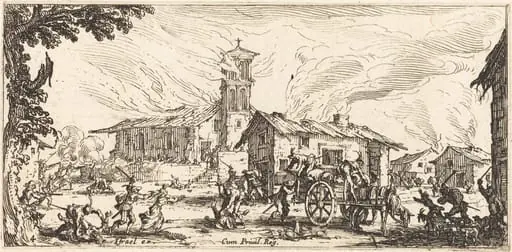
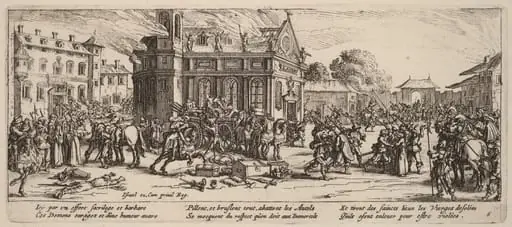
The image captures a violent intrusion of soldiers into a monastery, with figures dragging furnishings, breaking doors, and a fallen body lying on the ground.
The image captures a violent intrusion of soldiers into a monastery, with figures dragging furnishings, breaking doors, and a fallen body lying on the ground. A crowd of onlookers, both mounted and on foot, gathers along a street lined with trees and ancillary structures, while smoke curls from the damaged roof. The narrative element suggested by an inscription at the bottom implies a specific episode rather than a generic depiction of war.
Technique & Style
Callot employed the etching process, incising fine lines into a copper plate that were then transferred to laid paper. His characteristic use of crisp, sharply defined contours conveys the tumult and movement of the scene. The careful rendering of architectural details—such as the tall bell tower and arched portals—alongside the crowded figures demonstrates his skill in integrating landscape and human activity within a single, coherent tableau.
History & Provenance
Created during Callot’s most productive period, the print belongs to a body of work in which he documented contemporary military and social events. While the exact patron or original collector is not recorded, the piece has survived in several museum collections, reflecting its inclusion in the broader corpus of over 1,400 etchings that established Callot’s reputation among early modern printmakers.
Context
The early 1630s were marked by the Thirty Years’ War, a conflict that brought widespread devastation to the Holy Roman Empire and neighboring regions. Callot’s depiction of a monastic raid mirrors the real‑world incursions and looting that afflicted religious institutions during this period, offering a visual commentary on the disruption of sacred spaces by armed forces.
Legacy
Callot’s meticulous approach to crowd scenes and his ability to convey narrative detail influenced later generations of printmakers, notably the French etchers of the eighteenth century. His integration of precise line work with complex social commentary helped to expand the expressive possibilities of the etching medium, cementing his role in the evolution of old‑master printmaking.
Artist & collection

Artist
Jacques Callot was a baroque printmaker and draftsman from the Duchy of Lorraine.

 Holy Family at supper
 Restoration of the Aqueduct at Pisa
 Restoration of the Aqueduct at Pisa
 Square in Paris with Many Figures
 Square in Paris with Many Figures
 Horsemen Attacked by Robbers
 HOW WILL A COVERED PART BE CORRECTED?HOW WIKA A COVERED HEART DEED CORRECTED?
![Christ Walking on the Water [second plate], by Jacques Callot](https://artifactworldgallery.com/img/jacques-callot--christ-walking-on-the-water-second-plate--2069f3bfe4cb2126-w320.webp) Christ Walking on the Water [second plate]
Christ Walking on the Water [second plate]