Artwork
The Last Supper
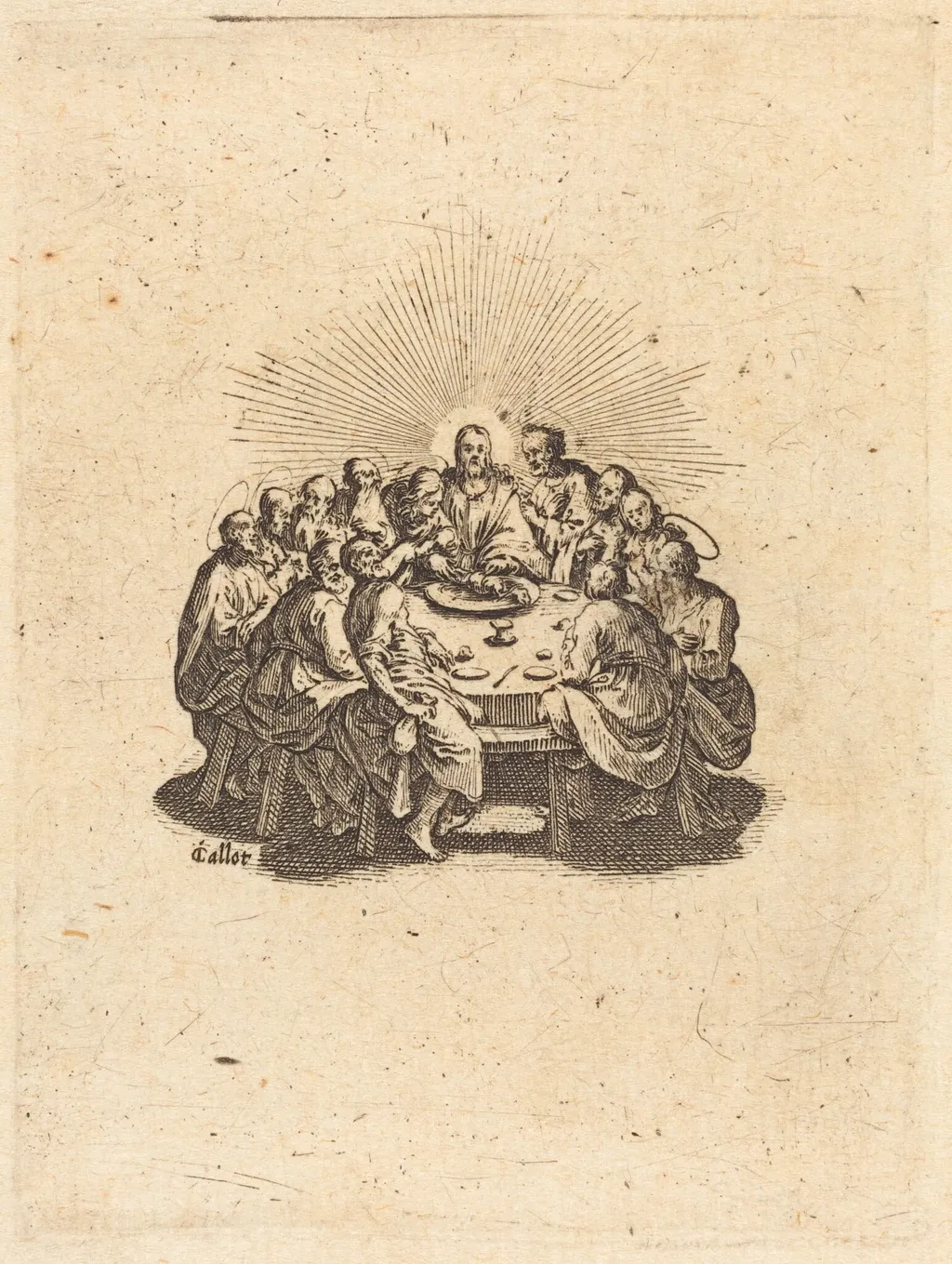
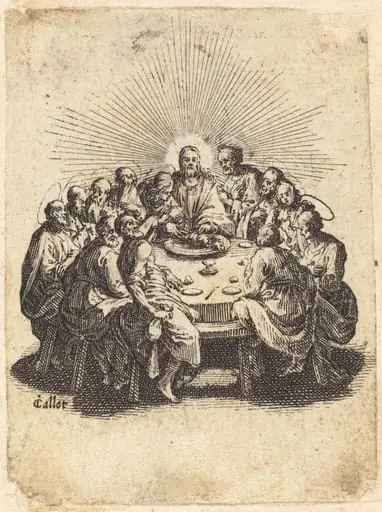
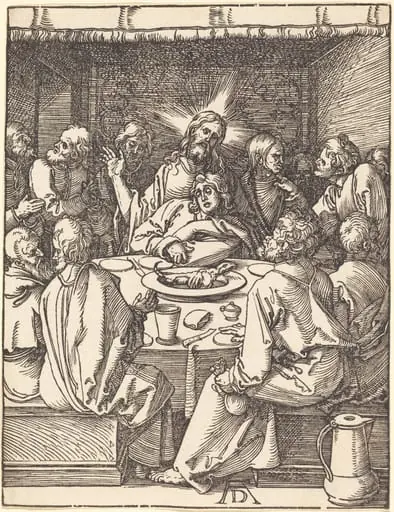
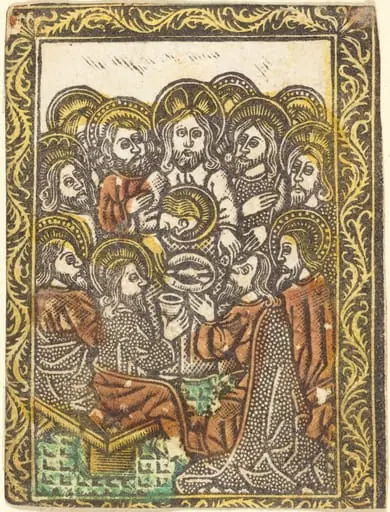
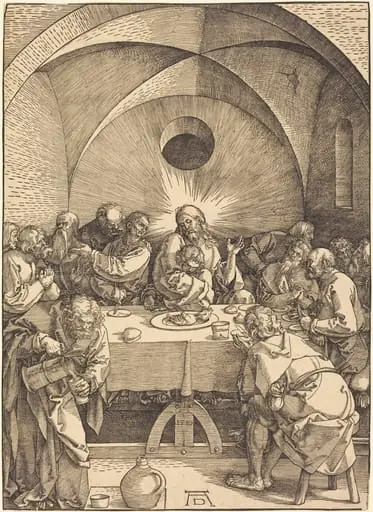
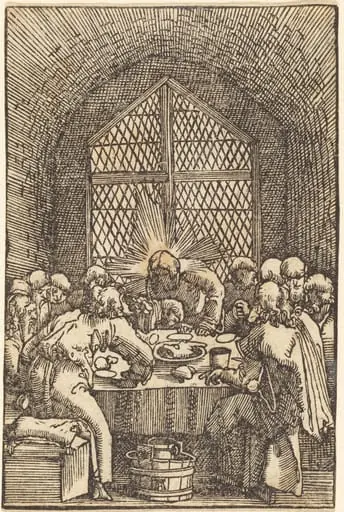
The Last Supper is an ink print by the Baroque artist Jacques Callot. It dates from 1618 and is held in the collection of the National Gallery of Art.
About this work
Overview
Jacques Callot produced *The Last Supper* in 1618 as an etching on laid paper, part of his vast body of over 1,400 prints.
Jacques Callot produced *The Last Supper* in 1618 as an etching on laid paper, part of his vast body of over 1,400 prints. A native of the Duchy of Lorraine, he was known for his technical precision and engagement with religious themes. This work exemplifies his mastery of the etching medium, capturing a biblical moment with fine linear detail and a restrained tonal range that emphasizes clarity over ornamentation.
Subject & Meaning
The scene depicts Christ at the center of the table, haloed, announcing his betrayal to the twelve apostles. Each disciple reacts with varied gestures—some raise hands in shock, others lean in intently—conveying emotional tension without theatricality. The modest table setting, with bread and vessels, grounds the moment in everyday reality, reinforcing the narrative’s intimacy and spiritual gravity within the context of Counter-Reformation devotional imagery.
Technique & Style
Callot employed fine, controlled etching lines to render textures and forms with remarkable clarity. The paper’s laid texture subtly informs the surface, enhancing the work’s tactile quality. His use of delicate cross-hatching and minimal shading creates depth without heavy contrast, resulting in a composition that feels both precise and serene. The linear economy reflects his training in Northern European print traditions and his focus on narrative legibility.
History & Provenance
Created during Callot’s early career in Florence, the print likely circulated among collectors and clergy familiar with biblical imagery. Though no specific early ownership records survive, its survival in multiple institutional collections suggests it was valued for its technical refinement. As part of his broader output, the print aligns with his documented interest in religious subjects during his time in Italy, where he absorbed both Italian composition and Northern draftsmanship.
Context
In early 17th-century Europe, printmaking served as a vital medium for disseminating religious imagery, especially in regions affected by the Reformation. Callot’s etchings responded to this demand, offering accessible, emotionally resonant scenes rooted in scripture. His work bridged French, Italian, and Flemish traditions, contributing to a broader visual culture that prioritized clarity and moral instruction over grandeur.
Legacy
Callot’s *The Last Supper* remains a representative example of his influence on printmaking’s evolution. His technical innovations in etching, including fine-line control and compositional restraint, inspired later generations of printmakers. Though less celebrated than his war scenes or genre works, this religious etching underscores his consistent commitment to narrative precision and the expressive potential of the printed line.
Artist & collection

Artist
Jacques Callot was a baroque printmaker and draftsman from the Duchy of Lorraine.

 Holy Family at supper
 Restoration of the Aqueduct at Pisa
 Restoration of the Aqueduct at Pisa
 Square in Paris with Many Figures
 Square in Paris with Many Figures
 Horsemen Attacked by Robbers
 HOW WILL A COVERED PART BE CORRECTED?HOW WIKA A COVERED HEART DEED CORRECTED?
![Christ Walking on the Water [second plate], by Jacques Callot](https://artifactworldgallery.com/img/jacques-callot--christ-walking-on-the-water-second-plate--2069f3bfe4cb2126-w320.webp) Christ Walking on the Water [second plate]
Christ Walking on the Water [second plate]