Artwork
The Last Supper
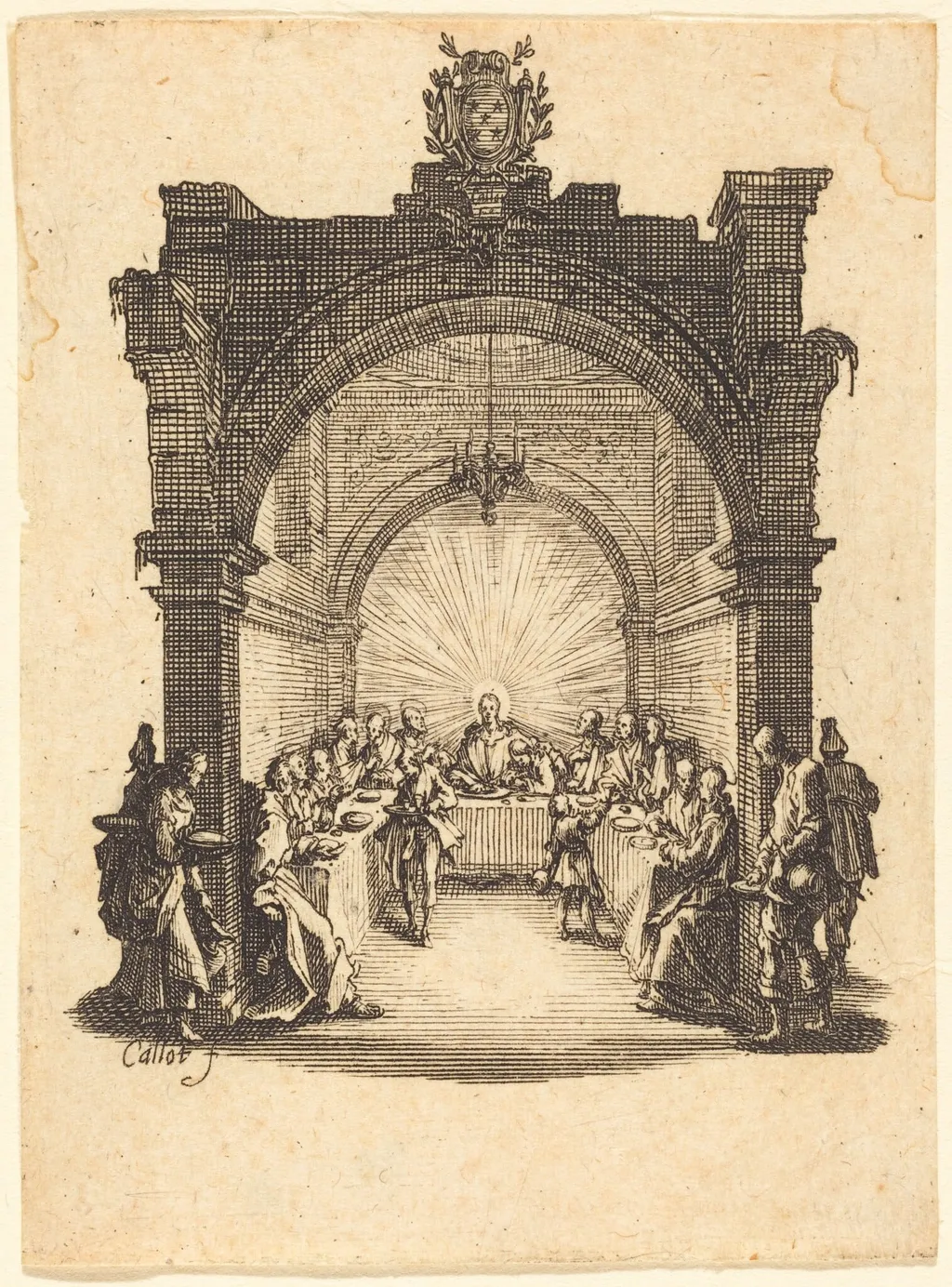
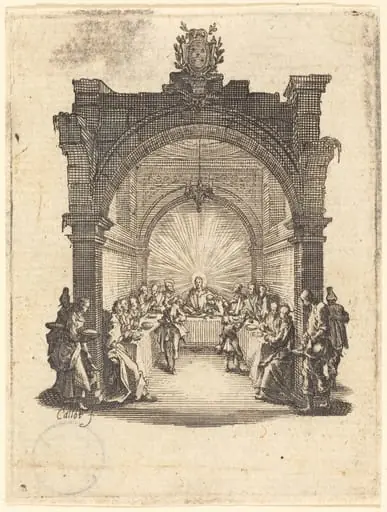
The Last Supper is an ink print by the Baroque artist Jacques Callot. It dates from 1624 and is held in the collection of the National Gallery of Art.
About this work
Overview
Part of a vast oeuvre exceeding 1,400 prints, this work reflects his engagement with religious themes alongside scenes of contemporary life.
Jacques Callot, a printmaker from the Duchy of Lorraine, produced *The Last Supper* circa 1624 as an etching on laid paper. Part of a vast oeuvre exceeding 1,400 prints, this work reflects his engagement with religious themes alongside scenes of contemporary life. The medium allowed for fine linear detail and tonal variation, suited to the intimate gravity of the subject. Callot’s approach to biblical narratives often emphasized psychological presence over grandeur.
Subject & Meaning
The scene captures the moment Jesus announces that one of his disciples will betray him, as recounted in the Gospels. Figures are arranged around a long table, their postures and glances conveying tension and introspection. The central figure, Christ, is framed by an ornate archway, reinforcing his spiritual authority. The absence of overt spectacle focuses attention on the emotional weight of the moment, aligning with Counter-Reformation ideals of devotional clarity.
Technique & Style
Callot employed etching to achieve precise, delicate lines and subtle gradations of shadow. The use of laid paper, with its visible chain lines, added a tactile quality to the surface. His mastery of fine cross-hatching and controlled line weight rendered depth and texture without heavy ink tones. The architectural backdrop, richly detailed, grounds the figures in a believable space, enhancing the scene’s solemn realism.
History & Provenance
Created during Callot’s time in Florence, the print likely circulated among collectors and religious institutions in Italy and northern Europe. Though no specific early ownership records are documented, its technical refinement suggests it was intended for discerning audiences. The work survives in multiple impressions, preserved in major print collections, reflecting its recognition among contemporaries for its craftsmanship.
Context
In early 17th-century Europe, religious imagery remained central to print culture, especially amid the Catholic Church’s efforts to reinforce doctrine through visual means. Callot’s etchings responded to this demand while maintaining personal precision. Unlike monumental paintings, his small-scale works offered accessible, portable devotion. His focus on human expression within sacred narratives distinguished his approach from more theatrical contemporaries.
Legacy
Callot’s *The Last Supper* exemplifies the potential of etching to convey narrative depth and emotional nuance on a modest scale. His technical innovations influenced later generations of printmakers, particularly in the handling of fine detail and atmospheric tone. While not widely reproduced in popular culture, the work remains a reference point in studies of Baroque printmaking and religious iconography.
Artist & collection
Artist
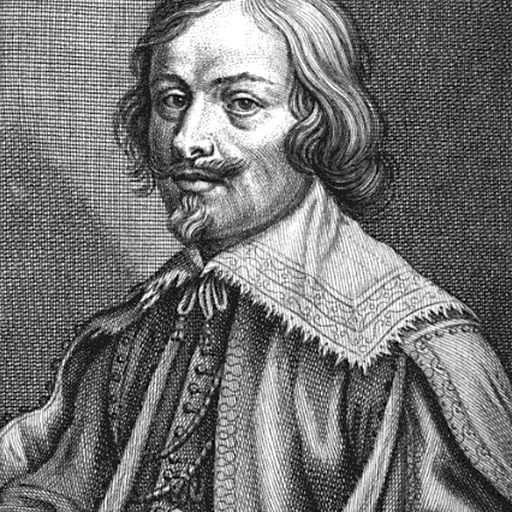
Jacques Callot was a baroque printmaker and draftsman from the Duchy of Lorraine.

 Holy Family at supper
 Restoration of the Aqueduct at Pisa
 Restoration of the Aqueduct at Pisa
 Square in Paris with Many Figures
 Square in Paris with Many Figures
 Horsemen Attacked by Robbers
 HOW WILL A COVERED PART BE CORRECTED?HOW WIKA A COVERED HEART DEED CORRECTED?
![Christ Walking on the Water [second plate], by Jacques Callot](https://artifactworldgallery.com/img/jacques-callot--christ-walking-on-the-water-second-plate--2069f3bfe4cb2126-w320.webp) Christ Walking on the Water [second plate]
Christ Walking on the Water [second plate]