Artwork
The Massacre of the Innocents
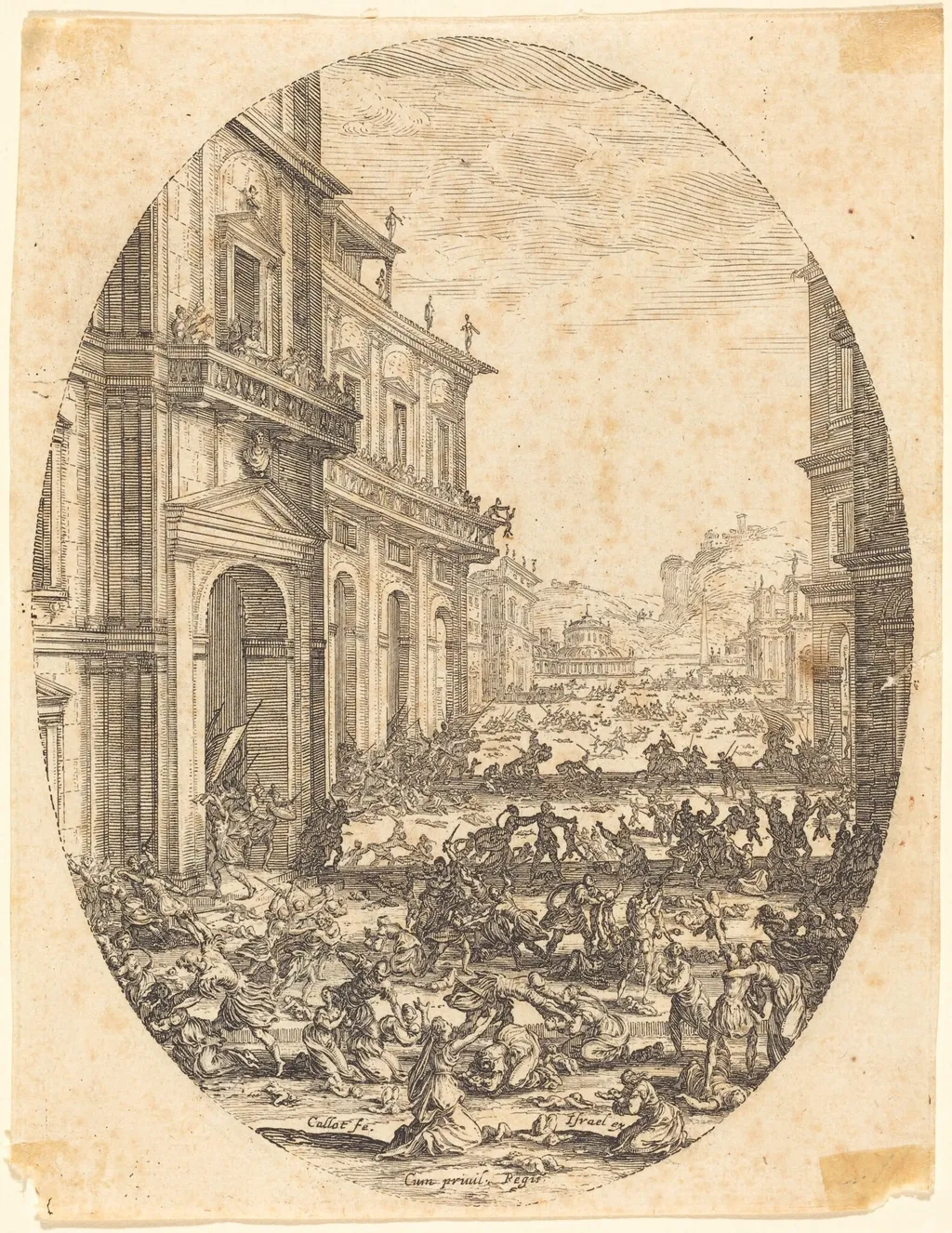
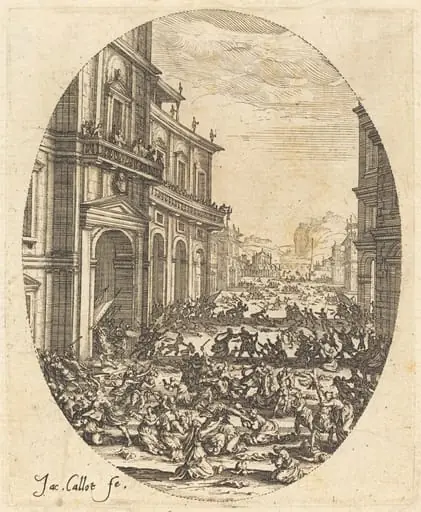
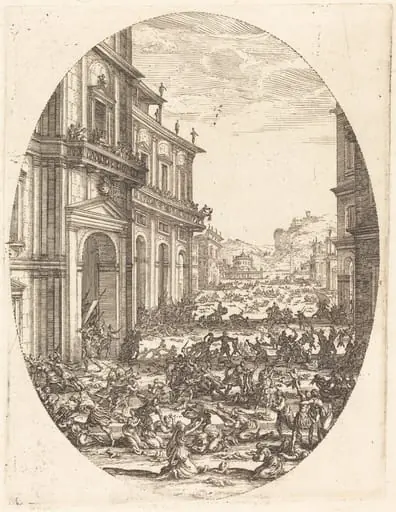
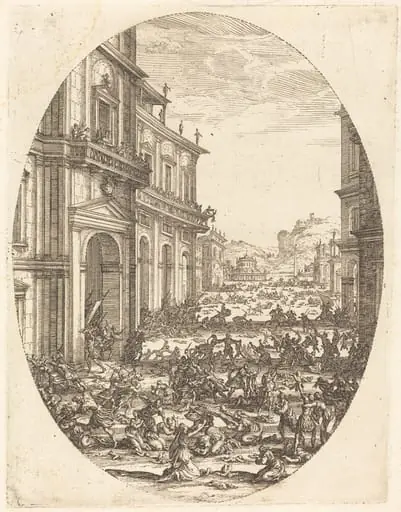
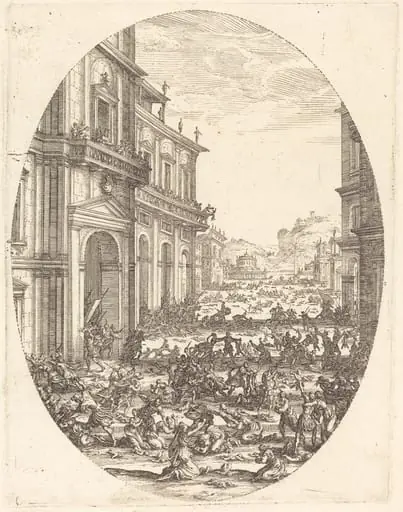
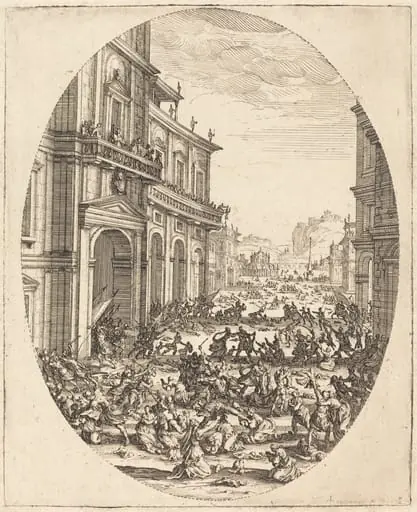
The Massacre of the Innocents is an ink print by the Baroque artist Jacques Callot. It dates from 1619 and is held in the collection of the National Gallery of Art.
About this work
Overview
Executed on laid paper, the work belongs to a series of religious and historical scenes Callot produced during his early career.
Created around 1619, this etching by Jacques Callot depicts a violent episode from the Gospel of Matthew: King Herod’s command to slaughter infant boys in Bethlehem. Executed on laid paper, the work belongs to a series of religious and historical scenes Callot produced during his early career. His technical precision and narrative intensity distinguish this print among his more than 1,400 known etchings, which frequently explored themes of conflict and human suffering.
Subject & Meaning
The scene portrays soldiers overwhelming civilians in a crowded town square, targeting women and children in a brutal enforcement of Herod’s decree. Callot avoids idealization, presenting the massacre as a chaotic, intimate tragedy. The inclusion of varied facial expressions and gestures underscores individual suffering, transforming a biblical event into a visceral commentary on power, violence, and vulnerability in civilian life.
Technique & Style
Callot employed drypoint etching, using a sharp needle to incise lines directly into a metal plate, leaving raised burrs that hold ink and create rich, textured shadows. The resulting lines are dense and urgent, enhancing the scene’s turmoil. Unlike smoother etchings, this method produces a gritty, tactile quality. The small scale of figures contrasts with the overwhelming density of the composition, drawing the viewer into the claustrophobic violence.
History & Provenance
The print was made during Callot’s time in Florence, where he was influenced by Italian art and the political unrest of the early 17th century. Though originally part of a larger series, this image circulated independently and was widely reproduced. Its survival in multiple museum collections suggests early recognition of its technical and emotional power, though its exact early ownership remains undocumented.
Context
Callot worked amid the turmoil of the Thirty Years’ War, during which civilian populations suffered widespread violence. His depictions of military brutality, including this biblical scene, reflect contemporary anxieties about war’s impact on the innocent. The etching’s emotional weight aligns with broader Baroque tendencies to evoke empathy through dramatic, unflinching imagery, bridging religious narrative and lived experience.
Legacy
Callot’s use of drypoint and his unvarnished portrayal of violence influenced later printmakers, including Rembrandt, who adopted similar techniques to convey psychological depth. While not widely exhibited in his lifetime, this etching gained scholarly attention in the 19th century as interest in Northern Baroque printmaking grew. Today, it remains a key example of how printmaking could convey complex moral narratives with remarkable immediacy.
Artist & collection

Artist
Jacques Callot was a baroque printmaker and draftsman from the Duchy of Lorraine.

 Holy Family at supper
 Restoration of the Aqueduct at Pisa
 Restoration of the Aqueduct at Pisa
 Square in Paris with Many Figures
 Square in Paris with Many Figures
 Horsemen Attacked by Robbers
 HOW WILL A COVERED PART BE CORRECTED?HOW WIKA A COVERED HEART DEED CORRECTED?
![Christ Walking on the Water [second plate], by Jacques Callot](https://artifactworldgallery.com/img/jacques-callot--christ-walking-on-the-water-second-plate--2069f3bfe4cb2126-w320.webp) Christ Walking on the Water [second plate]
Christ Walking on the Water [second plate]