Artwork
The Chamber Idyll
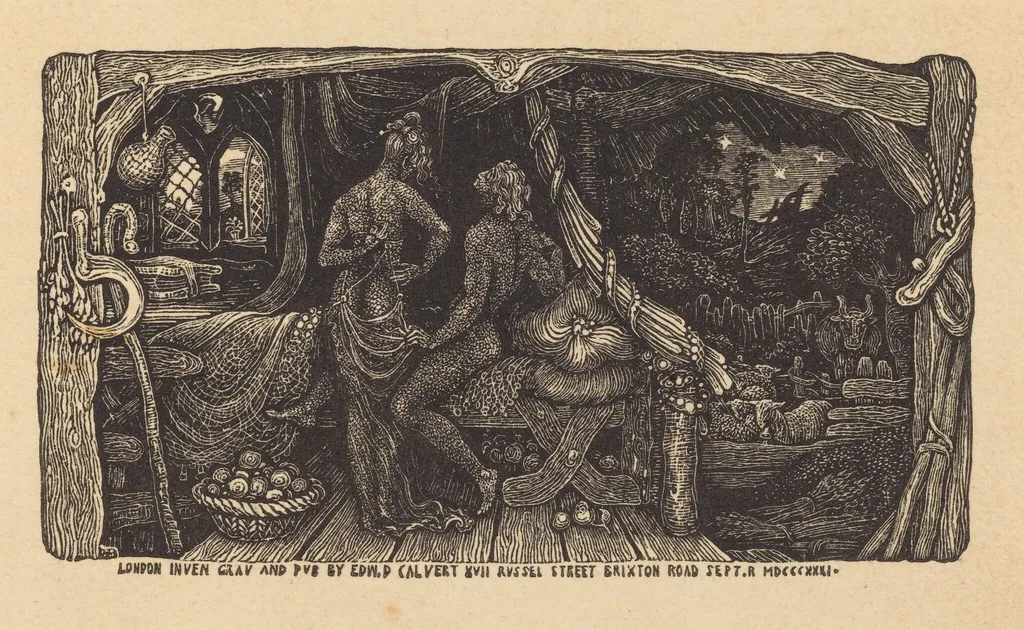
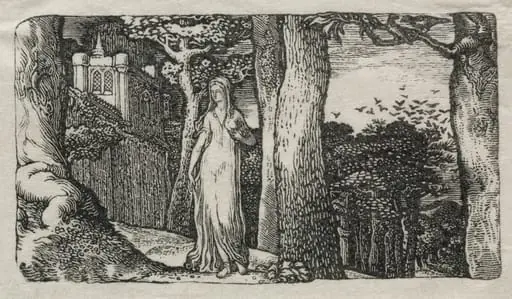
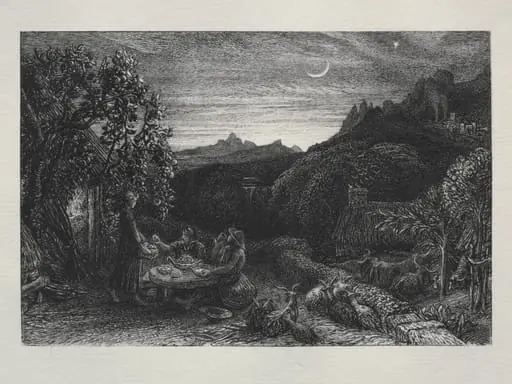
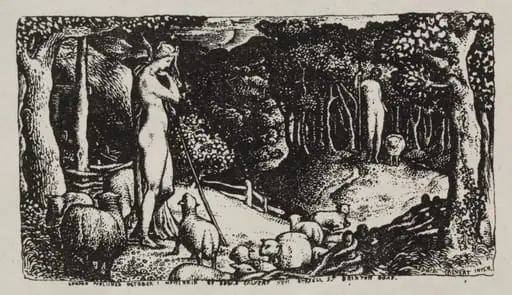
The Chamber Idyll is an ink print by the Romanticist artist Edward Calvert. It dates from 1831 and is held in the collection of the National Gallery of Art.
About this work
Overview
The work is a small-scale print distinguished by its intricate line work and meticulous texture, capturing a quiet interior scene with a contemplative mood.
Created in 1831, The Chamber Idyll is a wood engraving by Edward Calvert, a British artist associated with the Shoreham Ancients. The work is a small-scale print distinguished by its intricate line work and meticulous texture, capturing a quiet interior scene with a contemplative mood. Unlike mass-produced illustrations of the period, it reflects Calvert’s personal vision and handcrafted approach to printmaking.
Subject & Meaning
Two figures inhabit a modest interior: one stands near a window, the other sits in stillness. A table holds a basket of fruit, while a curtain drapes beside the window. The scene lacks narrative action, suggesting introspection or a suspended moment. The arrangement evokes spiritual stillness, aligning with Calvert’s interest in symbolic, almost mystical domesticity rather than literal storytelling.
Technique & Style
Calvert employed fine, controlled lines to model form and depth, using cross-hatching and delicate stippling to render surfaces. The wood engraving technique allowed for sharp detail, particularly in the texture of fabric, wood, and fruit. The dense patterning creates a luminous atmosphere, where light seems to emanate from within the room rather than from an external source.
History & Provenance
The print was made during Calvert’s time in Shoreham, Kent, where he lived in relative isolation and developed a distinctive symbolic style. It was not widely distributed in his lifetime, and only a small number of impressions were likely produced. Surviving examples are held in institutional collections, including the British Museum, reflecting its rarity and niche appeal among 19th-century print collectors.
Context
Calvert worked outside mainstream artistic trends, rejecting industrialization’s influence in favor of romanticized, nature-infused spirituality. The Chamber Idyll reflects his alignment with the Shoreham Ancients, a group that looked to William Blake for inspiration. Their work emphasized inner vision over realism, drawing from biblical, mythological, and pastoral themes to express transcendental ideals.
Legacy
Though little known during his lifetime, Calvert’s prints gained retrospective attention in the 20th century for their poetic precision and quiet intensity. The Chamber Idyll is now recognized as a key example of British visionary printmaking, admired for its restraint and emotional resonance. It continues to influence artists interested in the intersection of craft, symbolism, and intimate subject matter.
Artist & collection