Artwork
S. Giustina in pra della Vale
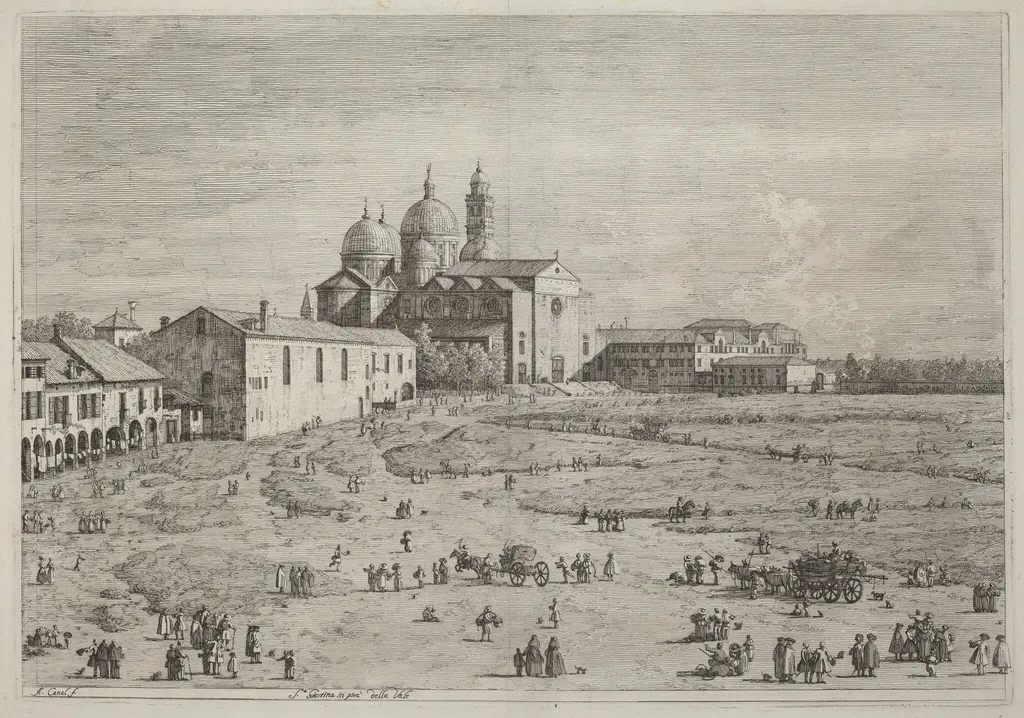
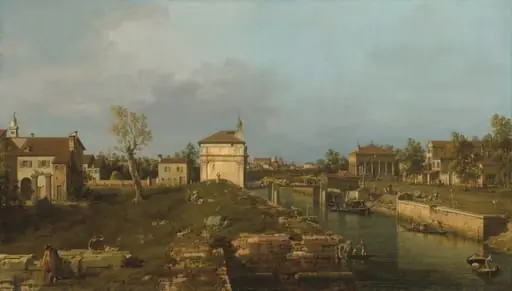
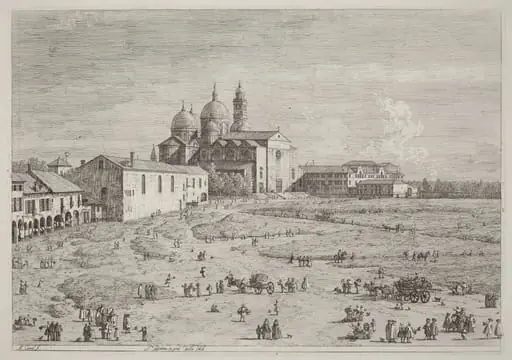
S. Giustina in pra della Vale is an ink print by the Baroque artist Canaletto. It dates from 1740 and is held in the collection of the National Gallery of Art.
About this work
Overview
Unlike his more famous Venetian views, this work documents a northern Italian urban setting.
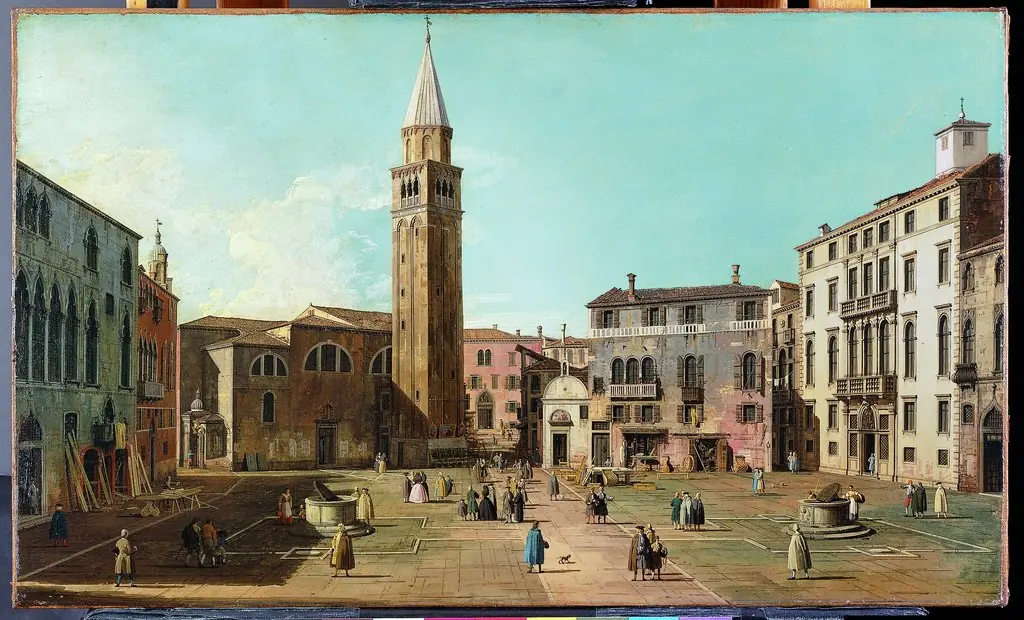
Created around 1740, this etching by Giovanni Antonio Canal, known as Canaletto, captures a view of the Piazza della Giustizia in Padua, centered on the church of S. Giustina. Unlike his more famous Venetian views, this work documents a northern Italian urban setting. Executed in black ink on paper, it exemplifies Canaletto’s precision in rendering architecture and spatial depth through fine linear technique, characteristic of his printmaking practice.
Subject & Meaning
The scene portrays a bustling public square with pedestrians, horse-drawn carts, and figures gathered near the church’s entrance. The architecture dominates the composition, suggesting civic and religious centrality. While the activity is visible, the tone remains restrained, avoiding theatricality. The image functions as a topographical record, emphasizing the relationship between urban life and monumental structures rather than narrative or emotional content.
Technique & Style
Canaletto employed etching to achieve fine, controlled lines that define building facades, pavement, and figures. Perspective is constructed through diminishing scale and receding lines, guiding the eye toward the church’s twin domes and bell tower. The absence of tone or wash creates a crisp, linear clarity, typical of his printed works. Crowd details are rendered with minimal strokes, suggesting movement without individualization.
History & Provenance
This print belongs to a series of architectural views Canaletto produced during his travels outside Venice, likely commissioned or circulated among collectors interested in Italian urban landscapes. Though less documented than his Venetian prints, it reflects his broader engagement with regional architecture. Its survival in museum and private collections attests to its appeal among 18th-century connoisseurs of topographical art.
Context
In the mid-18th century, etched vedute were valued for their accuracy and portability, serving as both artistic records and souvenirs. Canaletto’s reputation as a topographical draftsman extended beyond Venice, making his depictions of Padua and other cities desirable to northern European travelers. This work aligns with a growing interest in documenting civic spaces as expressions of cultural identity.
Legacy
The etching contributes to Canaletto’s broader legacy as a chronicler of urban environments through precise draftsmanship. While overshadowed by his oil paintings, his prints influenced later topographical artists and helped standardize the visual language of architectural documentation. This work remains a reference for scholars studying the representation of public space in early modern Italy.
Artist & collection
Artist
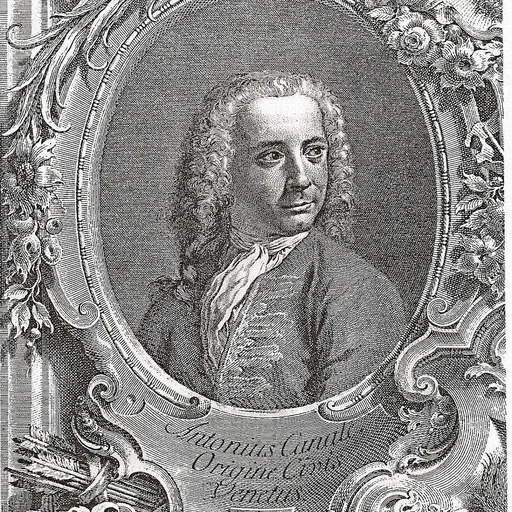
Giovanni Antonio Canal (18 October 1697 – 19 April 1768), commonly known as Canaletto (Italian: ), was an Italian painter from the Republic of Venice, considered an important member of the 18th-century Venetian school.