Artwork
The House with the Inscription [left]
![The House with the Inscription [left], by Canaletto, ink, 1741](https://artifactworldgallery.com/img/canaletto--the-house-with-the-inscription-left--004a53931bcd41d0-w1024.webp)
The House with the Inscription [left] is an ink print by the Baroque artist Canaletto. It dates from 1741 and is held in the collection of the National Gallery of Art.
About this work
Overview
It belongs to a series of prints documenting Venetian urban life, made alongside his more widely known paintings.
Created in 1741, *The House with the Inscription* is an etching by Giovanni Antonio Canal, known as Canaletto. It belongs to a series of prints documenting Venetian urban life, made alongside his more widely known paintings. Unlike his finished canvases, this work captures a spontaneous, observational quality, emphasizing architectural detail and atmospheric texture through precise line work. The print reflects Canaletto’s dual role as both painter and printmaker in 18th-century Venice.
Subject & Meaning
The scene depicts a crowded waterfront in Venice, with tightly packed buildings lining the canal and a single vessel moored near the shore. One structure bears a partially legible inscription, 'MCCYLL...', suggesting a commercial or civic function. The distant dome likely represents a recognizable landmark, anchoring the view in a real location. The composition conveys the daily rhythm of the city’s port, without overt narrative or symbolism—offering a quiet record of urban activity.
Technique & Style
Canaletto employed etching to render fine, controlled lines that define each architectural element and ripple in the water. The technique allowed him to achieve remarkable clarity in textures—from weathered stonework to the subtle undulations of the lagoon. His approach prioritizes accuracy over dramatic effect, using delicate hatching and cross-contouring to model form and depth. The result is a meticulous, almost topographical rendering that values observation over embellishment.
History & Provenance
This etching was produced during Canaletto’s peak years as a printmaker, when he was actively supplying collectors with views of Venice. It was likely made for private patrons or as part of a portfolio, circulating among European connoisseurs. While its early ownership is undocumented, it survives as part of a broader corpus of his printed works, many of which were later reissued or copied by other artists and publishers.
Context
In the 1740s, Venice was a center of artistic production, and Canaletto’s views catered to the Grand Tour market. His etchings served as both souvenirs and records of the city’s architecture. Unlike theatrical vedute, this work avoids idealization, presenting a modest, unadorned corner of the city. It reflects a growing interest in documentary precision among artists and travelers seeking authentic glimpses of Venetian life.
Legacy
Canaletto’s etchings, including this one, influenced later topographical printmakers and contributed to the standardization of urban representation in print. Though less celebrated than his paintings, these works demonstrate his commitment to observational fidelity. They remain valuable for historians studying 18th-century Venetian urban fabric, offering a detailed, unembellished record of the city’s architecture and waterways.
Artist & collection
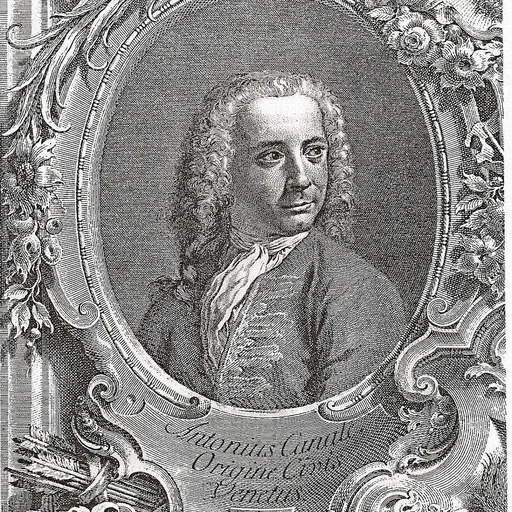
Artist
Giovanni Antonio Canal (18 October 1697 – 19 April 1768), commonly known as Canaletto (Italian: ), was an Italian painter from the Republic of Venice, considered an important member of the 18th-century Venetian school.

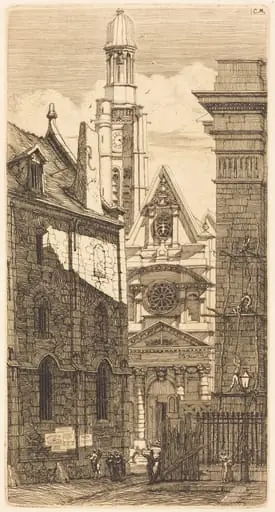 Saint-Etienne-du-Mont, Paris (Church of St. Stephen of the Mount, Paris)
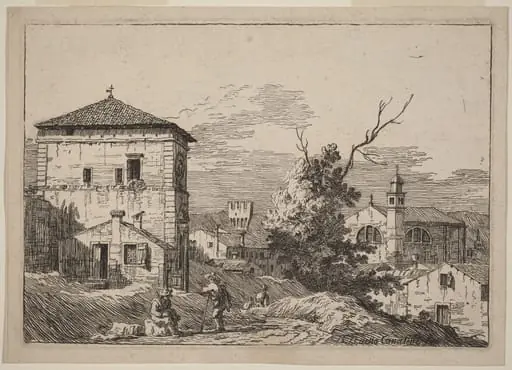 Landscape with a Dead Tree
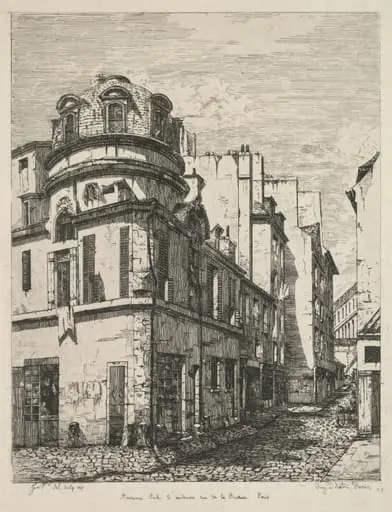 Eaux-Fortes sur le Vieux Paris: Ancienne école de médecine rue de la Bûcherie (Etchings of Old Paris: Former Medical School, rue de la Bucherie)
 Saint-Etienne-du-Mont
 Etchings of Paris: Church of St. Stephen of the Mount
 A Priest Processing through a Medieval Street in Viterbo
 The Oriental Merchant