Artwork
Corail
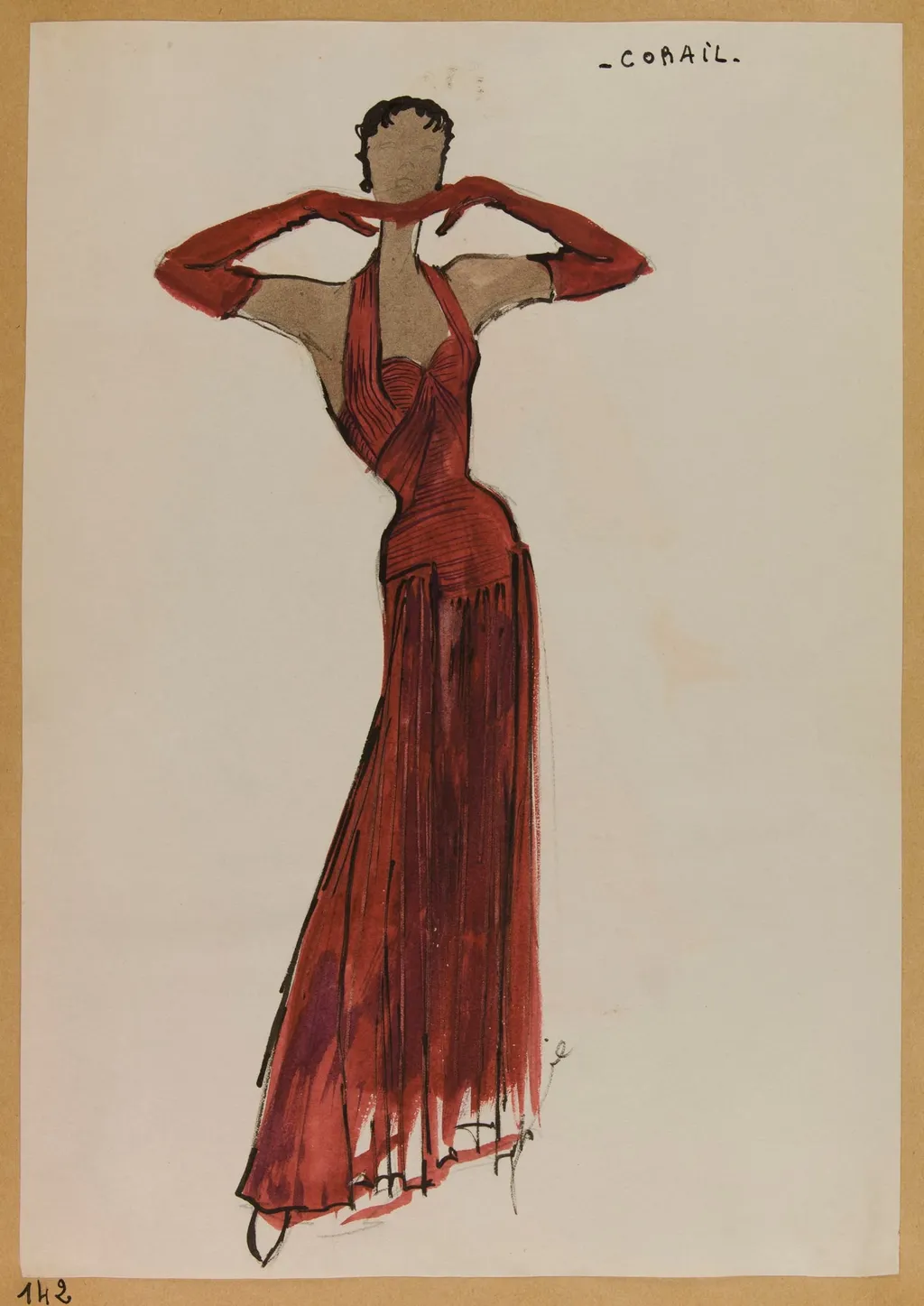
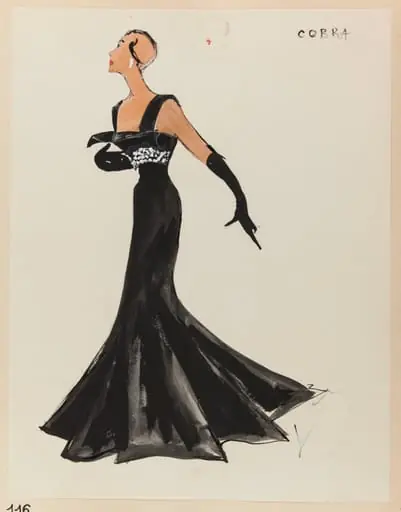
Corail is a drawing by Carven. It dates from 1952 and is held in the collection of the Palais Galliera - Musée de la Mode de la Ville de Paris.
About this work
Overview
Its title, meaning 'coral' in French, alludes to the garment’s hue and organic form, linking the visual to natural inspiration.
Corail is a 1952 ink sketch by French designer Carven, currently held in the Museum of Ethnography’s collection. Executed with swift, expressive lines, it captures a female figure in motion, dressed in a red gown. The work lacks finish, suggesting it was a preliminary study rather than a polished illustration. Its title, meaning 'coral' in French, alludes to the garment’s hue and organic form, linking the visual to natural inspiration.
Subject & Meaning
The figure, depicted with arms raised behind her head, pulls the fabric of a long, flowing gown upward, emphasizing movement and volume. The pose suggests a moment of transition—perhaps adjusting the dress or dancing. The coral reference in the title may evoke the color’s warmth and texture, implying a connection between the garment and marine life. The focus is on silhouette and gesture, not identity, making the dress itself the central subject.
Technique & Style
Carven rendered Corail with loose, confident strokes and minimal shading, using ink that bleeds and smudges in places. The lines are economical, prioritizing rhythm over precision. Vertical folds in the skirt are suggested with parallel marks, while the bodice is defined by tighter contours. The absence of facial features and fine details reinforces the sketch’s function as a study of form and flow, typical of fashion designers’ working methods.
History & Provenance
Created in 1952, Corail entered the Museum of Ethnography’s holdings as part of a broader collection documenting 20th-century fashion design. Its preservation suggests recognition of its value as a document of creative process rather than a finished product. No record of prior ownership or exhibition exists beyond its current institutional context, indicating it remained within Carven’s personal or professional archive until acquisition.
Context
In the early 1950s, Parisian fashion houses emphasized fluid silhouettes and hand-drawn sketches as essential tools in design development. Carven, known for elegant, wearable garments, used such studies to explore volume and movement before fabric selection. Corail reflects this era’s emphasis on the body in motion, aligning with postwar trends that favored naturalism and ease over rigid structure in women’s wear.
Legacy
Corail survives as a quiet testament to the iterative nature of fashion design. It offers insight into how ideas were translated from paper to garment without the polish of commercial illustration. While not widely published, its presence in a museum of ethnography underscores its role as a cultural artifact—evidence of craftsmanship, intuition, and the transient moments that precede creation.
Artist & collection
Artist
These delicate ink-on-paper drawings capture the quiet poetry of everyday things: pinecones, reeds, apples.
Museum
Palais Galliera - Musée de la Mode de la Ville de Paris
Continue through works from the same source collection.