Artwork
Kon Tiki
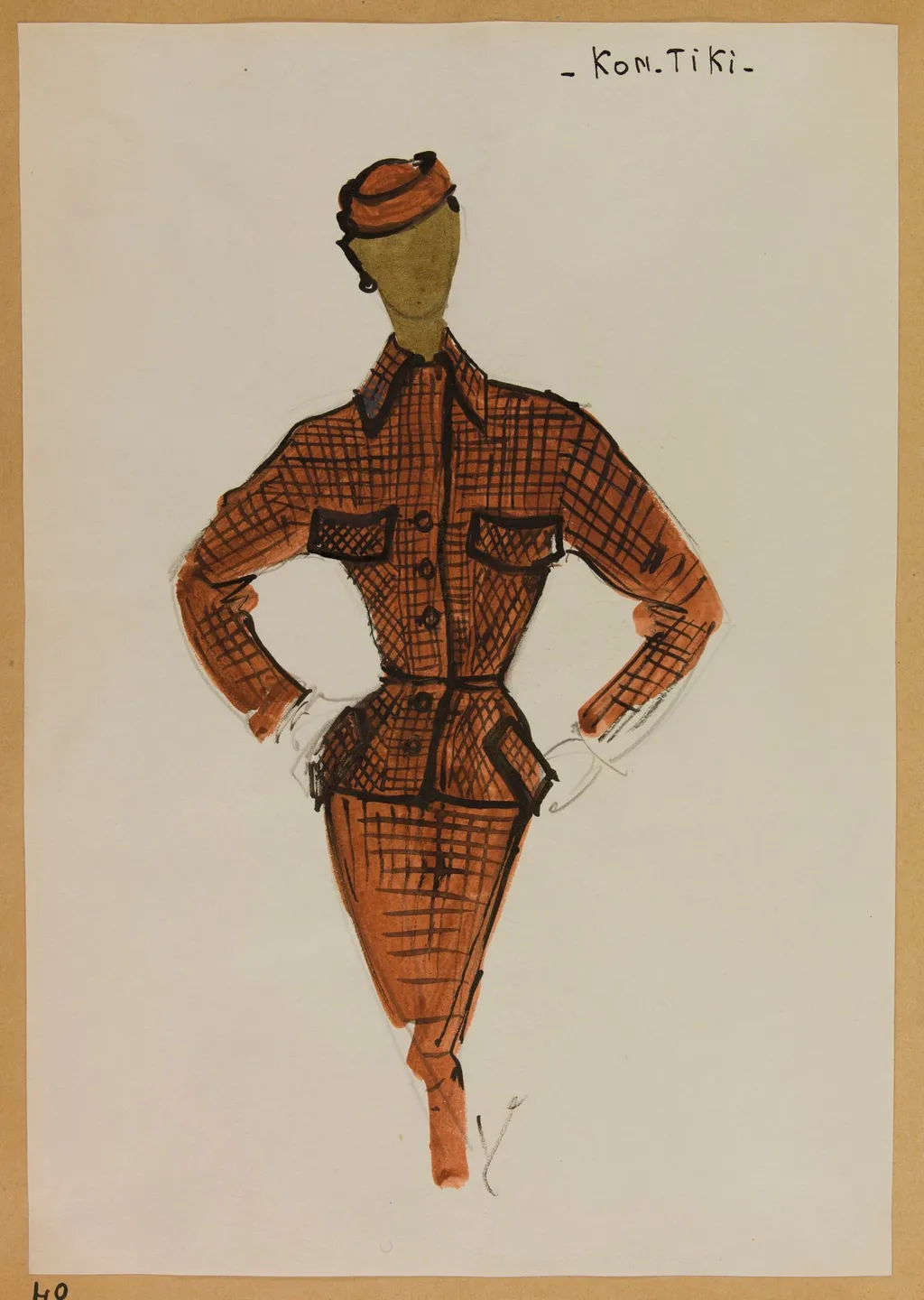
Kon Tiki is a drawing by Carven. It dates from 1952 and is held in the collection of the Palais Galliera - Musée de la Mode de la Ville de Paris.
About this work
Overview
Unlike finished illustrations, it functions as a working study—rapidly executed, unpolished, and focused on form rather than finish.
Created in 1952 by the fashion designer Carven, this ink sketch is part of the Museum of Ethnography’s collection. Unlike finished illustrations, it functions as a working study—rapidly executed, unpolished, and focused on form rather than finish. The label 'Kon Tiki' appears in the corner, possibly a personal reference or internal designation for the design. Its purpose was likely practical: to capture a silhouette for garment development.
Subject & Meaning
The figure depicts a woman dressed in a loose, brown plaid ensemble with oversized pockets and a matching hat. The attire suggests practical, utilitarian styling, possibly inspired by travel or outdoor wear. The absence of facial features or environmental context shifts focus entirely to the clothing’s structure. 'Kon Tiki' may reference a nickname, a cultural allusion, or a code used within Carven’s studio to identify this particular design concept.
Technique & Style
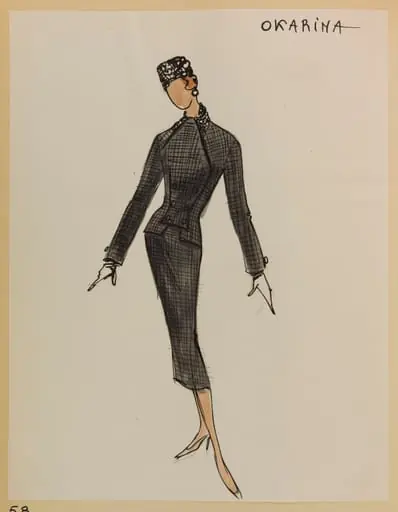
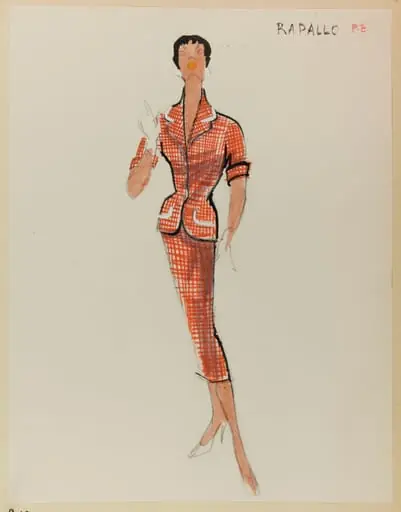
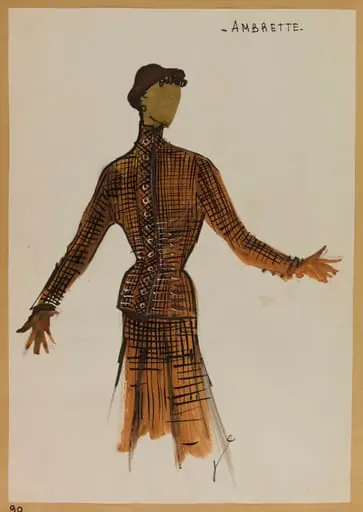
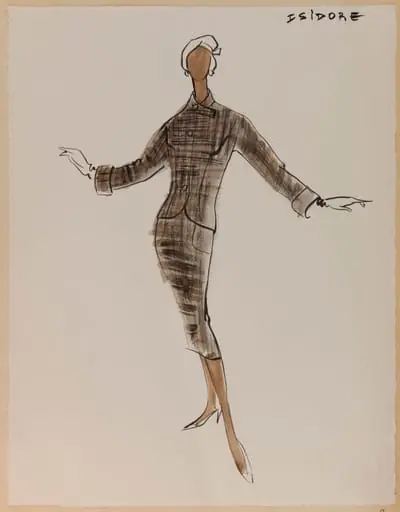
Rendered with swift, confident lines, the drawing emphasizes silhouette and volume over fine detail. The fabric is suggested through bold strokes that imply folds and texture, with minimal shading. Stitching and seams are hinted at with short, angular marks, conveying materiality without realism. The sketch’s immediacy reflects its role as a design tool—intended for quick iteration rather than display.
History & Provenance
The sketch entered the Museum of Ethnography’s holdings as part of a broader collection of fashion documentation. Its origin lies within Carven’s atelier, where such drawings served as preliminary records for garment production. Though unsigned and undated beyond 1952, its style aligns with the designer’s mid-century working methods. It was preserved not as art, but as evidence of design practice.
Context
In the early 1950s, fashion houses relied on hand-drawn sketches to communicate ideas to tailors and patternmakers. Carven, known for her understated elegance, often prioritized comfort and movement in her designs. This sketch reflects that ethos—its loose fit and functional pockets suggest a modern, active woman. The use of a coded title like 'Kon Tiki' hints at the informal, personal language used within design studios of the era.
Legacy
The sketch endures as a quiet testament to the behind-the-scenes labor of fashion design. It reveals how ideas took shape before mass production, emphasizing process over presentation. While Carven’s finished garments are more widely recognized, this drawing offers insight into the raw, intuitive phase of creation. It remains a valuable artifact for understanding mid-century design methodology.
Artist & collection
Artist
These delicate ink-on-paper drawings capture the quiet poetry of everyday things: pinecones, reeds, apples.
Museum
Palais Galliera - Musée de la Mode de la Ville de Paris
Continue through works from the same source collection.