Artwork
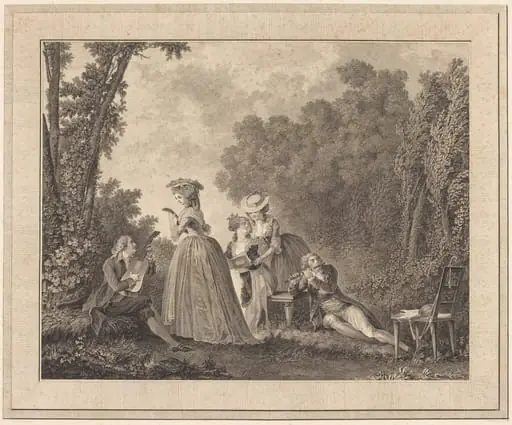
Trissotin Reading to Philaminte, Bélise, and Armande (from act 3, scene 2 of Molière's "Les Femmes Savantes"
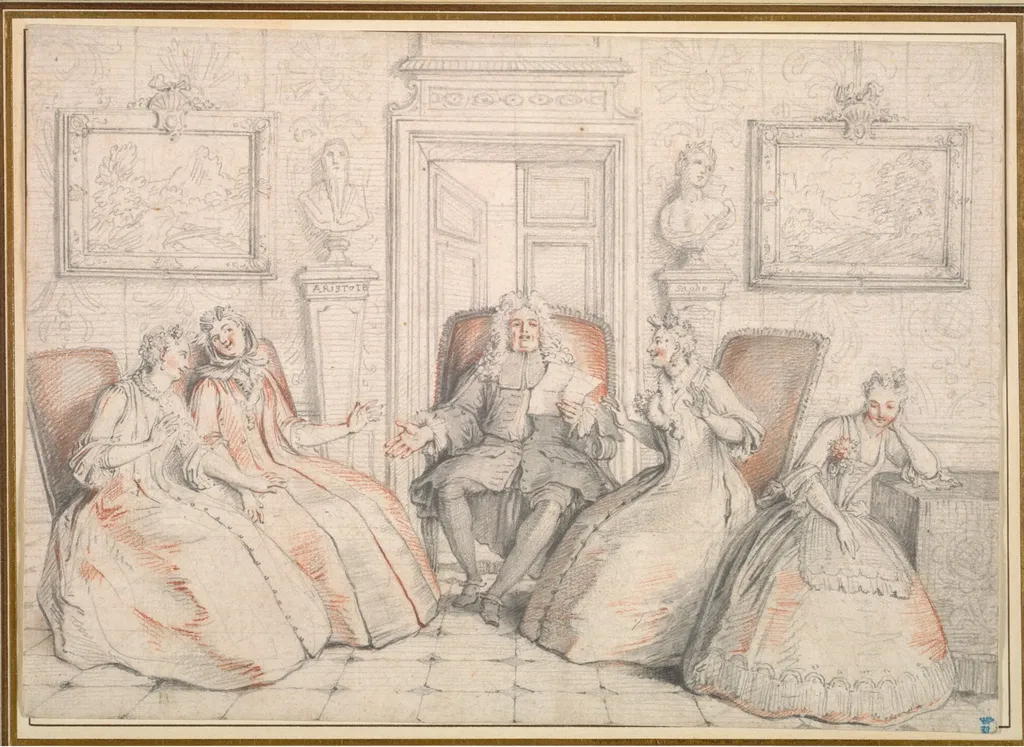
Trissotin Reading to Philaminte, Bélise, and Armande (from act 3, scene 2 of Molière's "Les Femmes Savantes" is a drawing by the Baroque artist Charles-Antoine Coypel. It dates from 1726 and is held in the collection of the Cleveland Museum of Art.
About this work
Overview
Created as a preparatory study for a series of printed scenes, it is the sole surviving sketch from Coypel’s project to visualize Molière’s plays.
This drawing by Charles Coypel illustrates a moment from Molière’s comedy 'Les Femmes Savantes,' depicting the self-important tutor Trissotin reading his verse to three female admirers. Created as a preparatory study for a series of printed scenes, it is the sole surviving sketch from Coypel’s project to visualize Molière’s plays. The composition captures a theatrical exchange with precise attention to gesture and expression, reflecting the artist’s dual role as both dramatist and draftsman.
Subject & Meaning
The scene portrays Trissotin, a pretentious scholar, delivering his dull poetry to Philaminte, Bélise, and Armande—women who mistake his empty rhetoric for brilliance. Their exaggerated nods and rapt attention contrast with Henrietta, seated apart, whose quiet demeanor signals her skepticism. Coypel highlights the satire of intellectual vanity, using body language to distinguish genuine sensitivity from performative admiration, a core theme in Molière’s critique of false learning.
Technique & Style
Executed in pen and ink with subtle wash, the drawing emphasizes expressive line and tonal contrast to convey emotional nuance. Coypel’s brushwork is economical yet precise, capturing the curl of a hand, the tilt of a head, and the fold of fabric with minimal strokes. The figures are arranged in a shallow stage-like space, directing focus to their interactions. His theatrical training informs the clarity of gesture, turning each posture into a narrative cue.
History & Provenance
This drawing is the only known preparatory study for Coypel’s planned series of prints based on Molière’s plays, commissioned around the early 18th century. Though the full set was never published, this sheet survived as a standalone work. It passed through private collections before entering a public collection, where it remains as a rare testament to Coypel’s ambition to translate theatrical satire into visual form.
Context
Coypel worked in a cultural climate where Molière’s comedies remained widely performed and studied. As the son of painter Antoine Coypel and a member of the Académie Royale, he moved in circles that valued literary and visual arts in tandem. His decision to illustrate Molière reflects a broader trend among artists to engage with contemporary theater, not merely as illustration but as a means of interpreting social behavior through visual narrative.
Legacy
Though the print series was abandoned, this drawing endures as a significant example of 18th-century French draftsmanship tied to literary satire. It offers insight into how artists interpreted dramatic texts visually, bridging performance and graphic art. Its survival underscores the value placed on preparatory work in an era when finished prints were often the primary goal—making this sketch a rare window into Coypel’s creative process.
Artist & collection
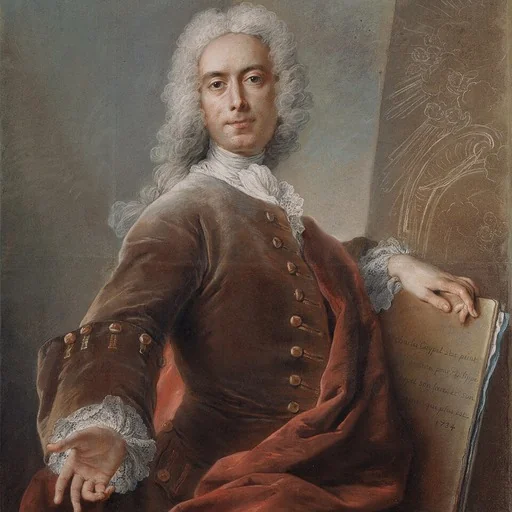
Artist
Charles-Antoine Coypel (French pronunciation: ; 11 July 1694 – 14 June 1752) was a French painter, art critic, and playwright.

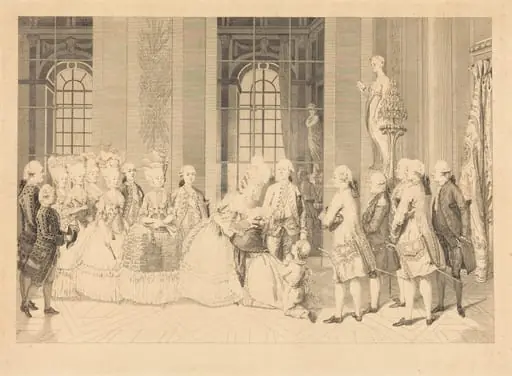 La Reine annonçant à Mme Bellegarde, des Juges, et la liberté de son mari en mai 1777
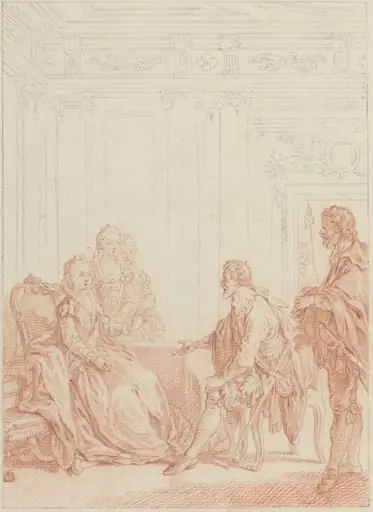 Quoi! Vous servez Valois...
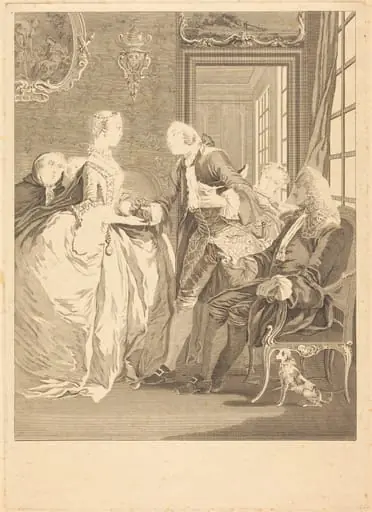 L'accord du mariage
![A Game of Cards [recto], by Anton Weiss](https://artifactworldgallery.com/img/anton-weiss--a-game-of-cards-recto--6bb6d053bcd336b7-w320.webp) A Game of Cards [recto]
A Game of Cards [recto]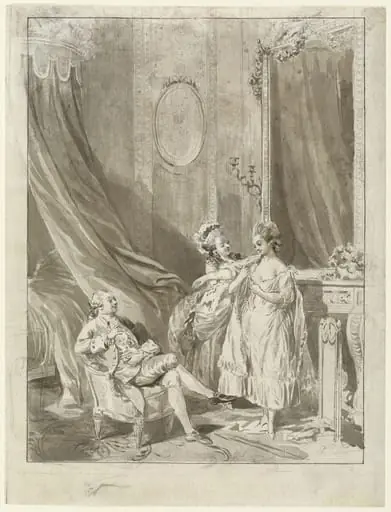 Early Morning
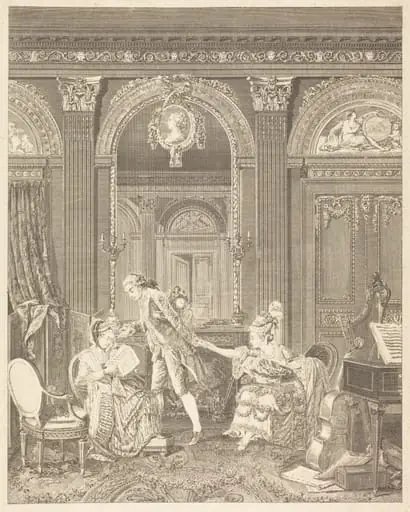 Le Billet doux
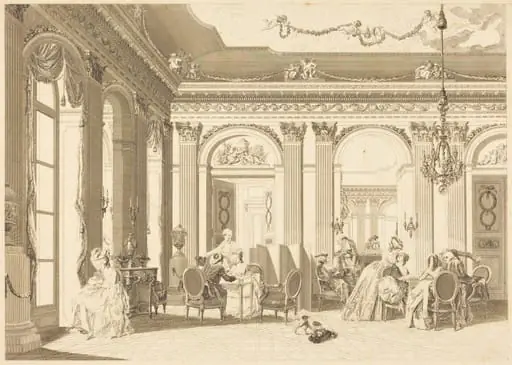 L'assemblee au salon
 Le mari confesseur
 La toilette
 Conversation Piece
 A Man and Two Women on a Rocky Shore
 Le concert agreable