Artwork
The Boat Trip: Moving into "Le Botin" (The Ship's Furnishings) or Moving to the Boat
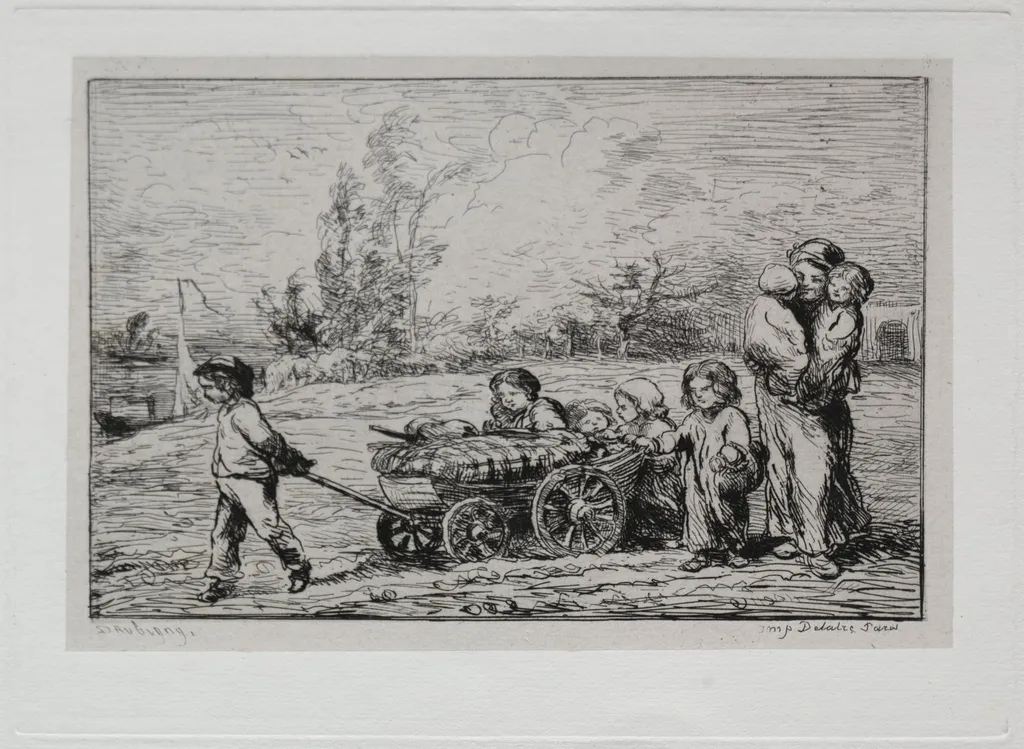
The Boat Trip: Moving into "Le Botin" (The Ship's Furnishings) or Moving to the Boat is a work on paper by the Impressionist artist Charles François Daubigny. It dates from 1861 and is held in the collection of the Cleveland Museum of Art.
About this work
Overview
The Cleveland Museum of Art holds the work, which reflects his interest in quiet, unidealized rural activity rather than grand nautical narratives.
Charles-François Daubigny produced this work in 1861 as part of a portfolio exploring maritime life, though the scene depicted is terrestrial. While he is best known for river landscapes and etchings, this piece diverges by focusing on a land-based transport moment near water. The Cleveland Museum of Art holds the work, which reflects his interest in quiet, unidealized rural activity rather than grand nautical narratives.
Subject & Meaning
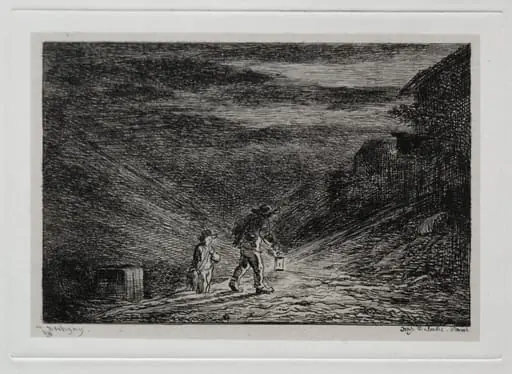
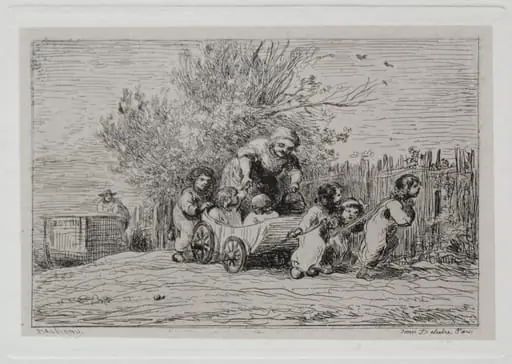
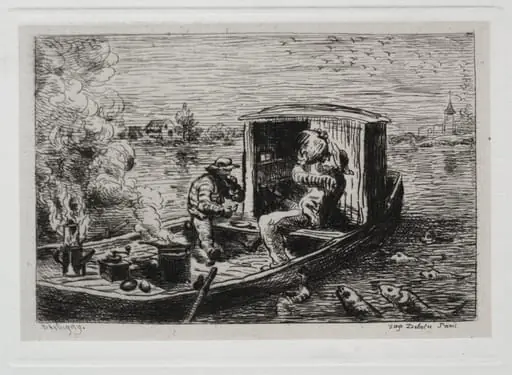
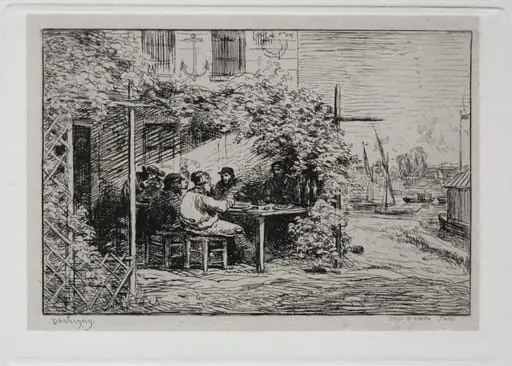
The scene shows a man hauling a large covered wagon, likely carrying household goods, while a woman holds a child nearby. Trees and water frame the background, suggesting a transition between land and riverine life. No dramatic event unfolds—instead, the image captures a routine, almost unnoticed moment of movement and domestic relocation, emphasizing continuity in everyday existence.
Technique & Style
Daubigny employed loose, fluid brushwork to convey motion and atmosphere, with earthy browns and muted greens dominating the palette. The composition avoids sharp detail, favoring suggestive forms that imply rather than define. This approach aligns with his broader practice of prioritizing light and mood over precise rendering, anticipating the observational methods of later Impressionists.
History & Provenance
Created in 1861, the work entered the Cleveland Museum of Art’s collection as part of a broader acquisition of 19th-century French drawings and prints. Though less famous than his etchings, this piece reflects Daubigny’s consistent engagement with rural mobility and the rhythms of working life. Its provenance traces back to private French collections before its institutional acquisition.
Context
In the 1860s, French artists increasingly turned to scenes of ordinary labor and landscape, moving away from historical or mythological subjects. Daubigny, though associated with Barbizon, often worked near waterways, documenting the interplay between human activity and nature. This image fits within that trend, presenting labor not as spectacle but as embedded in the land and its rhythms.
Legacy
While not among Daubigny’s most widely reproduced works, this piece contributes to understanding his shift toward intimate, transient moments. Its emphasis on unembellished daily life and atmospheric handling influenced emerging Impressionist concerns with light, movement, and the dignity of the commonplace, even if the subject is not aquatic.
Artist & collection
Artist
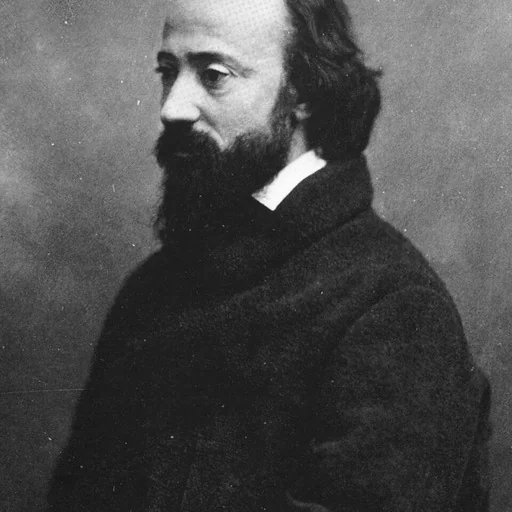
Charles-François Daubigny ( DOH-bin-yee, US: DOH-been-YEE, doh-BEEN-yee, French: ; 15 February 1817 – 19 February 1878) was a French painter, one of the members of the Barbizon school, and is considered an important precursor of…