Artwork
Torre dei Schiavi, Roman Campagna
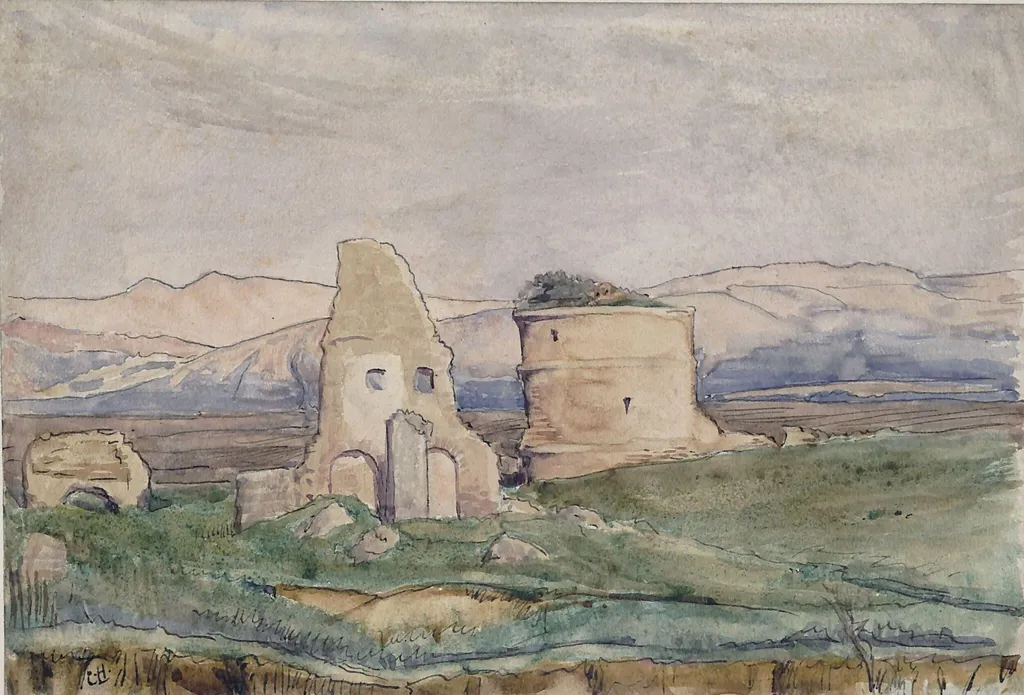
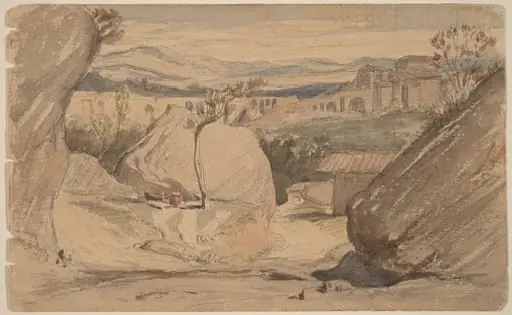
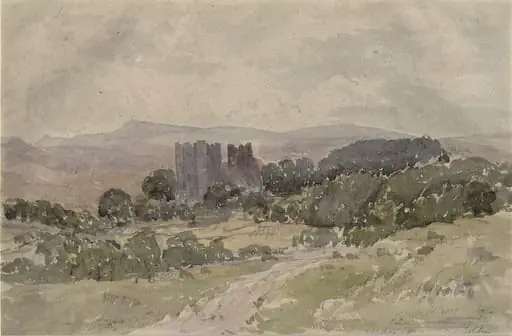
Torre dei Schiavi, Roman Campagna is a watercolor work on paper by the Impressionist artist Charles Holroyd. It dates from 1891 and is held in the collection of the Victoria and Albert Museum.
About this work
Overview
The composition centers on the tower, framed by distant hills and a soft sky, suggesting a meditative observation of the landscape.
Charles Holroyd created this watercolour in 1891, capturing the Torre dei Schiavi, a solitary ruin in the Roman countryside. The work is signed and dated by the artist, affirming its origin. Executed in transparent washes, it conveys a quiet sense of place through subtle tonal shifts rather than detailed rendering. The composition centers on the tower, framed by distant hills and a soft sky, suggesting a meditative observation of the landscape.
Subject & Meaning
The Torre dei Schiavi, an ancient watchtower in the Campagna, stands as a silent witness to time’s erosion. Holroyd presents it not as a monument but as a quiet element within a broader, weathered terrain. The presence of vegetation on its summit hints at nature’s reclamation of human structures. The scene evokes solitude and decay, reflecting a 19th-century fascination with ruins as symbols of transience rather than grandeur.
Technique & Style
Holroyd employed loose, fluid brushwork and layered watercolour washes to suggest texture and depth. Warm beiges and muted greens dominate the palette, with faint blues in the sky adding atmospheric perspective. The brushstrokes are deliberate yet unpolished, allowing the paper’s white to suggest light and air. This approach aligns with Impressionist sensibilities, prioritizing mood and light over precise detail.
History & Provenance
The watercolour was completed during Holroyd’s travels in Italy, a period when British artists frequently visited the Roman Campagna to study classical ruins. It remained in the artist’s possession until his death, later entering a private collection. Its survival in good condition reflects careful handling, though its exhibition history remains limited to regional British shows in the early 20th century.
Context
In the late 19th century, the Roman Campagna attracted artists drawn to its pastoral decay and classical remnants. Holroyd’s work aligns with a broader trend among British watercolourists who sought to capture the emotional resonance of ancient landscapes, distinct from academic history painting. His approach reflects a shift toward personal, observational art, influenced by both Romanticism and emerging Impressionist techniques.
Legacy
Though not widely reproduced, Holroyd’s watercolour contributes to a quiet tradition of British landscape watercolours that valued atmosphere over spectacle. It stands as a modest but thoughtful record of a specific ruin at a specific moment, offering insight into how artists of the time engaged with Italy’s layered past. The piece remains a quiet example of late-Victorian topographical sensitivity.
Artist & collection

Artist
Sir Charles Holroyd RE was an English painter, original printmaker and curator during the late Victorian and Edwardian eras up to and including the First World War.