Artwork
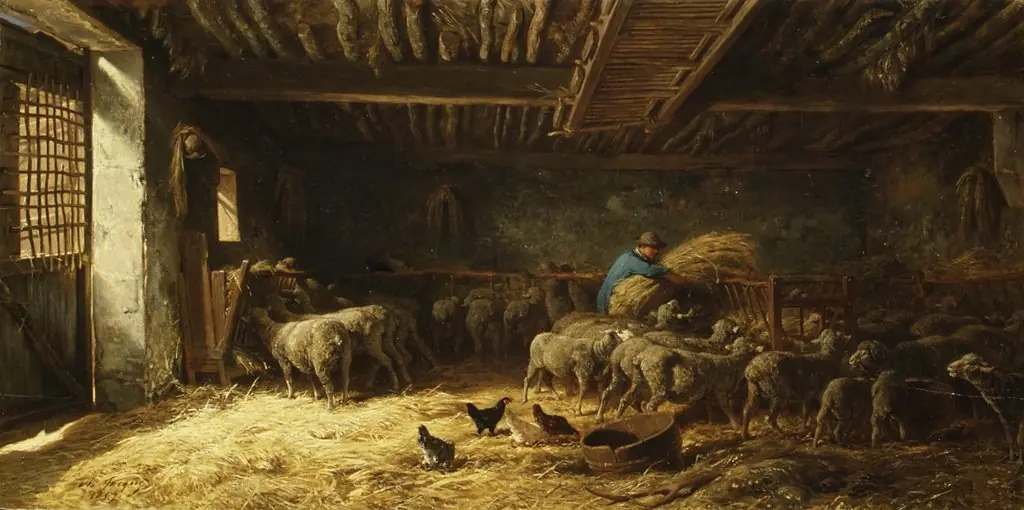
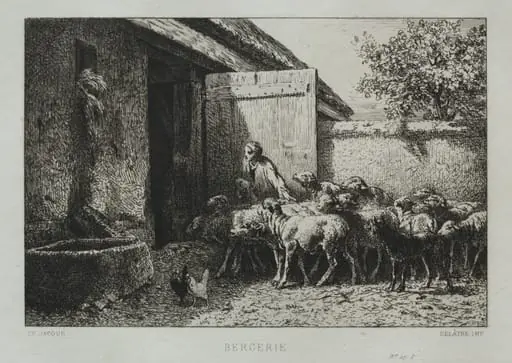
Interior of a Sheep Pen
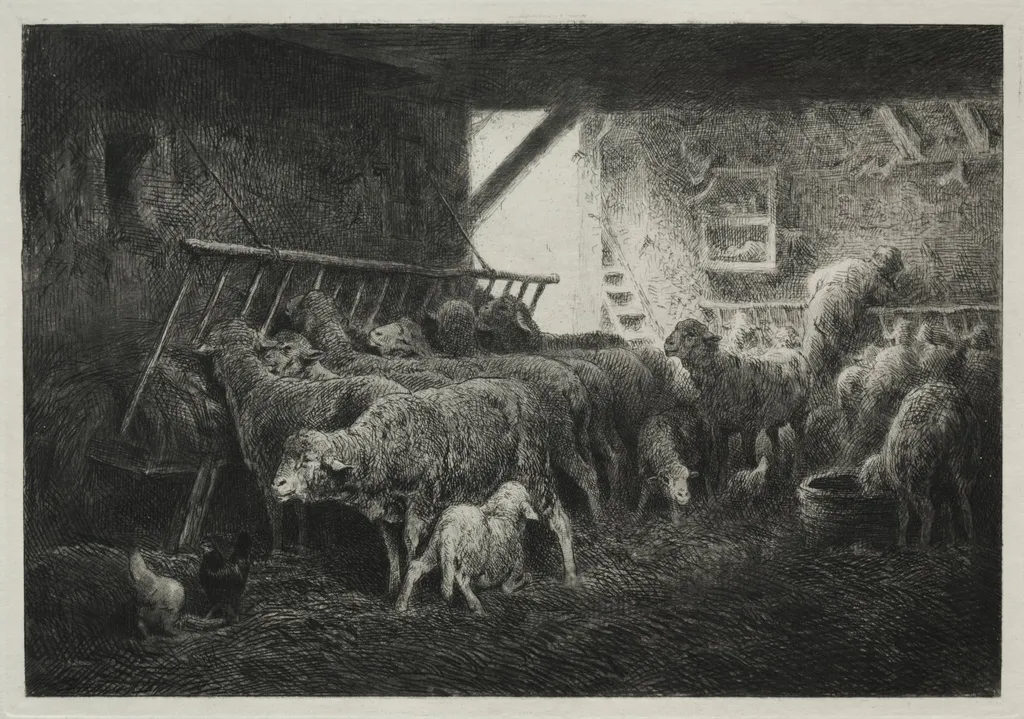
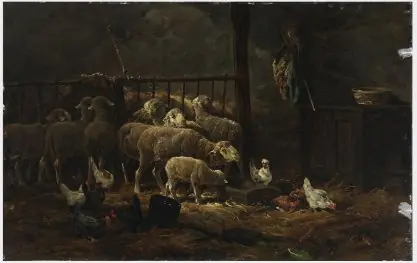
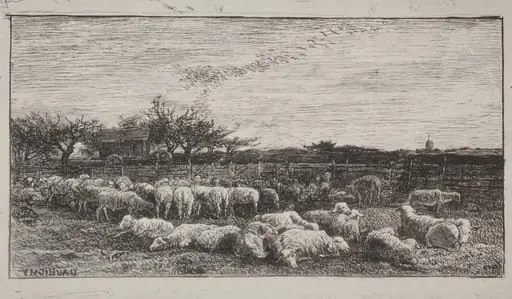
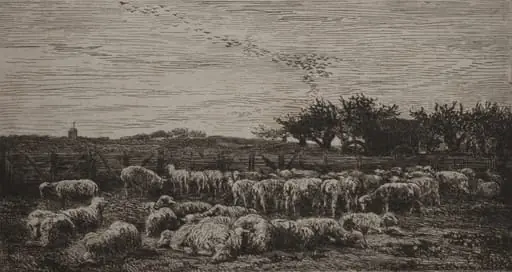
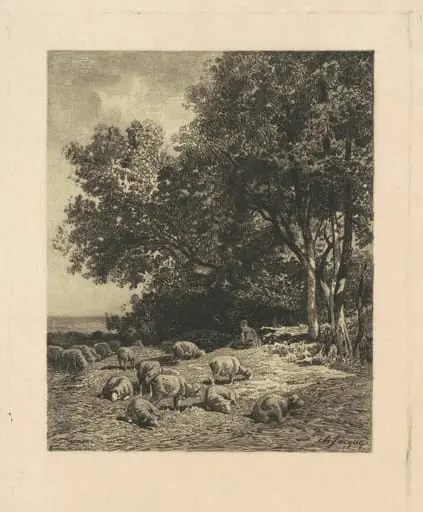
Interior of a Sheep Pen is a print by the Impressionist artist Charles Jacque. It dates from 1878 and is held in the collection of the Cleveland Museum of Art.
About this work
Overview
This work exemplifies his shift from military service to quiet, observational depictions of agricultural life, rendered with the precision of an engraver.
Created around 1878, *Interior of a Sheep Pen* is a print by Charles-Émile Jacque, a French artist linked to the Barbizon School. Known for his focus on rural subjects, Jacque honed his draftsmanship during seven years in the French military before dedicating himself to art. This work exemplifies his shift from military service to quiet, observational depictions of agricultural life, rendered with the precision of an engraver.
Subject & Meaning
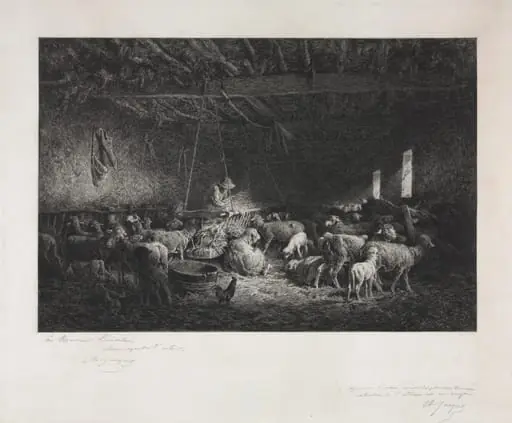
The scene captures a modest sheep pen at a quiet moment, with adult sheep and lambs clustered in close proximity. A figure stands near the entrance, leaning on a staff, observing without intervention. The composition avoids drama or idealization, instead emphasizing the unremarkable rhythms of animal husbandry. The stillness and confinement suggest a contemplative relationship between human and livestock, grounded in daily necessity.
Technique & Style
Jacque employed drypoint and etching techniques to create a textured, almost sketch-like surface. Fine, irregular lines define the wool of the sheep, the weathered wood of the walls, and the uneven floor, conveying tactile immediacy. The dim lighting, suggested by sparse ink washes and stark contrasts, enhances the sense of enclosure. The style is deliberate yet unpolished, prioritizing authenticity over refinement.
History & Provenance
The print emerged during Jacque’s mature period, after years of engagement with rural themes and printmaking. While specific early ownership records are sparse, it aligns with his broader output in the 1870s, when he increasingly focused on livestock and farmsteads. The work was likely circulated among collectors interested in French Realism and the Barbizon tradition, though it never achieved widespread public prominence.
Context
Jacque worked alongside figures like Jean-François Millet, sharing the Barbizon School’s commitment to depicting rural labor and nature without romanticism. In an era of rapid industrialization, such images offered a quiet counterpoint, valuing the dignity of ordinary agricultural life. This print reflects a broader 19th-century interest in documenting the vanishing rhythms of pre-modern farming communities.
Legacy
Though less known than his contemporaries, Jacque’s prints contributed to the legitimacy of rural subjects in fine art. His technical mastery in etching influenced later generations of printmakers interested in naturalism. *Interior of a Sheep Pen* remains a quiet testament to the value of unadorned observation, preserving the texture of rural existence through disciplined, unembellished mark-making.
Artist & collection
Artist
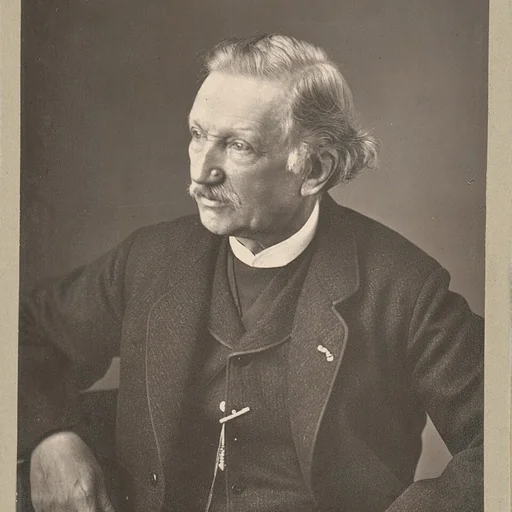
Charles-Émile Jacque (23 May 1813 – 7 May 1894) was a French painter of Pastoralism and engraver who was, with Jean-François Millet, part of the Barbizon School. He first learned to engrave maps when he spent seven years in the French Army.