Artwork
Greenwich Hospital from the Observatory
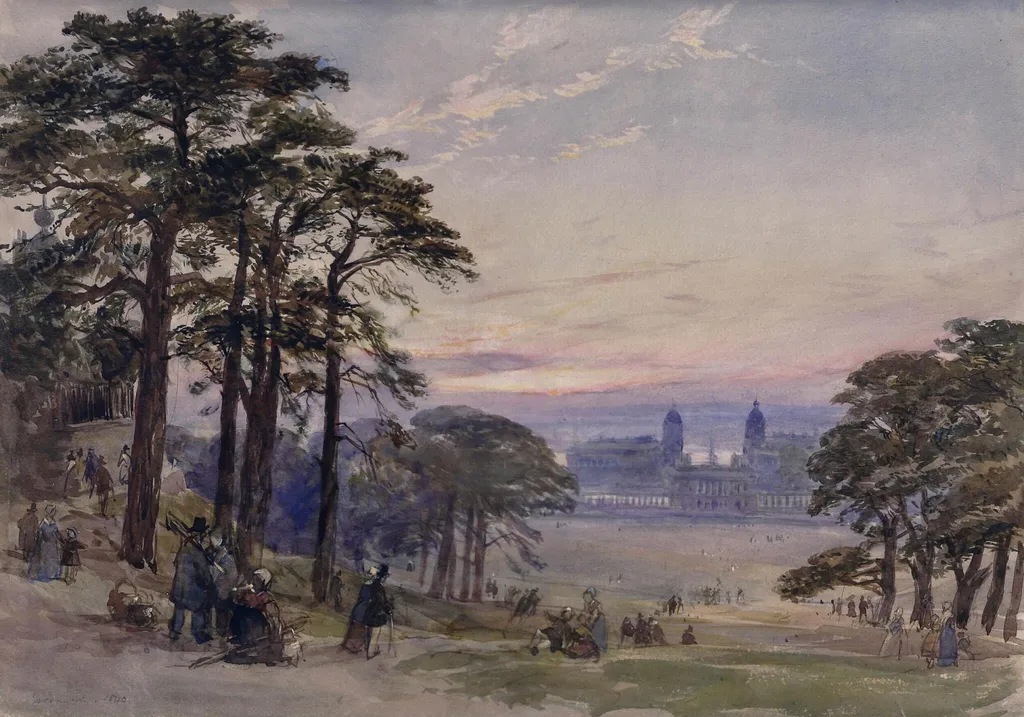
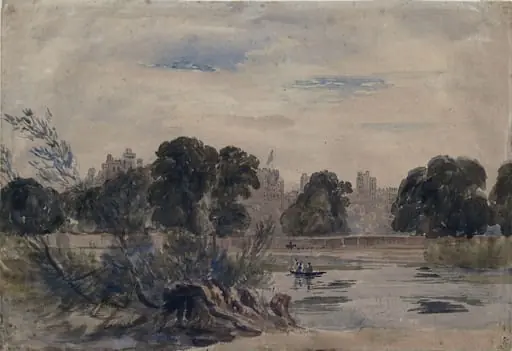
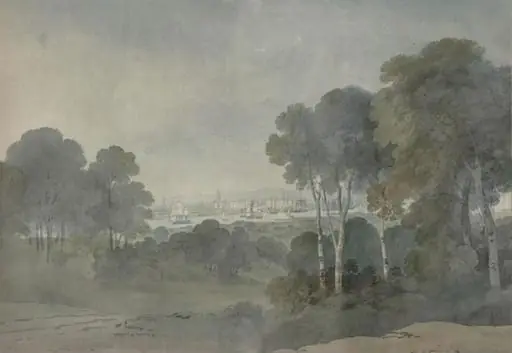
Greenwich Hospital from the Observatory is a watercolor work on paper by the British Romanticist artist William Collingwood. It dates from 1840 and is held in the collection of the Victoria and Albert Museum.
About this work
Overview
The artist’s name and the title are inscribed directly on the surface, affirming its personal and observational character.
Created in 1840 by William Collingwood, this watercolour depicts Greenwich Hospital as seen from the Royal Observatory. The work captures a quiet, everyday scene with careful attention to atmospheric perspective and natural light. The artist’s name and the title are inscribed directly on the surface, affirming its personal and observational character. The composition balances detailed foreground elements with a softly rendered distant structure.
Subject & Meaning
The painting presents Greenwich Hospital as a quiet landmark amid a cultivated landscape. Figures are scattered across the foreground—walking, resting, or standing—suggesting public use of the grounds without narrative emphasis. The hospital’s domes and towers rise beyond the trees, framed by nature rather than dominating it. The scene reflects a peaceful coexistence between institutional architecture and the surrounding park, evoking a sense of orderly public life.
Technique & Style
Collingwood employed loose, fluid brushwork to suggest foliage and figures, avoiding precise definition in favor of suggestive form. The palette is restrained, dominated by muted greens, soft blues, and earthy browns, with a warm horizontal glow hinting at late afternoon light. Depth is achieved through atmospheric fading: foreground details are sharper, while the hospital recedes into a hazy, tonal wash. The technique conveys immediacy, as if the scene was observed and recorded in a single sitting.
History & Provenance
The watercolour was made in 1840, during a period when topographical and landscape watercolours were widely collected by amateur and professional artists alike. Its inscription with title and artist’s name suggests it was intended as a personal record or presentation piece. While its early ownership is undocumented, its survival and preservation indicate it was valued within artistic or institutional circles, likely in Britain.
Context
In the 1840s, Greenwich Hospital—originally a naval retirement home—was a symbol of national care and maritime heritage. The Royal Observatory, nearby, represented scientific authority. Depicting the hospital from this vantage point linked institutional power with public access and natural beauty. Such views were common in British watercolour traditions, where landscape served as a quiet vehicle for civic and cultural reflection.
Legacy
Collingwood’s work contributes to a broader 19th-century British tradition of observational watercolour painting, where everyday scenes were rendered with sensitivity to light and atmosphere. Though not widely exhibited in his lifetime, the piece remains a representative example of amateur and professional topographical art. It aligns with the aesthetic values preserved in collections such as the Victoria and Albert Museum, where similar works are held as records of visual culture.
Artist & collection
Artist
William Collingwood R.W.S. (23 April 1819 – 25 June 1903) was an English watercolour painter best known for his mountain landscapes. He also wrote on religion. He should not be confused with his cousin, the painter…