Artwork
Winter
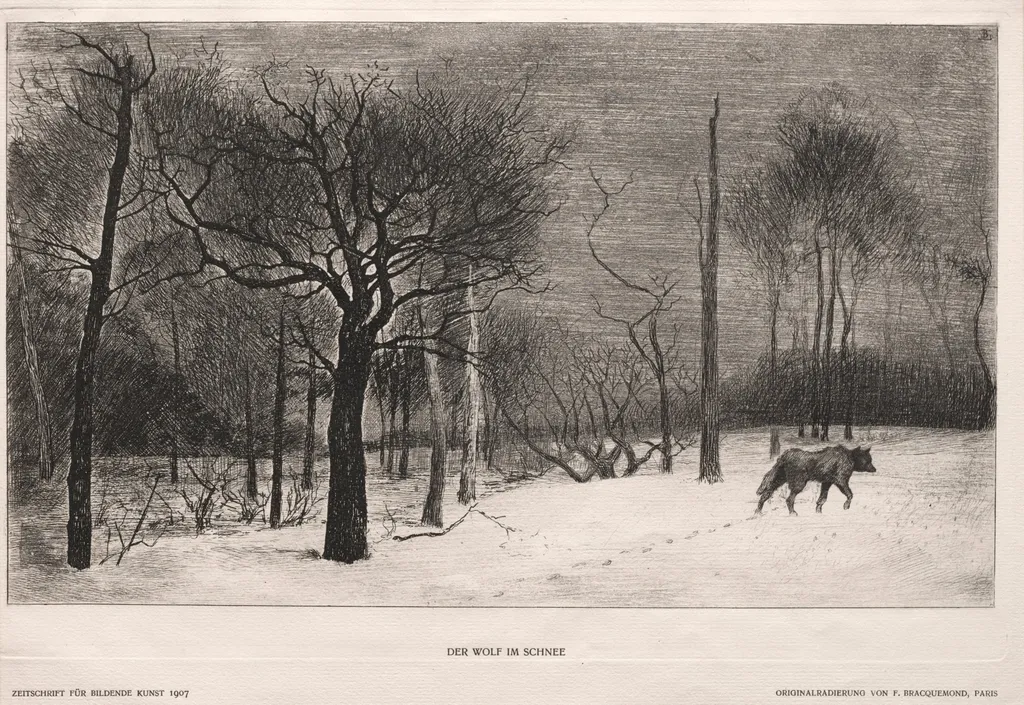
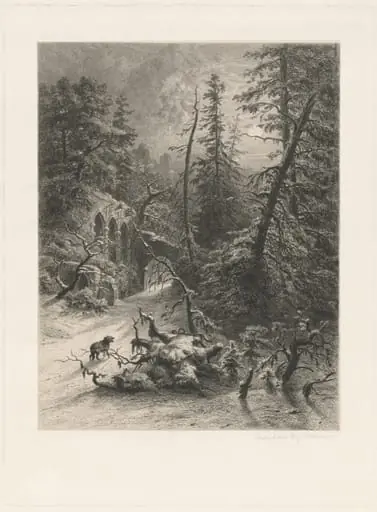
Winter is a print by the Impressionist artist Félix Bracquemond. It dates from 1862 and is held in the collection of the Cleveland Museum of Art.
About this work
Overview
Unlike a painting, it is a print, likely produced through etching or aquatint, reflecting Bracquemond’s engagement with printmaking during the mid-19th century.
Félix Bracquemond created the print Winter in 1862, capturing a quiet winter landscape in monochrome. The work is part of the collection at The Cleveland Museum of Art. Unlike a painting, it is a print, likely produced through etching or aquatint, reflecting Bracquemond’s engagement with printmaking during the mid-19th century. The composition emphasizes stillness and subtle tonal variation rather than color.
Subject & Meaning
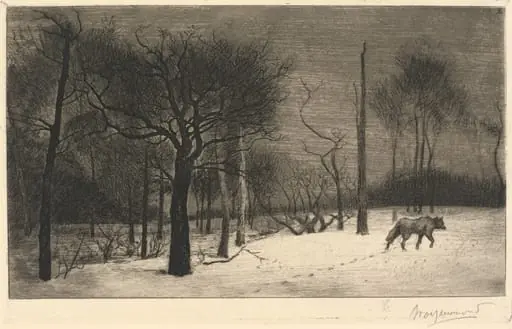
A lone wolf moves through a snow-covered ground, its form softened by the muted tones of the scene. Bare trees dominate the foreground, while distant evergreens hint at persistent life beneath the frost. The gray sky and stillness suggest a pause in nature’s cycle, evoking solitude rather than threat. The wolf, neither menacing nor domesticated, becomes an integral part of the landscape’s quiet rhythm.
Technique & Style
Bracquemond employed fine linear etching and controlled tonal gradations to model form and space. Shadows under trees and the wolf’s body contrast with the pale snow, creating depth without heavy chiaroscuro. The texture of snow is suggested through delicate stippling and fine hatching, while the trees are rendered with precise, angular lines. His approach reflects the influence of Japanese woodblock prints, which he admired for their clarity and restraint.
History & Provenance
Created in 1862, Winter emerged during a period when Bracquemond was deeply involved in the revival of printmaking in France. The work was likely produced in a small edition, typical of artist-led printmaking at the time. It entered the Cleveland Museum of Art’s collection through established acquisition channels, possibly as part of a broader interest in 19th-century French graphic arts.
Context
In the 1860s, French artists were reevaluating printmaking as a serious medium, moving beyond reproductive techniques. Bracquemond, influenced by Japanese aesthetics and the Barbizon painters, sought to elevate etching to the level of fine art. Winter reflects this shift—its quiet realism and emphasis on atmosphere align with contemporary interests in nature’s subtleties, distinct from academic grandeur.
Legacy
Winter exemplifies Bracquemond’s role in revitalizing printmaking in France, influencing later artists to treat etching as a vehicle for personal expression. While not widely known outside specialist circles, the work remains a quiet testament to the potential of monochrome print to convey mood and natural harmony. Its preservation in a major museum underscores its significance in the history of 19th-century graphic arts.
Own this work as a print
Artist & collection

Artist
Félix Henri Bracquemond (French pronunciation: ; 22 May 1833 – 29 October 1914) was a French painter, etcher, and printmaker.

 Hiver (Le Loup dans la neige)
 The Bugle Call
 Moonlit Stroll in Winter
 December
 Study of trees, Wotton Woods, Abinger
 Deer in the Woods (Les Cerfs sous bois)
 The Goatherd Girl
 Summer by the Lakeside
 Path in Parco delle Cascine (Un viale interno delle Cascine)
 Road to the Shore
 Deer Hunt (La chasse au cerf)
 Winter