Artwork
The Two Great Temples at Paestum
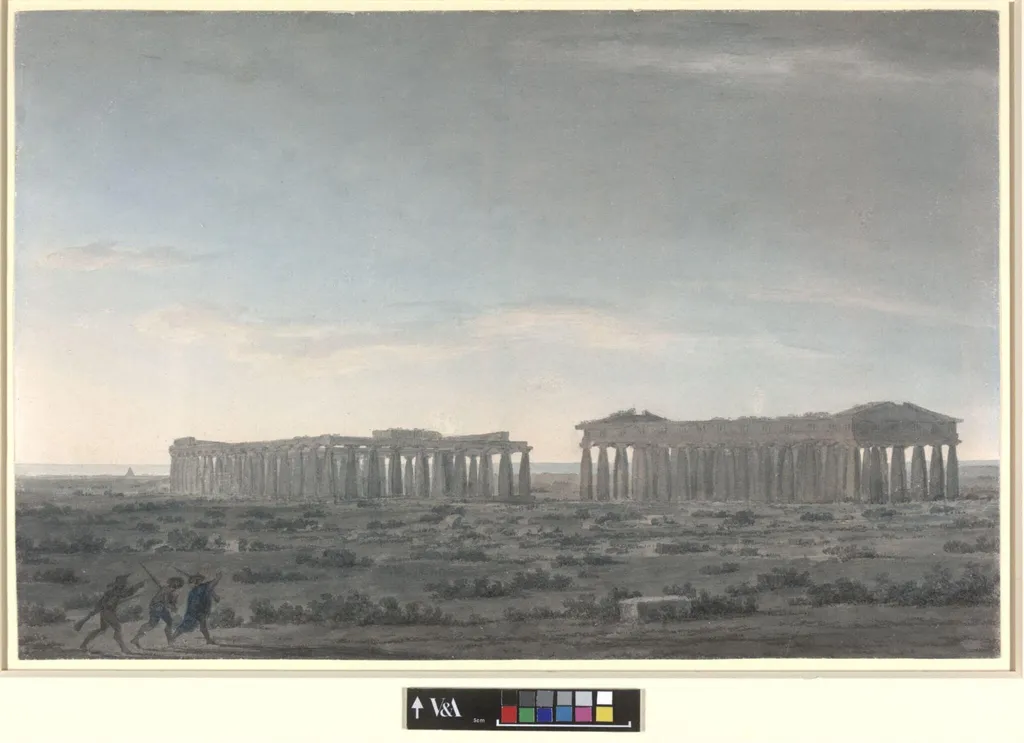
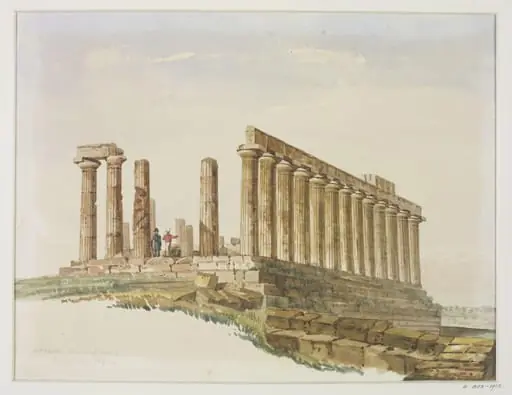
The Two Great Temples at Paestum is a watercolor work on paper by the Neoclassicist artist Cozens. It dates from 1782 and is held in the collection of the Victoria and Albert Museum.
About this work
Overview
Executed in muted greys and blues, the work captures the quiet decay of the structures amid sparse, undulating scrubland.
Created in 1782, this watercolour by John Robert Cozens depicts the ancient Greek temples of Paestum in southern Italy. Executed in muted greys and blues, the work captures the quiet decay of the structures amid sparse, undulating scrubland. Cozens produced four such watercolours during a single day of sketching, all intended for the collector William Beckford. The piece is inscribed on its reverse with the artist’s own hand, confirming its title and origin.
Subject & Meaning
The two temples, standing in solemn alignment, dominate the composition, their columns rising above a barren foreground. Three small figures, armed and barely discernible, enter from the lower left, emphasizing the scale and solitude of the ruins. The absence of human activity around the temples suggests a sense of temporal distance, evoking contemplation rather than narrative. The scene invites reflection on the passage of time and the endurance of architectural form.
Technique & Style
Cozens employed a restrained palette of pale washes to convey atmospheric light and spatial depth. The soft, diffused tones of the sky and ground unify the composition, while the temples are rendered with delicate linear precision. The contrast between the delicate watercolour medium and the monumental architecture creates a quiet tension, reinforcing the theme of nature reclaiming human achievement without dramatic intervention.
History & Provenance
Cozens painted this work during a brief visit to Paestum on 7 November 1782, producing four watercolours from on-site sketches. All were commissioned by William Beckford, a prominent English collector with a fascination for classical antiquity. Two of the four works reside in the Oldham Gallery, while another is held by Peter Agnew. This piece remains among the few surviving examples of Cozens’s Italian travels, valued for its directness and sensitivity to place.
Context
In the late 18th century, Italian ruins became subjects of scholarly and aesthetic interest among British travelers. Cozens’s watercolours reflect the growing Romantic sensibility that found emotional resonance in decay and silence. Unlike topographical records, his works prioritize mood over accuracy, aligning with a broader cultural turn toward subjective experience of the past. His approach influenced later artists who saw ruins not as relics, but as vessels of contemplation.
Legacy
Cozens’s Paestum watercolours contributed to the visual language of classical ruin imagery in British art. Their understated tone and emphasis on atmosphere helped shift focus from archaeological documentation to emotional response. Though not widely exhibited in his lifetime, these works gained recognition in the 19th century as early expressions of Romantic landscape sensibility, influencing how ruins were perceived as sites of introspection rather than mere antiquities.
Artist & collection
Artist
Cozens is an English surname. Following the Norman Conquest of England in 1066, the name Cozens was first found in Britina. It was a name for a person who was related to someone of note in the area. Further research…