Artwork
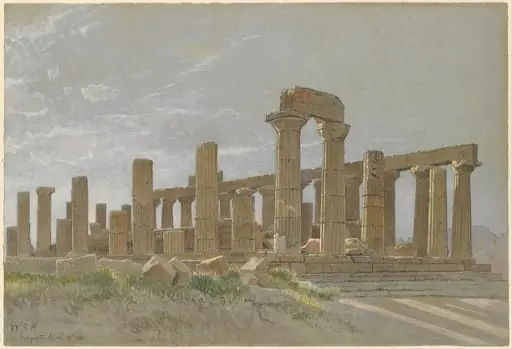
Girgenti. Temple of Juno Lucina.
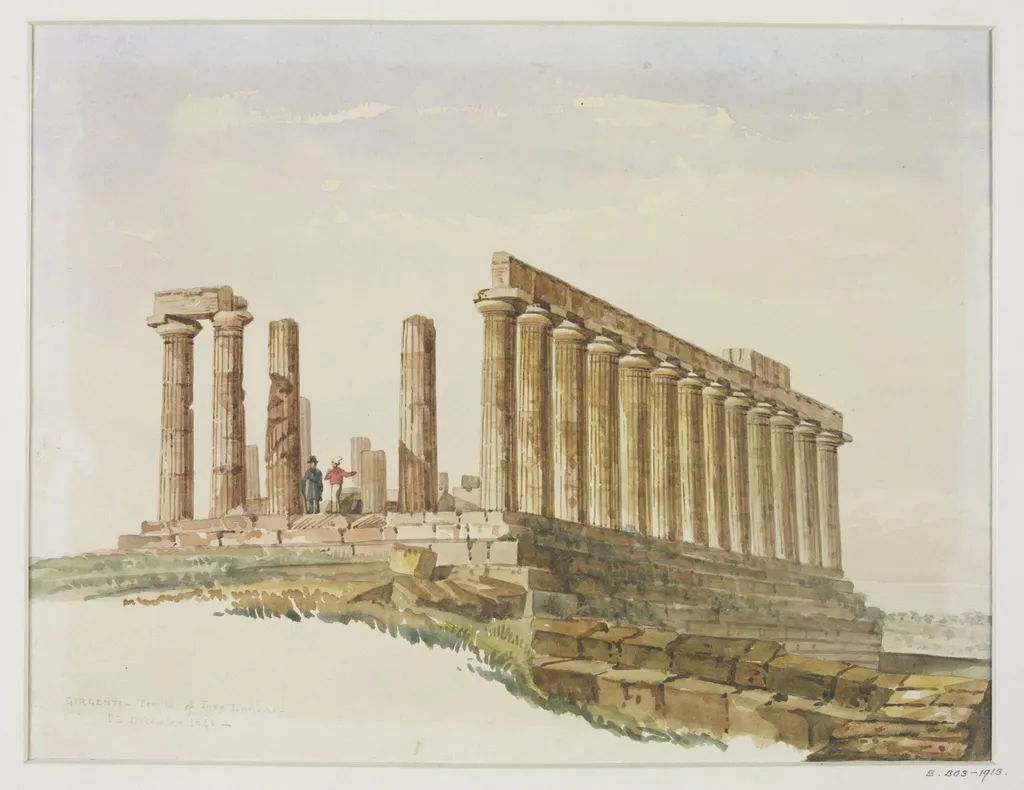
Girgenti. Temple of Juno Lucina. is a drawing by the Romanticist artist Thomas Hayter Lewis. It dates from 17 and is held in the collection of the Victoria and Albert Museum.
About this work
"* The drawing looks like it was made quickly, with loose lines and soft shading.
This sketch shows broken stone ruins with tall columns standing in a row. Two small figures stand near the center, one pointing at the ruins. The ground is uneven with scattered rocks and steps leading up to the columns. The sky is pale with light brushstrokes.
The artist wrote the title and date on the bottom left: *"Girgenti. Temple of Juno Lucina. 22 December 1841."* The drawing looks like it was made quickly, with loose lines and soft shading.
Check out the Victoria and Albert Museum to see this sketch in person.
Overview
Thomas Hayter Lewis’s drawing, dated 22 December 1841, records the remains of the Temple of Juno Lucina at Girgenti. Executed in a rapid, sketch‑like manner, the work is rendered in loose lines and subtle shading, capturing a scene of crumbling stone columns set against a pale sky. The drawing is part of the Victoria and Albert Museum’s collection.
Subject & Meaning
The composition depicts a row of tall, ruined columns that once supported the ancient sanctuary of Juno Lucina. Two diminutive figures stand near the centre, one gesturing toward the architecture, suggesting a moment of observation or scholarly interest. The uneven ground, scattered rocks, and descending steps emphasize the passage of time and the site's decay.
Technique & Style
Lewis employed quick, gestural strokes to outline the structural forms, allowing the drawing’s line work to convey both mass and atmosphere. Soft shading creates a sense of depth without detailed modeling, while the light, almost translucent sky is suggested through broad, airy brushmarks. The overall effect is that of an on‑site field sketch rather than a finished illustration.
History & Provenance
Created during a mid‑19th‑century visit to Sicily, the drawing entered the Victoria and Albert Museum’s holdings, where it remains accessible to researchers and the public. The date and title inscribed in the lower left corner confirm its origin and purpose as a documentary record of the Girgenti site.
Context
The Temple of Juno Lucina, an ancient Roman sanctuary, was a frequent subject for travelers and antiquarians in the 1800s, reflecting a broader European fascination with classical ruins. Lewis’s sketch aligns with this tradition, offering a visual account that complements contemporary travel journals and archaeological studies of the period.
Artist & collection
Artist
In his teens, Thomas Hayter Lewis sketched ruins instead of doing homework, filling notebooks with cracked columns and shadowed porches.