Artwork
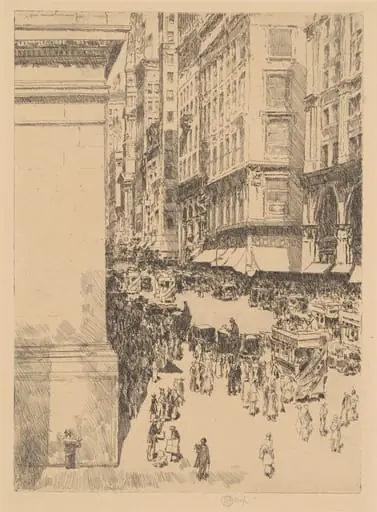
Broadway, New York: From the Western Union Telegraph Building Looking North
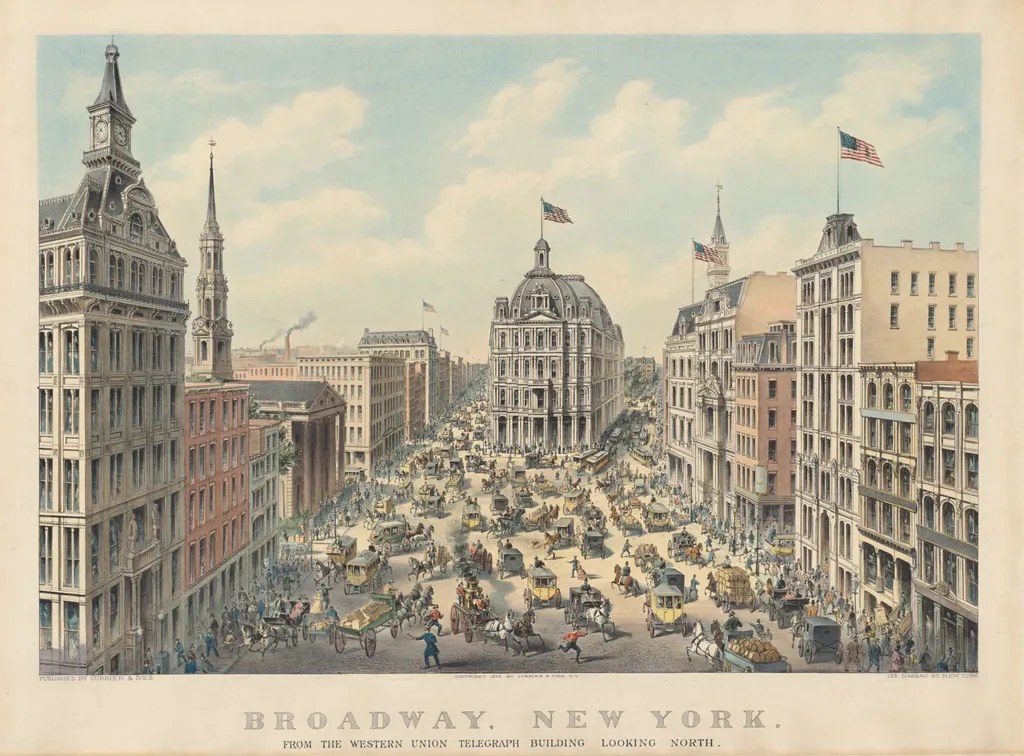
Broadway, New York: From the Western Union Telegraph Building Looking North is an ink print by the Impressionist artist Currier and Ives. It dates from 1875 and is held in the collection of the National Gallery of Art.
About this work
Overview
This 1875 hand-colored lithograph by Currier and Ives captures a northward view of Broadway from the Western Union Telegraph Building.
This 1875 hand-colored lithograph by Currier and Ives captures a northward view of Broadway from the Western Union Telegraph Building. The scene presents a densely populated urban corridor, rendered in fine detail with subtle color accents. The composition emphasizes verticality through towering structures and horizontal movement through traffic and pedestrians, conveying the rhythm of mid-19th century city life.
Subject & Meaning
The image portrays Broadway as a dynamic artery of commerce and transit, teeming with horse-drawn vehicles, pedestrians, and signage. American flags flutter from building tops, signaling civic pride amid rapid urbanization. The presence of a distant factory chimney suggests industrial expansion, while the ornate architecture reflects the era’s aspiration toward grandeur in public spaces.
Technique & Style
Executed as a hand-colored lithograph on wove paper, the work combines the precision of stone-based printing with manual tinting to enhance realism. Details like clock faces, arched windows, and smoke plumes are delicately rendered, while the color palette—soft blues, grays, and muted reds—adds atmospheric depth without overwhelming the line work. The style aligns with popular 19th-century American printmaking traditions.
History & Provenance
Produced by the prominent New York firm Currier and Ives, the print was part of a series documenting urban life for a broad middle-class audience. It was likely sold as a decorative item for homes and offices, reflecting public fascination with the city’s transformation. The Western Union Building, completed in 1872, served as both vantage point and symbol of technological progress.
Context
In the 1870s, New York City was expanding rapidly, with Broadway evolving into a commercial and cultural spine. The coexistence of horse-drawn transport and emerging industrial elements reflects a transitional phase before electrification and automobiles. The print captures a moment when civic identity was being shaped by architecture, commerce, and the daily movement of people.
Legacy
The lithograph remains a visual record of urban density and infrastructure during a pivotal era in American city development. While no longer widely circulated, it is preserved in institutional collections as an artifact of popular visual culture. Its enduring value lies in its unembellished documentation of everyday urban experience in post-Civil War America.
Artist & collection