Artwork
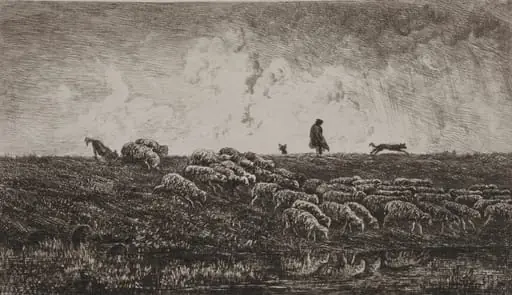
Large Sheepfold (Le Grand parc a moutons)
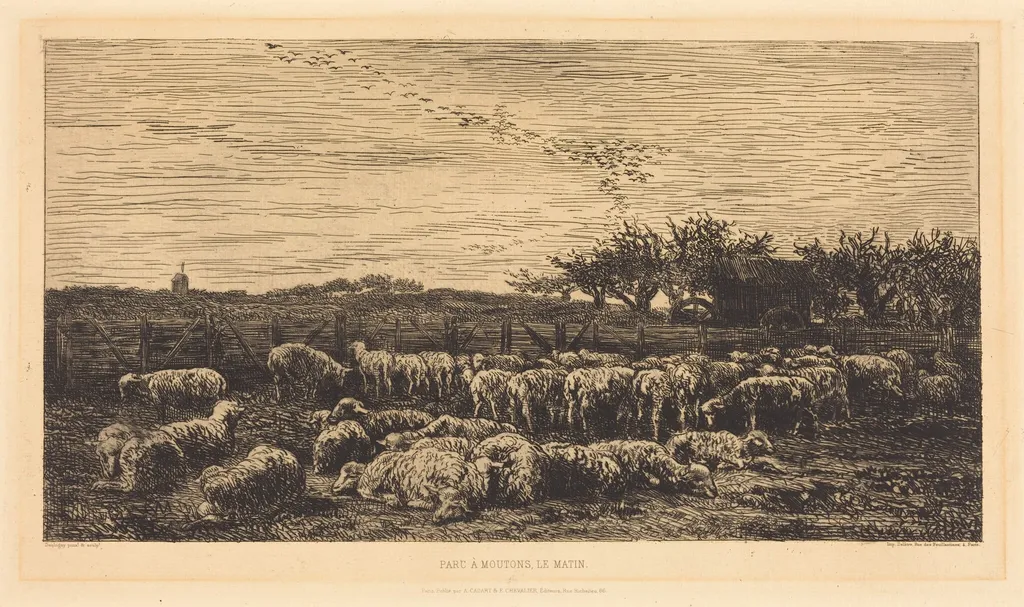
Large Sheepfold (Le Grand parc a moutons) is an ink print by the Impressionist artist Charles François Daubigny. It dates from 1860 and is held in the collection of the National Gallery of Art.
About this work
Overview
Charles-François Daubigny produced *Large Sheepfold* in 1860 as an etching, part of his broader engagement with rural landscapes and printmaking.
Charles-François Daubigny produced *Large Sheepfold* in 1860 as an etching, part of his broader engagement with rural landscapes and printmaking. Unlike grand historical scenes, this work focuses on an ordinary agricultural setting, reflecting his commitment to observing nature directly. Daubigny’s technique in this piece combines etching with drypoint, allowing for rich tonal variation and a tactile quality that enhances the scene’s quiet realism.
Subject & Meaning
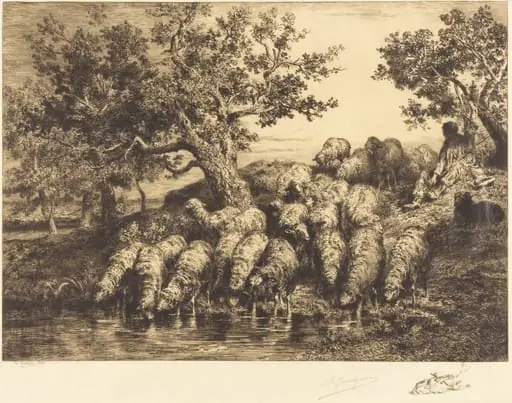
The scene captures a flock of sheep gathered in a circular enclosure at twilight, their forms softened by fading light. There is no human presence, emphasizing the animals’ quiet coexistence with the land. The composition avoids idealization, presenting the sheepfold as a functional, weathered structure. The work conveys a sense of stillness and endurance, rooted in the rhythms of rural life rather than romanticized pastoral fantasy.
Technique & Style
Daubigny used a drypoint needle to incise deep, expressive lines into the plate, trapping ink to create velvety blacks that define the sheep’s mass and the shadowed ground. Fine, scratchy etched lines suggest the texture of bark, grass, and sky. The contrast between the dense flock and the hazy, atmospheric background demonstrates his mastery of tonal gradation, achieving depth without heavy shading or dramatic contrast.
History & Provenance
Created during Daubigny’s most active period as a printmaker, this etching was likely made for private collectors and fellow artists rather than public exhibition. It reflects his experimentation with techniques like cliché verre and etching, which allowed him to capture fleeting effects of light. The work remained within French artistic circles, influencing later printmakers drawn to naturalism and direct observation.
Context
Daubigny worked alongside the Barbizon painters, who rejected academic conventions in favor of painting outdoors and depicting ordinary rural life. *Large Sheepfold* aligns with this movement’s ethos, emphasizing the dignity of everyday scenes. His prints, often made in small editions, circulated among artists and connoisseurs, contributing to a broader shift toward intimate, observational art in mid-19th-century France.
Legacy
The etching exemplifies Daubigny’s role in bridging traditional landscape traditions and emerging modern approaches to printmaking. His use of atmospheric tone and loose, expressive lines prefigured techniques later adopted by Impressionist printmakers. Though not widely known today, the work remains a quiet testament to his dedication to capturing the subtle poetry of the natural world through direct, unembellished observation.
Own this work as a print
Artist & collection
Artist
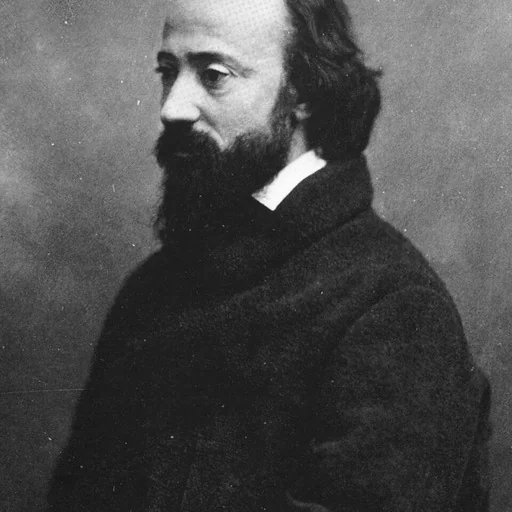
Charles-François Daubigny ( DOH-bin-yee, US: DOH-been-YEE, doh-BEEN-yee, French: ; 15 February 1817 – 19 February 1878) was a French painter, one of the members of the Barbizon school, and is considered an important precursor of…