Artwork
Abusant de la liberté
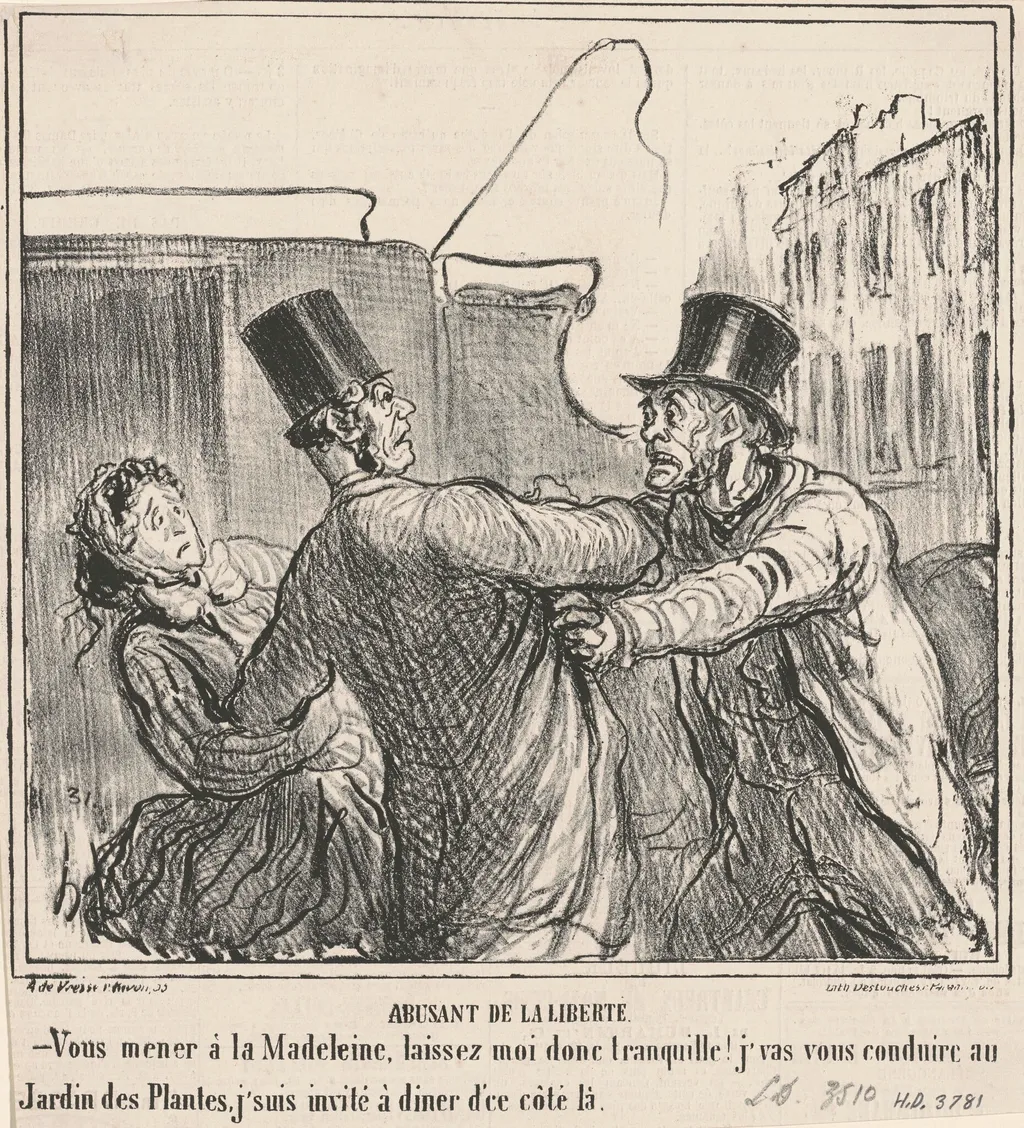
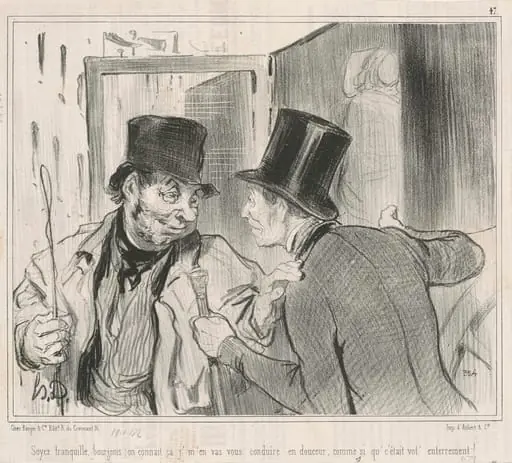
Abusant de la liberté is an ink print by the Impressionist artist Honoré Daumier. It dates from 1866 and is held in the collection of the National Gallery of Art.
About this work
Here’s the rewrite: Daumier’s *Abusant de la liberté* shows a wild scene by a carriage.
Here’s the rewrite:
Daumier’s *Abusant de la liberté* shows a wild scene by a carriage. Two men scuffle outside while a third looks trapped inside. The lines are rough and fast, like a quick sketch.
Daumier made this as a lithograph in 1866. Back then, lithography was new and cheap. Cartoonists used it to mock politics fast.
See how the background blurs? It keeps your eye on the fight.
Check out Daumier, Honoré next.
Overview
Created in 1866, *Abusant de la liberté* is a lithograph by Honoré Daumier that captures a moment of public disorder near a horse-drawn carriage. The print belongs to a series of satirical works produced during a period of political tension in France. Daumier used the accessibility of lithography to distribute sharp social commentary widely, often targeting abuses of power and public behavior.
Subject & Meaning
The scene centers on a physical altercation between two men beside a carriage, while a third figure appears confined within, expressing distress. The title, translating to 'Abusing Freedom,' suggests a critique of unchecked behavior under the guise of liberty. Daumier frames the moment not as heroic but as chaotic and degrading, reflecting his skepticism toward societal claims of progress and order.
Technique & Style
Daumier employed rapid, gestural lines typical of his lithographic process, creating a sense of urgency and movement. The background is deliberately blurred and simplified, directing attention to the central conflict. His style avoids fine detail in favor of expressive distortion, emphasizing emotional intensity over realism. This approach aligns with his broader use of caricature to amplify social critique.
History & Provenance
The print was produced during Daumier’s prolific period for illustrated journals, where lithography allowed quick, low-cost reproduction. It likely appeared in a periodical such as *Le Charivari*, which regularly published his political cartoons. Though the original publication context is unrecorded, the work survives as part of institutional collections that preserve his critical engagement with 19th-century French society.
Context
In 1866, France was under the Second Empire, with Napoleon III suppressing dissent and controlling the press. Daumier, long a critic of authority, used visual satire to circumvent censorship. Lithography’s speed made it ideal for timely commentary. His depictions of public chaos often mirrored real incidents of unrest, offering a veiled but potent critique of state control and civic decay.
Legacy
Daumier’s work in lithography influenced later generations of cartoonists and social realists by demonstrating how print media could serve as a tool for public critique. *Abusant de la liberté* exemplifies his ability to condense complex social tensions into a single, visceral image. Though not widely exhibited in his lifetime, his prints gained recognition in the 20th century as foundational to modern political illustration.
Artist & collection

Artist
Honoré-Victorin Daumier was a French painter, sculptor, and printmaker, whose many works offer commentary on the social and political life in France, from the Revolution of 1830 to the fall of the Second French Empire in 1870.