Artwork
Adélaide...Adélaide...il me semble que je vois deja venir la comète !!...
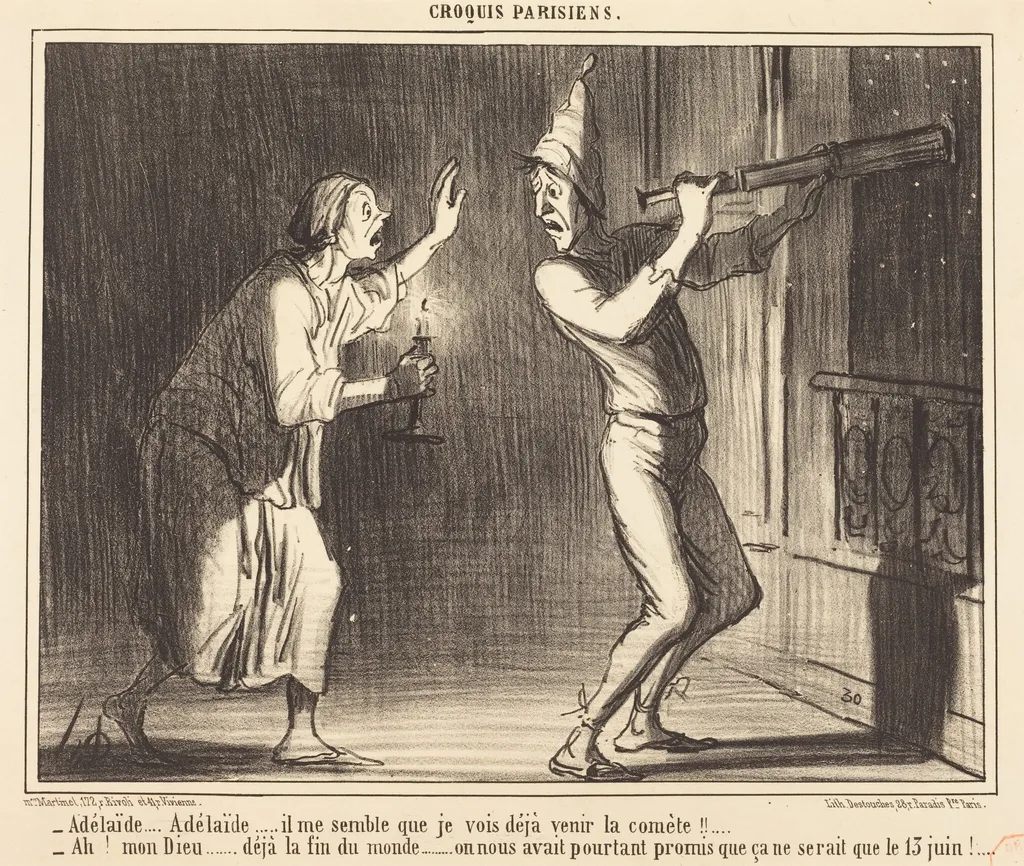
Adélaide...Adélaide...il me semble que je vois deja venir la comète !!... is an ink print by the Impressionist artist Honoré Daumier. It dates from 1857 and is held in the collection of the National Gallery of Art.
About this work
Overview
This 1857 lithograph by Honoré Daumier captures a moment of quiet alarm in a domestic interior, where a woman alerts a man to an unseen celestial event.
This 1857 lithograph by Honoré Daumier captures a moment of quiet alarm in a domestic interior, where a woman alerts a man to an unseen celestial event. Rendered in the medium of lithography, the work was originally published in a satirical newspaper, reflecting Daumier’s role as a visual commentator on French society. The image’s subdued lighting and intimate scale contrast with its implied urgency, inviting viewers to consider the metaphor behind the comet’s arrival.
Subject & Meaning
The scene portrays a woman pointing toward the window while a man peers through a telescope, suggesting a shared moment of dread or awe. The comet, though unseen, functions as a symbol of impending change—possibly political upheaval or societal collapse. Daumier often used astronomical phenomena as metaphors for instability, and here the figures’ reactions mirror public anxiety during the fragile years of the July Monarchy, when fears of revolution and authoritarianism were widespread.
Technique & Style
Daumier employed lithography to achieve sharp contrasts between deep shadows and the narrow pool of candlelight, enhancing the scene’s tension. His loose, expressive lines convey movement and emotion without detail, focusing on posture and gesture. The wove paper’s texture absorbs ink unevenly, adding a tactile sense of unease. This restrained technique—avoiding caricature’s exaggeration—heightens the psychological realism, aligning with his mature style of understated social observation.
History & Provenance
Created for a periodical like *Le Charivari*, the print was part of Daumier’s regular contributions to satirical press, where he evaded censorship through allegory. Though the exact publication date and original context are not fully documented, its survival in museum collections reflects its recognition as a significant example of 19th-century political printmaking. Daumier’s works were widely circulated among the urban middle class, making such images tools of informal public discourse.
Context
In 1857, France was under the rule of Napoleon III, following the 1851 coup that ended the Second Republic. Public sentiment was tense, with censorship tightening and dissent suppressed. Daumier, a lifelong republican, used celestial imagery to bypass direct political commentary. The comet became a neutral yet potent symbol—its arrival could signify divine judgment, scientific progress, or societal doom, allowing viewers to project their own fears onto the scene.
Legacy
Daumier’s lithographs, including this one, helped redefine printmaking as a vehicle for serious social commentary rather than mere entertainment. His ability to convey complex emotions through minimal means influenced later artists, from the Impressionists to 20th-century graphic illustrators. The work endures not for its novelty, but for its quiet resonance—capturing how ordinary people respond to forces beyond their control, whether celestial or political.
Own this work as a print
Artist & collection
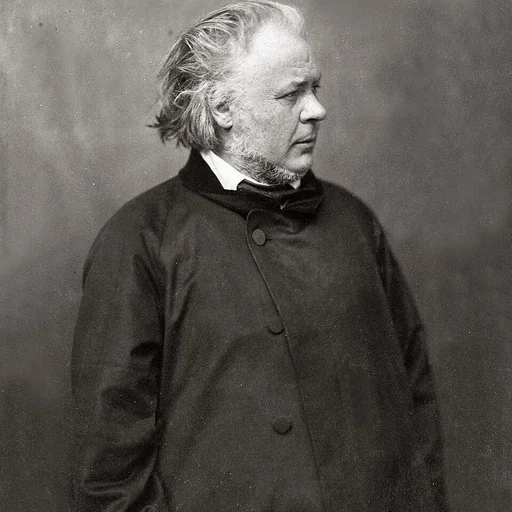
Artist
Honoré-Victorin Daumier was a French painter, sculptor, and printmaker, whose many works offer commentary on the social and political life in France, from the Revolution of 1830 to the fall of the Second French Empire in 1870.








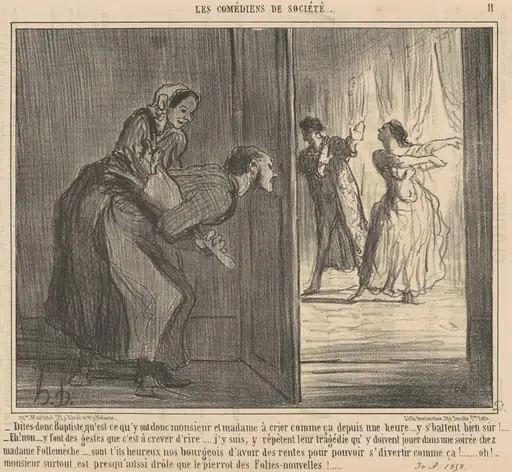 Dites-donc Baptiste ...
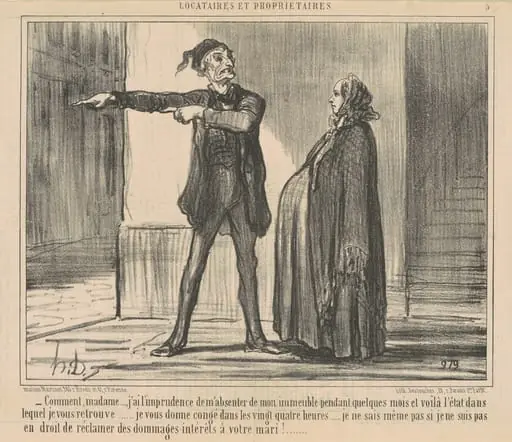 Comment, madame ... J'ai l'imprudence ...
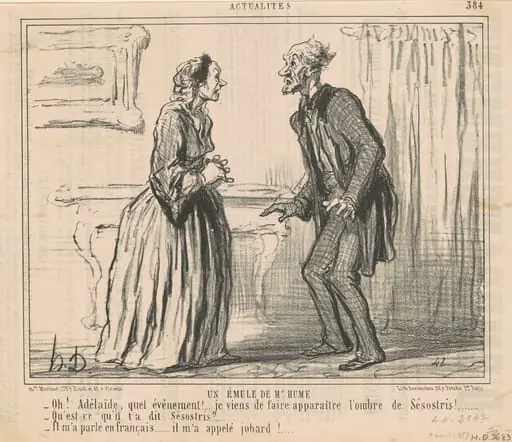 Un émule de Mr Hume
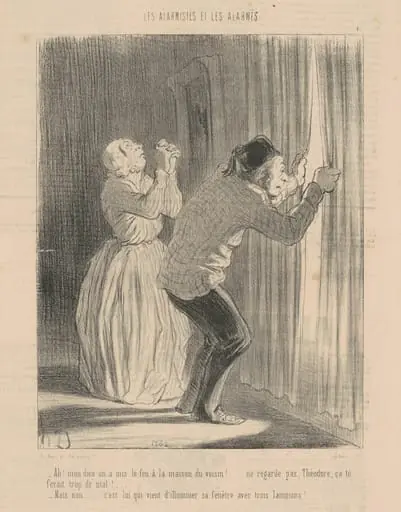 Ah! Mon dieu on a mis le feu a la maison du voisin ...
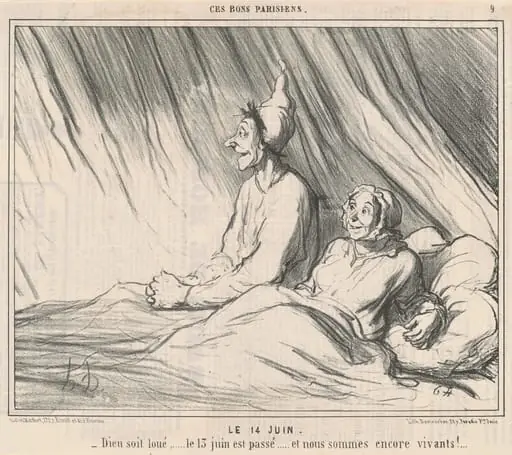 Le 14 Juin
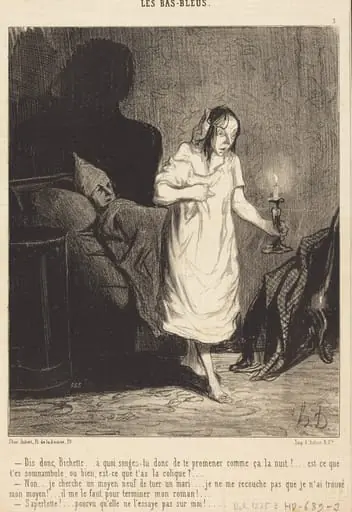 Dis donc, Bichette... a quoi songes-tu donc...
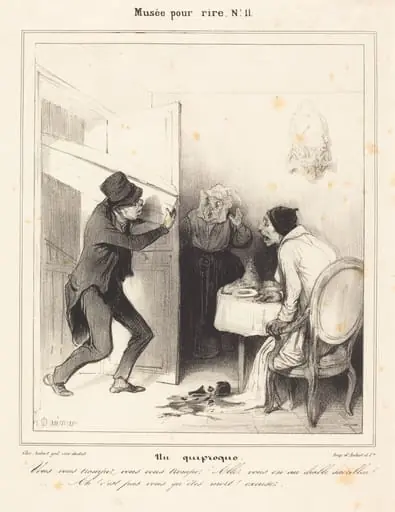 Un quiproquo - Vous vous trompez... allez... au diable...
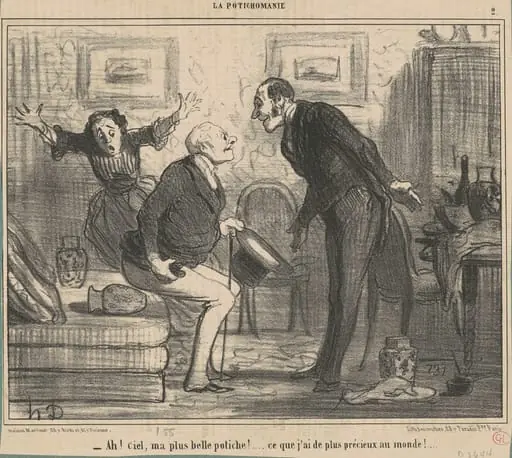 Ah! Ciel, ma plus belle potiche! ...
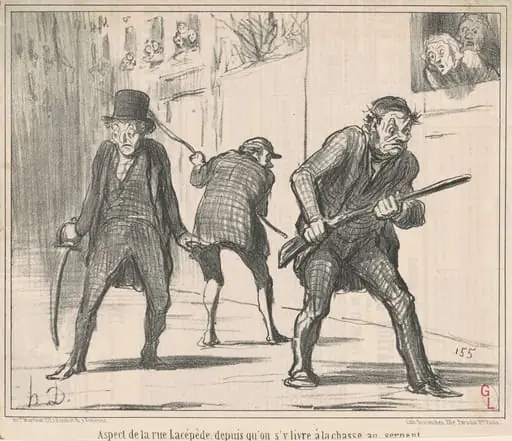 Aspect de la rue Lacépède ...
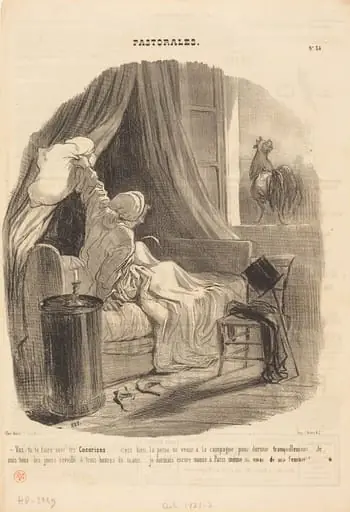 Vas-tu te taire avec tes Cocoricos...