Artwork
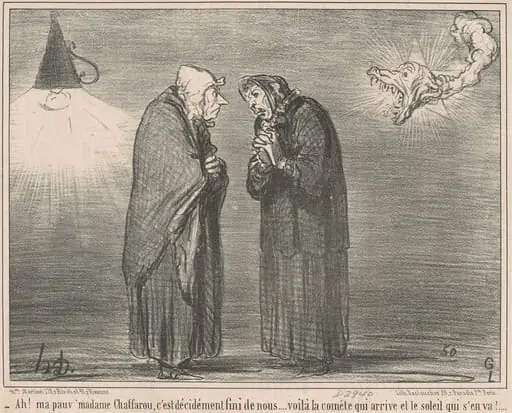
Ah! Pauv' Madame Chaffarou ...
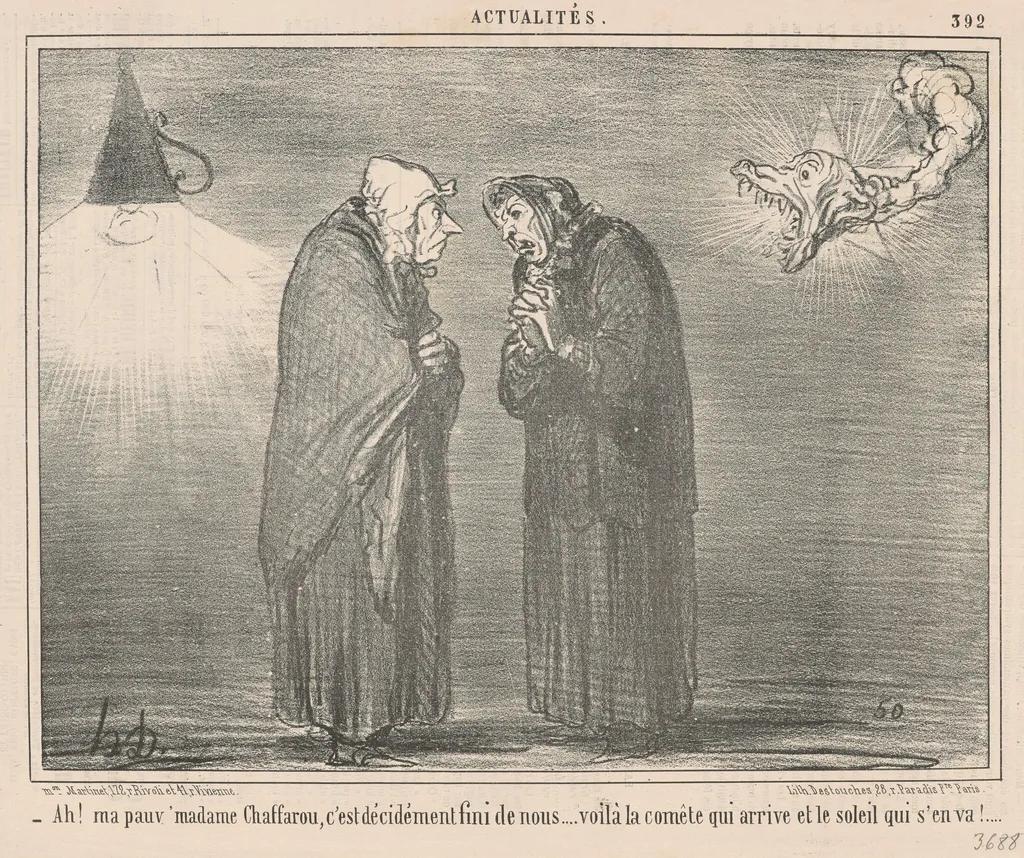
Ah! Pauv' Madame Chaffarou ... is an ink print by the Impressionist artist Honoré Daumier. It dates from 1857 and is held in the collection of the National Gallery of Art.
About this work
Overview
This lithograph by Honoré Daumier captures a quiet, unguarded moment between two elderly women. Rendered in stark monochrome, the composition eliminates extraneous detail to focus entirely on their facial expressions and postures. The absence of setting or context intensifies the intimacy of their encounter, suggesting a shared history of hardship and resilience.
Subject & Meaning
The two figures, distinguished only by subtle differences in posture and expression, appear to be engaged in a moment of mutual recognition. Their deeply lined faces and weary eyes convey exhaustion, not just from age but from a lifetime of labor and loss. Daumier avoids sentimentality, instead presenting their dignity through unflinching realism and emotional restraint.
Technique & Style
Daumier employed lithographic chalk to achieve a range of tonal textures, using heavy, fluid lines to define the women’s forms and a granular, atmospheric background to isolate them visually. The contrast between the dense, shadowed robes and the blurred, cloud-like ground heightens the psychological presence of their faces, turning simple gestures into silent narratives.
History & Provenance
Pauv' Madame Chaffarou' was likely published in a satirical journal, reflecting Daumier’s ongoing engagement with the lives of ordinary women.
Created during the mid-19th century, this work belongs to a series of lithographs Daumier produced for French periodicals, often commenting on social conditions through caricature. Though initially intended for mass circulation, these images gained later recognition for their humanistic depth. 'Ah! Pauv' Madame Chaffarou' was likely published in a satirical journal, reflecting Daumier’s ongoing engagement with the lives of ordinary women.
Context
In an era when urban poverty and the marginalization of the elderly were largely ignored by official art, Daumier turned his attention to the unseen. His lithographs offered a counter-narrative to idealized portraiture, portraying aging women not as comic figures but as individuals marked by time and circumstance. This work aligns with broader social critiques emerging in French visual culture during the July Monarchy.
Legacy
Daumier’s approach influenced later realist and expressionist artists who sought to depict everyday suffering without embellishment. This lithograph remains a touchstone for its economy of means and emotional precision. It stands as a quiet testament to the power of observation, elevating the mundane into a form of enduring human testimony.
Artist & collection

Artist
Honoré-Victorin Daumier was a French painter, sculptor, and printmaker, whose many works offer commentary on the social and political life in France, from the Revolution of 1830 to the fall of the Second French Empire in 1870.