Artwork
Au fait, maitre Barbotteau...
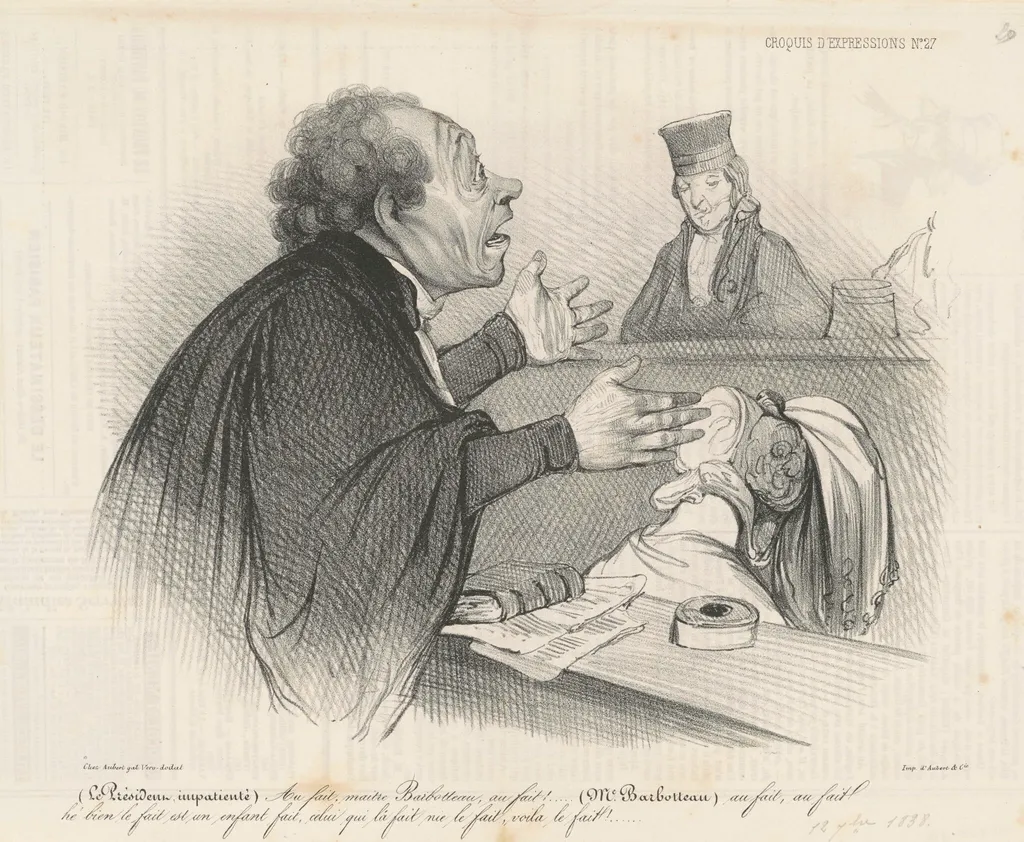
Au fait, maitre Barbotteau... is an ink print by the Romanticist artist Honoré Daumier. It dates from 1838 and is held in the collection of the National Gallery of Art.
About this work
He used cheap ink on stone to catch the crowd’s boredom and the lawyer’s big gestures.
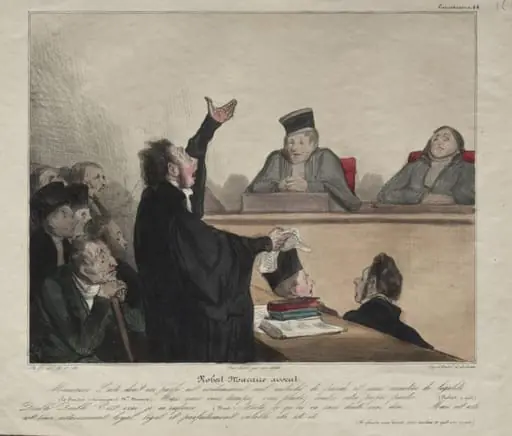
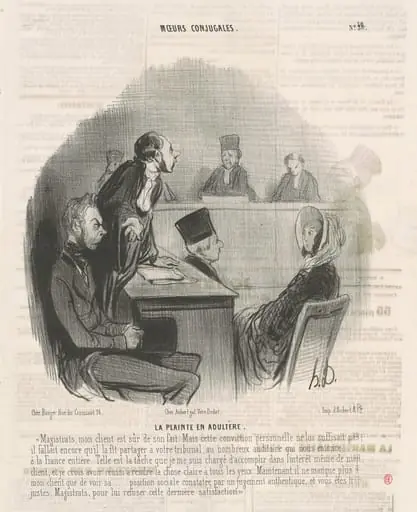
This lithograph shows a lawyer waving his arms in court. The judge bends over his papers. A woman slumps in the front row, half-asleep.
Daumier made this in 1838, before photography existed. He used cheap ink on stone to catch the crowd’s boredom and the lawyer’s big gestures. Lithography lets him draw fast, then print many copies.
It’s like watching a silent movie frame. See how the ink blurs at the edges? That’s the stone’s grain showing.
Look up lithography next.
Overview
Honoré Daumier’s lithograph ‘Au fait, maître Barbotteau’ (1838) portrays a bustling courtroom. A lawyer raises his arms in a vigorous argument, a judge leans over a pile of papers, and a woman in the front row appears half‑asleep, lending the scene a touch of everyday fatigue.
Subject & Meaning
The composition juxtaposes the fervor of legal advocacy with the weariness of the audience, hinting at Daumier’s subtle critique of judicial proceedings. By placing a slumped spectator beside the active participants, the work underscores the gap between public spectacle and personal disengagement.
Technique & Style
Executed on a limestone slab with inexpensive black ink, the lithograph exploits the medium’s capacity for swift, gestural drawing. The grain of the stone produces soft, blurred edges, giving the image a kinetic, almost cinematic quality that captures movement within a single frame.
History & Provenance
Created in 1838, before the advent of photographic documentation, the print reflects Daumier’s early engagement with social subjects. Multiple impressions were produced, allowing the image to circulate widely among contemporary audiences and reinforcing the artist’s reputation for topical commentary.
Context
Daumier, active during the July Monarchy, frequently depicted public institutions such as courts and salons, using humor and observation to comment on French society. This work aligns with his broader interest in the everyday drama of civic life, rendered in a straightforward, monochrome format.
Artist & collection

Artist
Honoré-Victorin Daumier was a French painter, sculptor, and printmaker, whose many works offer commentary on the social and political life in France, from the Revolution of 1830 to the fall of the Second French Empire in 1870.