Artwork
Ce monsieur Courbet...
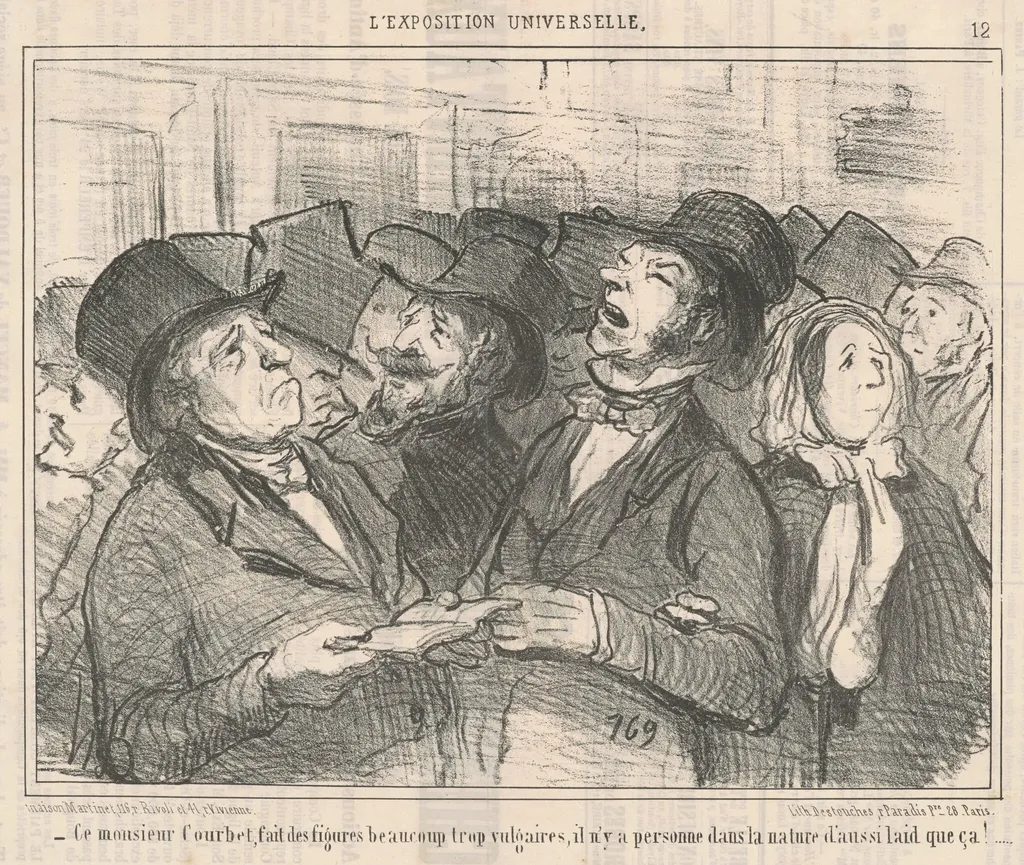
Ce monsieur Courbet... is an ink print by the Impressionist artist Honoré Daumier. It dates from 1855 and is held in the collection of the National Gallery of Art.
About this work
This lithograph shows a group of men in suits stiffly standing beside a woman in profile.
This lithograph shows a group of men in suits stiffly standing beside a woman in profile. Their faces twist into grins and frowns, like masks at a party.
Daumier made it in 1855, poking fun at rich Parisians. Lithography let him draw fast, bold lines that still feel sharp today.
See how the crowd behind them is just blurs? It’s not careless—it pushes the fancy folks forward. Check out the same artist next: Daumier, Honoré.
Overview
Created in 1855, this lithograph on newsprint by Honoré Daumier presents a satirical snapshot of Parisian social life. The image features a small group of well-dressed figures, their expressions exaggerated, standing beside a silent woman in profile. The background dissolves into indistinct smudges, isolating the subjects as objects of quiet ridicule. Daumier’s use of lithographic technique allowed rapid execution and bold, fluid lines that retain clarity despite the fragile medium.
Subject & Meaning
The figures represent affluent Parisians, their stiff postures and contorted faces suggesting performative social behavior. The woman, rendered in profile without expression, contrasts with the men’s animated grimaces, hinting at gendered roles in elite circles. Daumier critiques the artificiality of bourgeois manners, using caricature to expose the emptiness beneath polished appearances. The crowd behind them, rendered as vague shadows, underscores their detachment from the world beyond their self-absorbed sphere.
Technique & Style
Daumier employed lithography to achieve rapid, expressive line work, exploiting the medium’s capacity for tonal contrast and spontaneity. His strokes are decisive yet economical, defining forms with minimal detail. The background crowd is reduced to loose, smudged marks, creating depth without distraction. This deliberate simplification directs focus to the central figures’ exaggerated physiognomies, a hallmark of Daumier’s satirical approach—where economy of line amplifies emotional and social critique.
History & Provenance
Produced in 1855, the print emerged during a period of intense political and social scrutiny in France, shortly after Courbet’s controversial exhibition. Though not directly about Courbet, the title references him as a symbol of artistic rebellion. The work likely circulated in periodicals or as a standalone sheet, targeting middle-class audiences familiar with the social types depicted. Its survival on fragile newsprint speaks to its initial mass distribution and informal reception.
Context
Daumier created this work amid rising tensions between traditional academic art and emerging realist movements. The bourgeoisie, newly empowered by industrial wealth, became frequent targets of his satire. By mocking their rigid etiquette and hollow gestures, Daumier aligned himself with critics of social pretension. Lithography, as a reproducible medium, enabled his commentary to reach beyond elite galleries, embedding critique into everyday visual culture.
Legacy
This print exemplifies Daumier’s enduring influence on modern graphic satire. His ability to distill social observation into sharp, readable imagery paved the way for later cartoonists and illustrators. The work’s reliance on line over detail, and its focus on psychological exposure over narrative, prefigured 20th-century expressive drawing. Though produced for ephemeral consumption, its formal precision and social insight have secured its place in the history of printmaking.
Artist & collection

Artist
Honoré-Victorin Daumier was a French painter, sculptor, and printmaker, whose many works offer commentary on the social and political life in France, from the Revolution of 1830 to the fall of the Second French Empire in 1870.









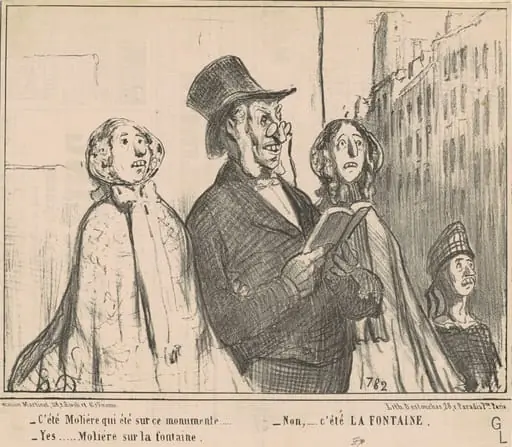 C'été Molière que été sur ce monumente ...
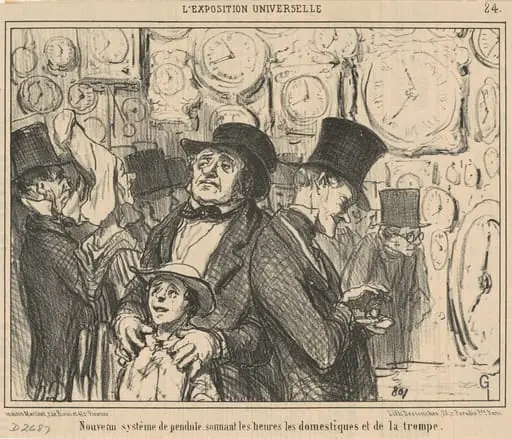 Nouveau système de pendule ...
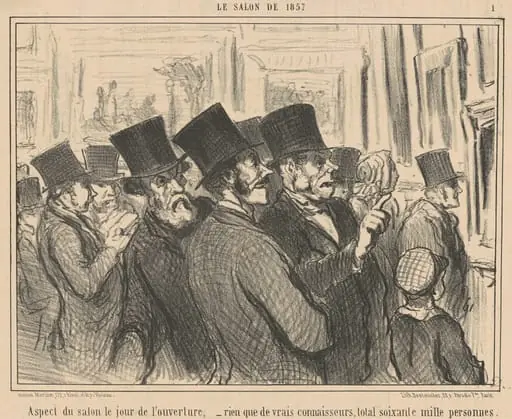 Aspect de salon le jour de l'ouverture ...
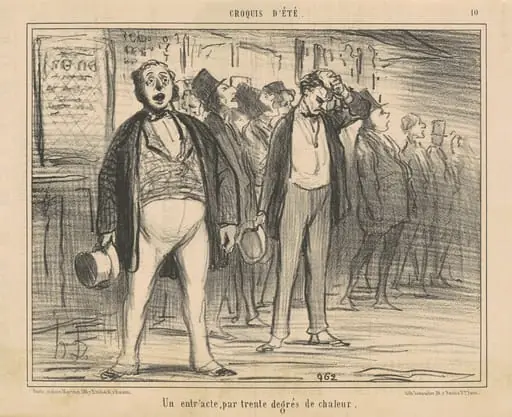 Un entr'acte, par trente degrés de chaleur
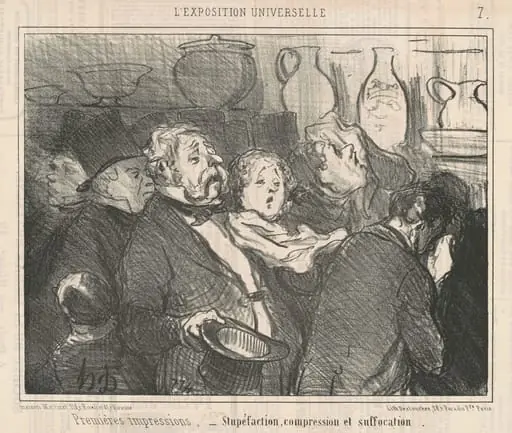 Premières impressions...Stupefaction ...
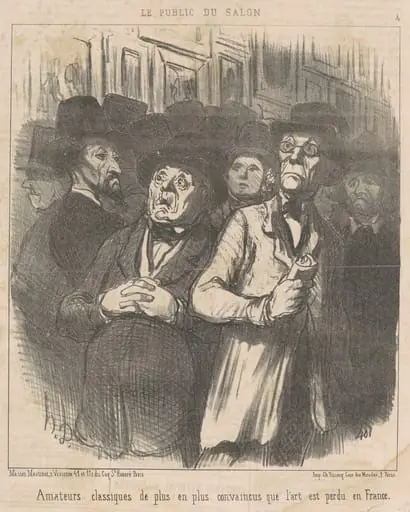 Amateurs classiques ... convaincus ...
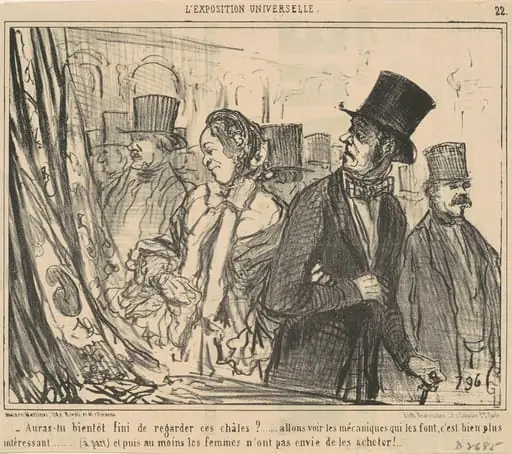 Auras-tu bientot fini de regarder ces chales?
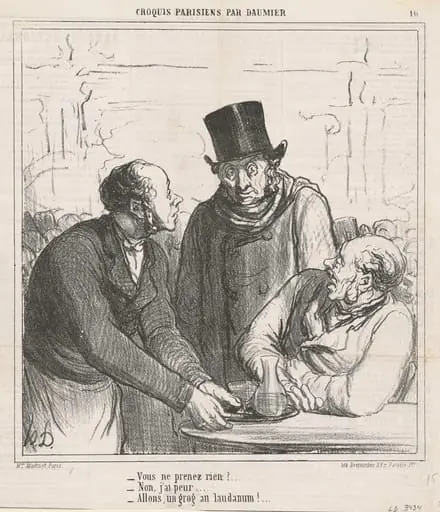 Vous ne prenez rien?
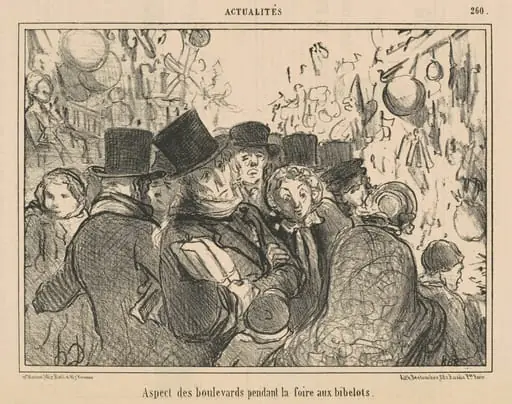 Aspect des boulevards pendant la foire aux bibelots