Artwork
Ce que certains journaux appeleraient...
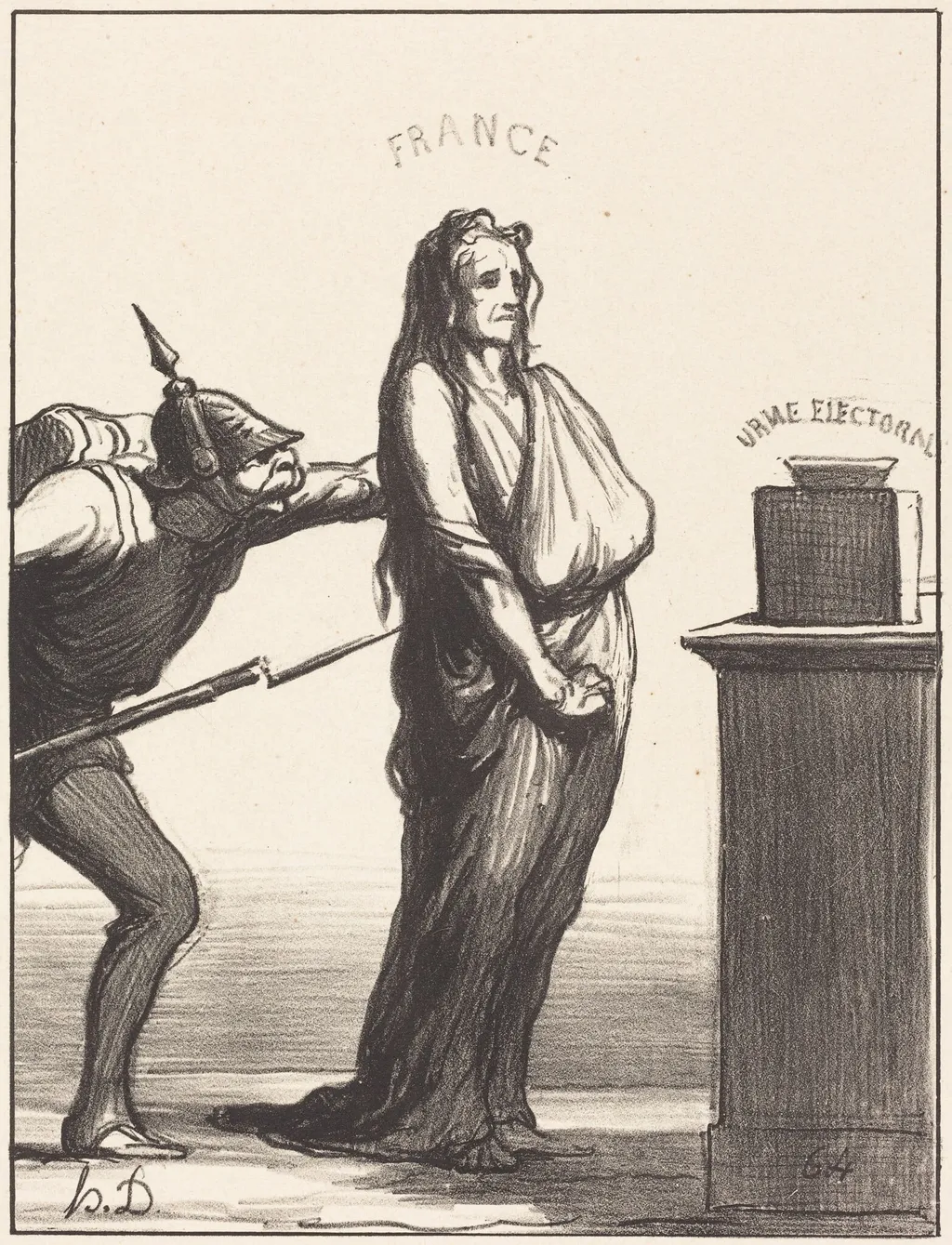
Ce que certains journaux appeleraient... is an ink print by the Impressionist artist Honoré Daumier. It dates from 1870 and is held in the collection of the National Gallery of Art.
About this work
Overview
Created in 1870, this lithograph by Honoré Daumier captures a moment of civic tension during France’s turbulent political climate.
Created in 1870, this lithograph by Honoré Daumier captures a moment of civic tension during France’s turbulent political climate. As part of his decades-long engagement with print media, Daumier used the accessibility of lithography to reach a broad audience. The image is one of many satirical works he produced for journals like *Le Charivari*, where his visual wit challenged entrenched power structures through understated yet pointed imagery.
Subject & Meaning
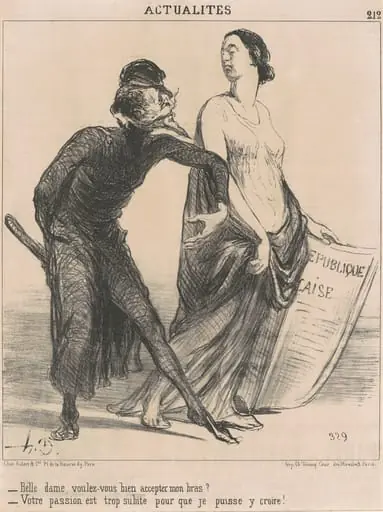
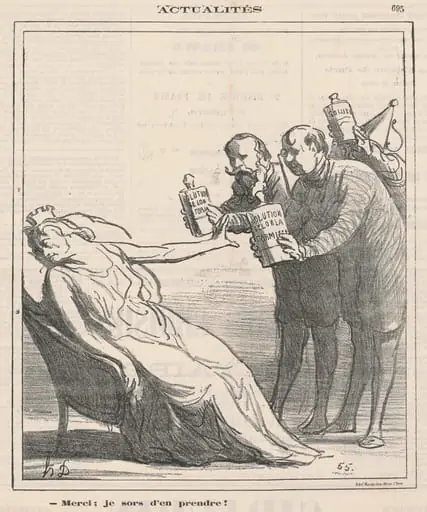
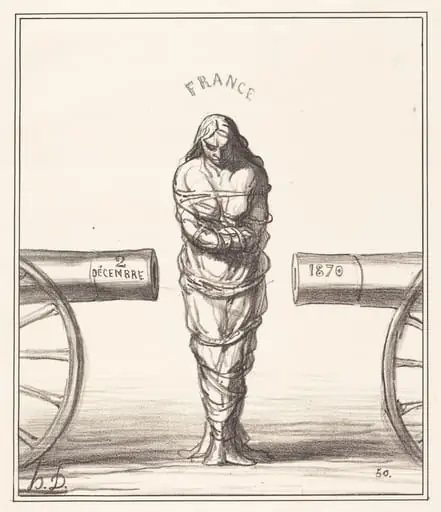
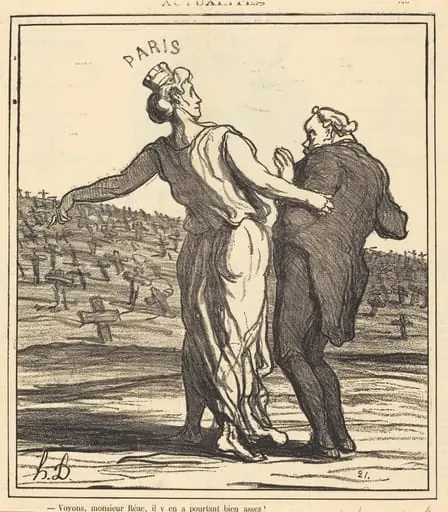
The scene depicts a woman standing beside a ballot box marked 'Urne Electorale,' with 'FRANCE' inscribed above her, suggesting national identity tied to civic participation. A man in a tricorn hat, likely a symbol of old regime authority, gestures dismissively with a stick. Her crossed arms and tense posture convey resistance or unease. The work critiques the marginalization of women in political processes, even as suffrage debates intensified in post-monarchical France.
Technique & Style
Daumier employed lithography for its capacity to produce rapid, expressive images suitable for periodical publication. His lines are economical yet forceful, using contrast and simplified forms to amplify emotional tension. Facial expressions and body language are exaggerated without caricature’s absurdity, grounding the satire in recognizable human behavior. The absence of background detail focuses attention on the psychological dynamic between the two figures.
History & Provenance
This print emerged during the final months of the Second French Empire, as public discontent grew ahead of the Franco-Prussian War and the fall of Napoleon III. Daumier had long been censored for his political cartoons, yet continued producing work for underground or liberal presses. Though the exact original publication is unconfirmed, the image aligns with his late-period themes of civic disillusionment and the fragility of democratic ideals.
Context
In 1870, France was on the brink of political upheaval. While universal male suffrage existed, women remained excluded from voting despite growing activism. Daumier’s depiction of a woman near a ballot box—yet barred from participation—reflects this contradiction. His imagery resonated with republican circles critical of both imperial overreach and the slow pace of social reform, using visual metaphor to highlight systemic exclusion.
Legacy
Daumier’s lithographs, including this one, influenced later generations of political illustrators and social realists. His ability to distill complex societal tensions into single, resonant images set a precedent for visual journalism. Though not widely exhibited in his lifetime, his prints gained recognition in the 20th century as foundational documents of modern political art, valued for their clarity and moral urgency.
Artist & collection

Artist
Honoré-Victorin Daumier was a French painter, sculptor, and printmaker, whose many works offer commentary on the social and political life in France, from the Revolution of 1830 to the fall of the Second French Empire in 1870.