Artwork
Moi, j'ai habitude de ne ... rien donner
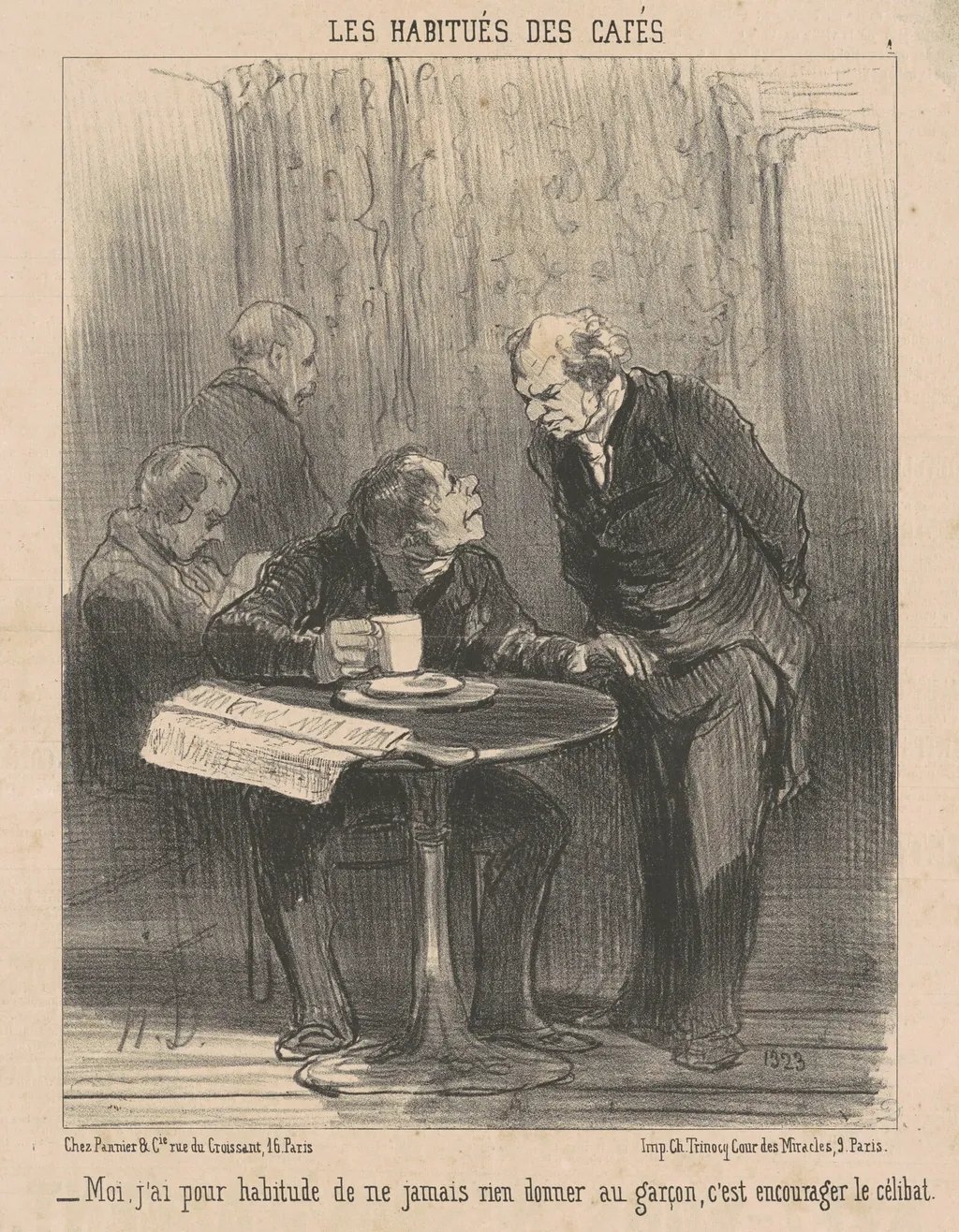
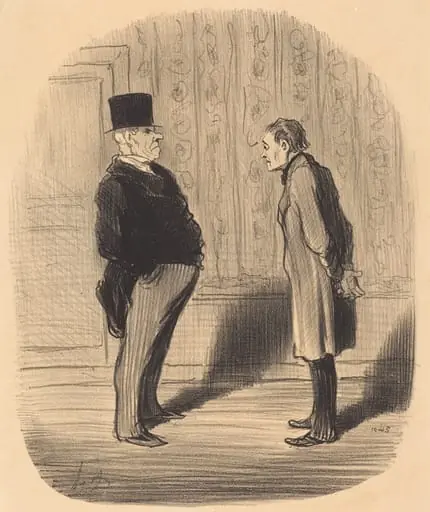
Moi, j'ai habitude de ne ... rien donner is an ink print by the Impressionist artist Honoré Daumier. It dates from 1851 and is held in the collection of the National Gallery of Art.
About this work
Overview
This lithograph by Honoré Daumier captures a quiet moment between two men in a Parisian café. One sits with a cup in hand, the other leans forward, engaged in conversation. The composition is intimate, focused on gesture and expression rather than setting. Daumier’s use of lithography allows for subtle tonal shifts that lend depth to the figures without elaborate detail.
Subject & Meaning
The scene portrays an unremarkable social exchange, yet the intensity of the leaning figure suggests urgency or persuasion. Daumier often depicted ordinary interactions to reveal underlying social tensions or human vulnerability. Here, the unspoken dynamics between the men reflect broader themes of communication, isolation, or transactional relationships in urban life.
Technique & Style
The textured washes behind the figures suggest ambient space without defining it, directing attention to the psychological interplay between the two men.
Daumier employed lithography to achieve a spontaneous, sketch-like quality. His lines are economical but precise, emphasizing facial structure and posture over background detail. The textured washes behind the figures suggest ambient space without defining it, directing attention to the psychological interplay between the two men. The medium’s immediacy aligns with his interest in capturing fleeting moments.
History & Provenance
Created during Daumier’s prolific period of social commentary in the mid-19th century, this work likely appeared in a periodical or as part of a series documenting Parisian life. It was not signed or dated, as was common with his journalistic prints. Its survival reflects its circulation among collectors and critics who valued his unvarnished portrayals of the bourgeoisie and working class.
Context
In 1830s–1870s Paris, lithography became a vital medium for mass-produced imagery, especially in newspapers and satirical journals. Daumier contributed regularly to publications like La Caricature and Le Charivari, where his images offered sharp, often critical observations of public behavior. This print fits within a broader body of work that documented the rhythms and rituals of urban society.
Legacy
Daumier’s focus on unidealized human interaction influenced later realist and modernist artists, including Degas and Toulouse-Lautrec. His ability to convey psychological nuance through minimal means set a precedent for narrative printmaking. Though not widely exhibited in his lifetime, his café scenes are now recognized as foundational to the depiction of modern life in 19th-century art.
Artist & collection

Artist
Honoré-Victorin Daumier was a French painter, sculptor, and printmaker, whose many works offer commentary on the social and political life in France, from the Revolution of 1830 to the fall of the Second French Empire in 1870.