Artwork
Entrée en classe du jeune Estancelin
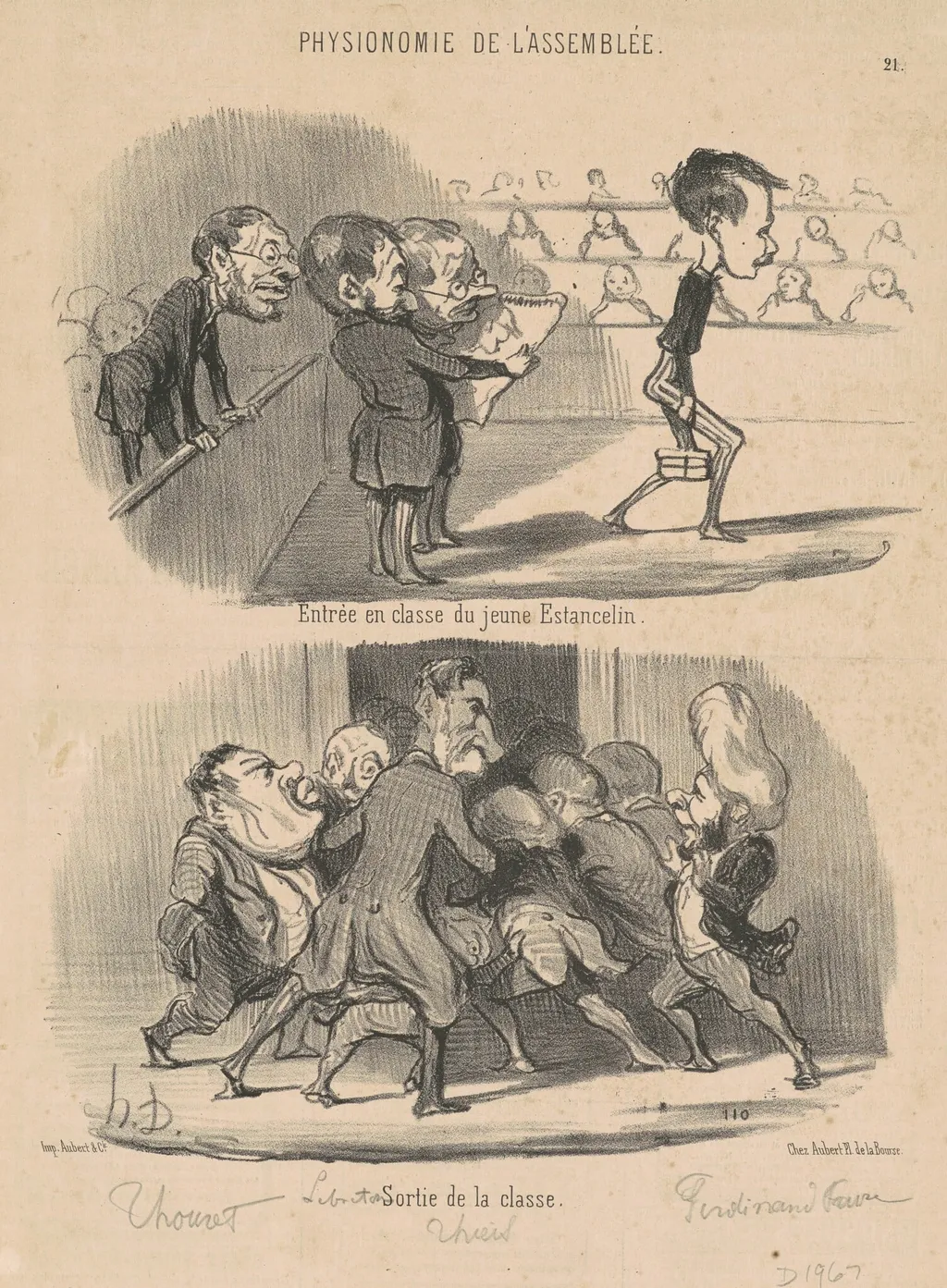
Entrée en classe du jeune Estancelin is an ink print by the Impressionist artist Honoré Daumier. It dates from 1850 and is held in the collection of the National Gallery of Art.
About this work
This one captures school in 1850 France—rows of hats, a single stern face.
A stiff little boy steps into a classroom under a teacher’s stern gaze. His stool is too small. Other kids crane their necks, some giggling. The room feels tight, like a play where roles are set.
Daumier liked poking fun at everyday life. Lithography let him print quick, sharp jokes in newspapers. This one captures school in 1850 France—rows of hats, a single stern face.
His lines look almost like doodles. See how he stacks heads and coats? Try sketching your own classroom scene.
Overview
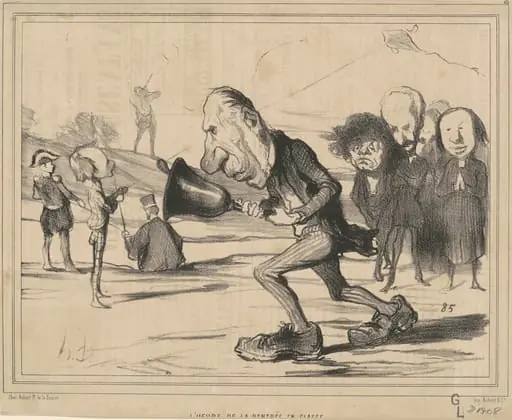
Honoré Daumier’s 1850 lithograph “Entrée en classe du jeune Estancelin” captures a moment of school life with a comic edge. The image shows a diminutive boy stepping into a classroom, his small stool undersized for him, while the teacher watches with a severe expression. Around him, classmates lean forward, some smiling, creating a bustling, cramped scene that reflects the everyday atmosphere of a French classroom in the mid‑nineteenth century.
Subject & Meaning
The work satirizes the rituals of education, emphasizing the awkwardness of the newcomer and the collective curiosity of his peers. By exaggerating the boy’s size and the cramped setting, Daumier highlights the social dynamics of conformity and observation that characterize school environments, while also poking gentle fun at the seriousness with which authority figures, such as the teacher, are portrayed.
Technique & Style
Executed in lithography, the print relies on bold, fluid lines that give the figures a sketch‑like immediacy. Daumier’s use of stark contrasts between dark outlines and lighter spaces accentuates facial expressions and the cramped interior. The rapid, almost spontaneous quality of the drawing reflects his practice of producing timely, newspaper‑ready illustrations that could be reproduced quickly for a broad audience.
History & Provenance
Created in 1850, the lithograph emerged during Daumier’s prolific period of social commentary, when he regularly contributed to satirical journals. Though originally intended for mass distribution, the print has since entered museum collections, illustrating the artist’s engagement with everyday French life and his role in shaping visual criticism of contemporary institutions.
Context
School scenes were a recurring motif in mid‑century French art, reflecting broader concerns about literacy, discipline, and social order. Daumier’s depiction aligns with the era’s interest in the public sphere, where institutions such as schools became sites for both instruction and subtle resistance, a theme that resonated with a readership familiar with the daily routines of urban life.
Legacy
The lithograph remains a reference point for later artists exploring institutional critique through humor. Its blend of caricature and social observation anticipates later graphic traditions, influencing both satirical illustration and the visual language of modern comic art, while continuing to serve as a document of 19th‑century French education.
Artist & collection

Artist
Honoré-Victorin Daumier was a French painter, sculptor, and printmaker, whose many works offer commentary on the social and political life in France, from the Revolution of 1830 to the fall of the Second French Empire in 1870.