Artwork
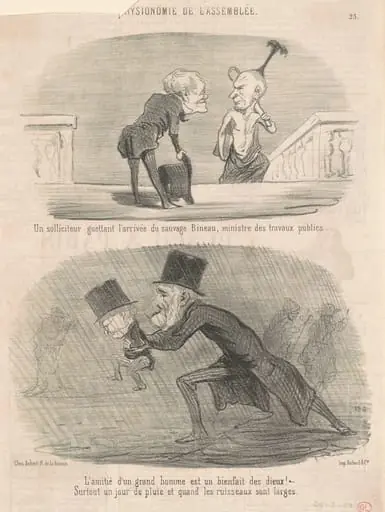
Le sauvage bineau faisant son entrée
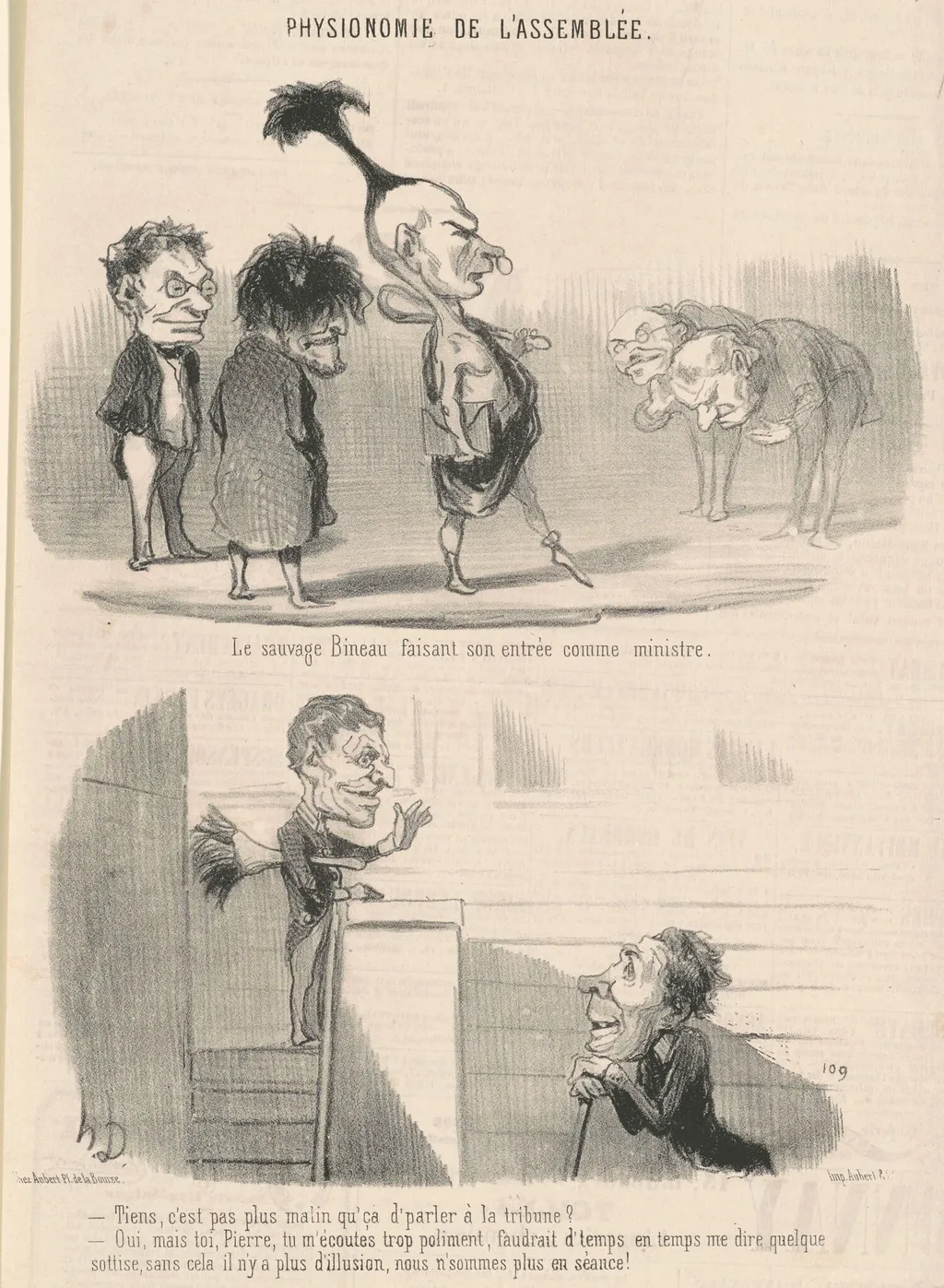
Le sauvage bineau faisant son entrée is an ink print by the Romanticist artist Honoré Daumier. It dates from 1849 and is held in the collection of the National Gallery of Art.
About this work
The others look extra serious or silly, with big noses and strange clothes.
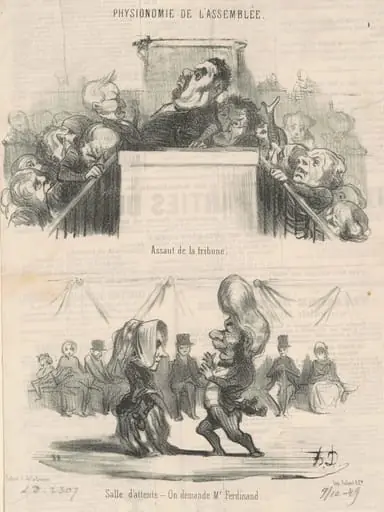
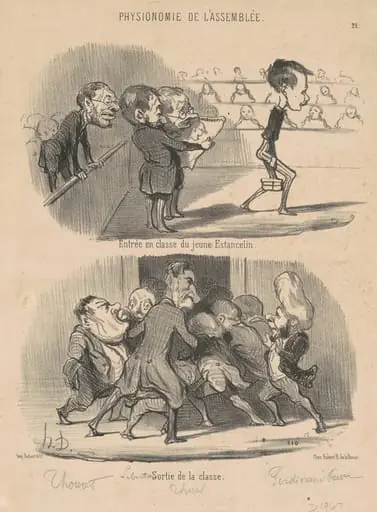
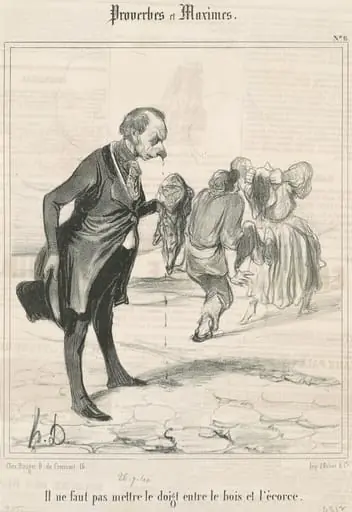
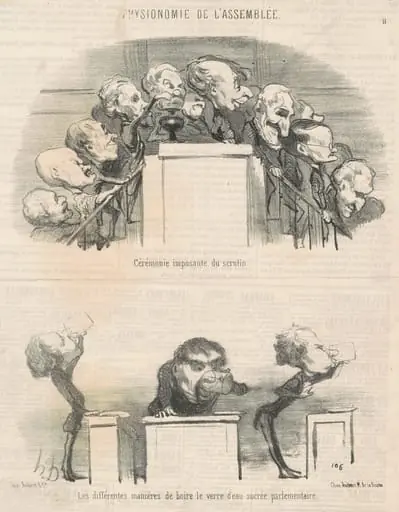
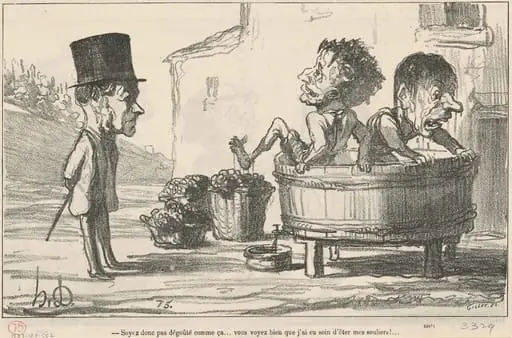
You see a crowd of five odd-looking men on a small stage. One man at a podium waves his arms like he’s giving a speech. The others look extra serious or silly, with big noses and strange clothes.
Daumier made this as a lithograph in 1849. He often mocked politicians and public figures in his work. This one feels like a joke about people who take themselves too seriously.
Want to see more like this? Look up Daumier, Honoré.
Overview
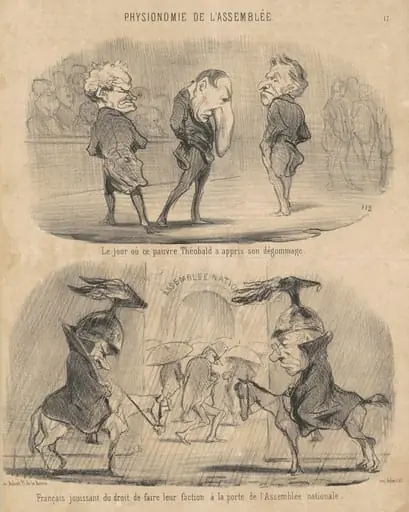
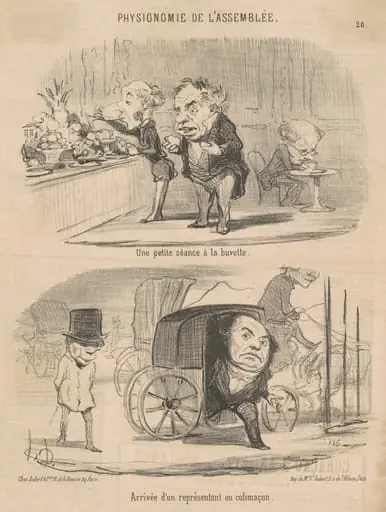
Created in 1849, this lithograph by Honoré Daumier captures a theatrical scene of five exaggerated male figures on a modest stage. Rendered in ink on paper, the work belongs to a series of satirical prints Daumier produced during the early years of the French Second Republic. Its composition centers on a speaker gesturing wildly, surrounded by solemn or absurd onlookers, reflecting the artist’s interest in public performance and social pretense.
Subject & Meaning
The figures represent a caricatured assembly, likely mocking political or civic figures who perform authority without substance. The central speaker, arms flailing at a podium, suggests empty rhetoric, while the others, with distorted features and stiff postures, embody gullibility or blind conformity. Daumier uses absurdity to critique the performative nature of public life, where appearance often replaces genuine leadership.
Technique & Style
Daumier employed lithography to achieve rapid, expressive lines and tonal contrasts, characteristic of his journalistic approach. The figures are rendered with minimal detail but maximal distortion—elongated limbs, oversized noses, and exaggerated gestures convey character through caricature. The flat stage and sparse background focus attention entirely on the absurdity of the group, enhancing the satirical effect without decorative distraction.
History & Provenance
Produced during a period of political instability in France, the print was likely published in a liberal periodical, as Daumier frequently contributed to journals like La Caricature and Le Charivari. Though the original publication context is unrecorded, the work survives as part of broader collections of Daumier’s graphic output, preserved in institutions such as the Musée d’Orsay and the Metropolitan Museum of Art.
Context
In post-1848 France, public discourse was saturated with political posturing and populist rhetoric. Daumier, a keen observer of urban life, used satire to expose the gap between official grandeur and human folly. This print aligns with his broader critique of institutions, mirroring public skepticism toward leaders who prioritized spectacle over substance during a time of democratic upheaval.
Legacy
Daumier’s lithographs, including this one, helped define modern political satire in visual art. His ability to distill complex social critiques into single, vivid images influenced generations of cartoonists and illustrators. Though created for ephemeral publication, these works endure as sharp, unflinching records of 19th-century public culture and its enduring absurdities.
Artist & collection
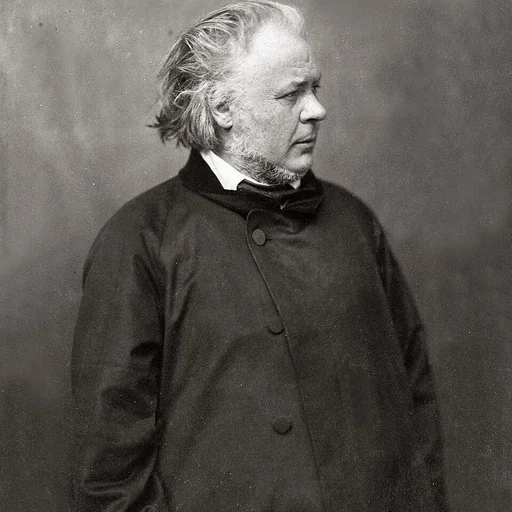
Artist
Honoré-Victorin Daumier was a French painter, sculptor, and printmaker, whose many works offer commentary on the social and political life in France, from the Revolution of 1830 to the fall of the Second French Empire in 1870.