Artwork
Excellent placement
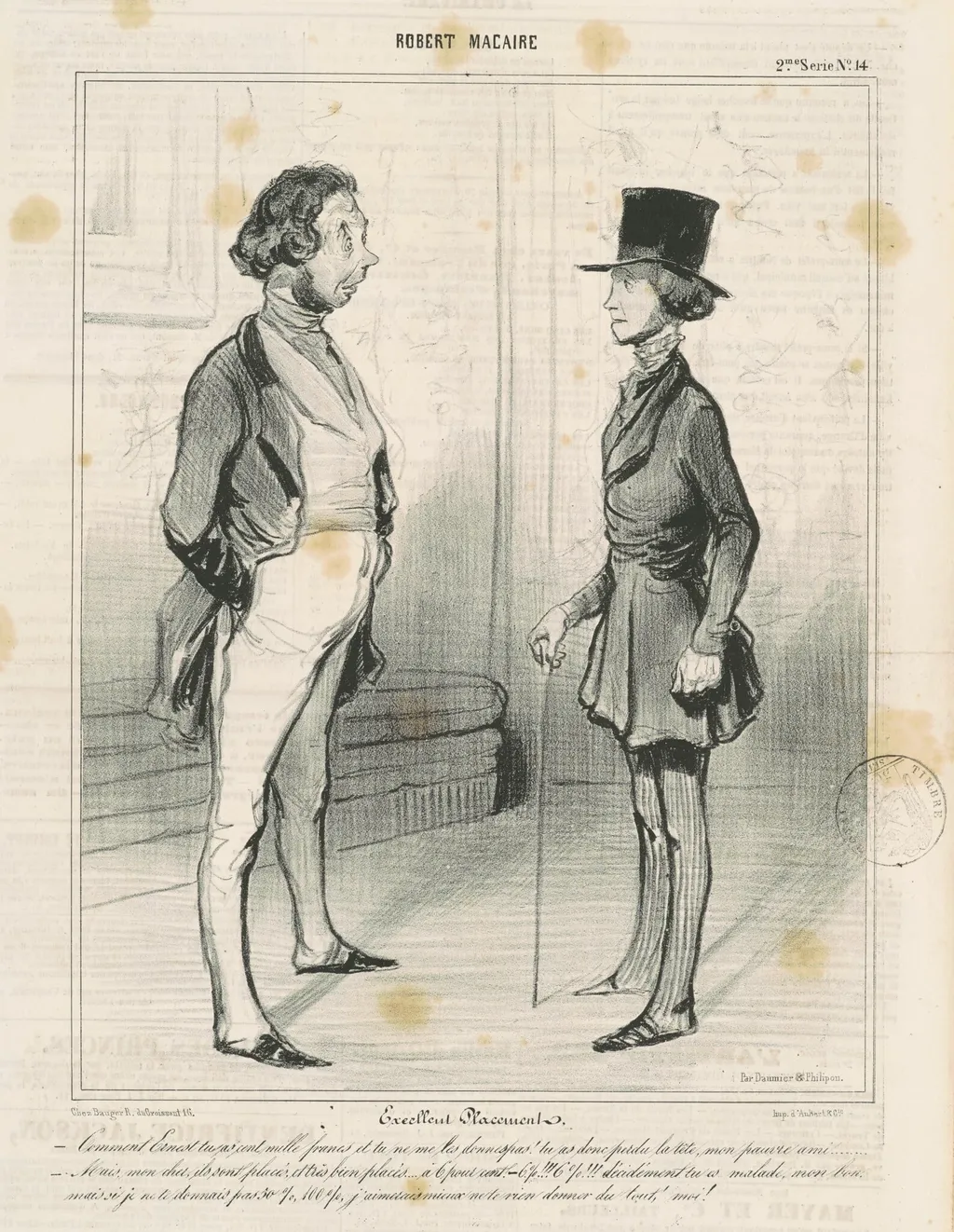
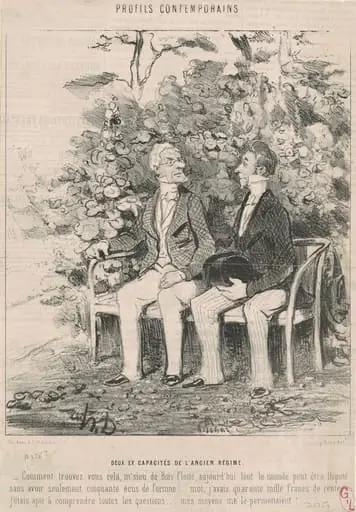
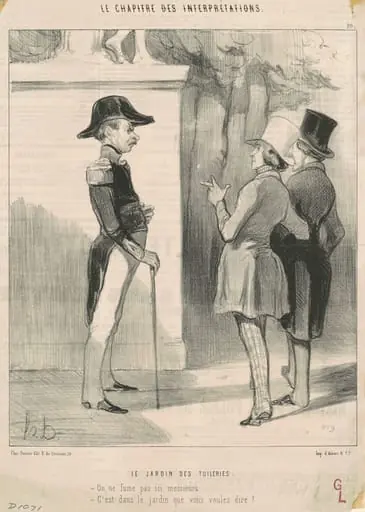
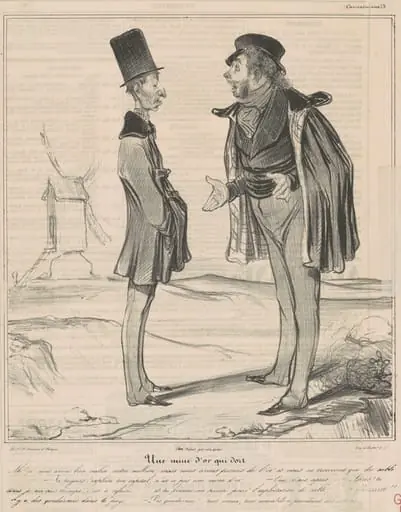
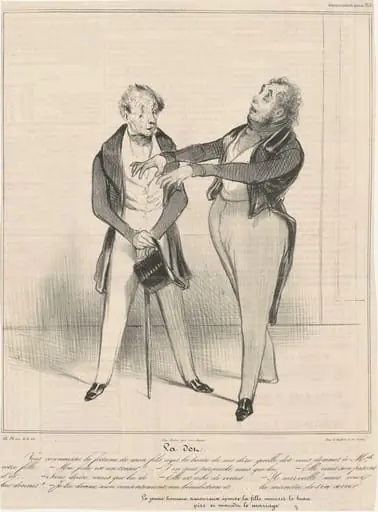
Excellent placement is an ink print by the Romanticist artist Honoré Daumier. It dates from 1841 and is held in the collection of the National Gallery of Art.
About this work
Overview
Created in 1841, 'Excellent Placement' is a lithograph by Honoré Daumier that captures a quiet, unspoken exchange between two men.
Created in 1841, 'Excellent Placement' is a lithograph by Honoré Daumier that captures a quiet, unspoken exchange between two men. Rendered in profile, the figures occupy a sparse composition, their interaction defined more by posture than setting. The work exemplifies Daumier’s interest in everyday social encounters, using minimal detail to suggest psychological tension. As a print, it was part of a broader effort to make visual commentary accessible beyond elite audiences.
Subject & Meaning
The two men face each other across an empty space, their body language revealing contrasting attitudes: one leans forward with apparent urgency, while the other remains rigid, arms folded in resistance. Their expressions are subtle but telling, suggesting a moment of social negotiation—perhaps a request, a rebuff, or an unspoken disagreement. Daumier avoids narrative clarity, instead inviting viewers to interpret the unspoken dynamics of class, authority, or personal boundaries.
Technique & Style
Daumier employed lithography, a process allowing him to draw directly on limestone with greasy crayon before transferring the image to paper. The lines are loose and fluid, resembling quick sketches, yet they convey precise emotional nuance. The absence of detailed backgrounds focuses attention on gesture and facial expression. The tonal range is restrained, relying on contrast and rhythm rather than shading to define form and mood.
History & Provenance
Produced during Daumier’s early career, this print emerged from his prolific output for satirical journals like 'La Caricature.' Though not part of a named series, it aligns with his broader project of documenting Parisian social life through observational sketches. Its survival as a standalone print suggests it was circulated among collectors or used as a standalone commentary, reflecting the growing market for lithographic art in mid-19th-century France.
Context
In the 1840s, France was undergoing political and social upheaval, and public discourse was increasingly shaped by visual satire. Daumier’s lithographs responded to this climate by portraying ordinary citizens with psychological depth, avoiding caricature in favor of quiet realism. 'Excellent Placement' reflects a shift from overt political satire toward nuanced depictions of interpersonal dynamics, mirroring broader cultural interests in human behavior and social etiquette.
Legacy
This work contributes to Daumier’s reputation as a pioneer of modern graphic art, influencing later artists who valued expressive line and psychological insight over ornamental detail. Its emphasis on unadorned human interaction anticipated 20th-century realist traditions in printmaking and illustration. Though not widely exhibited today, it remains a quiet testament to his ability to capture the subtleties of social life with economy and precision.
Artist & collection

Artist
Honoré-Victorin Daumier was a French painter, sculptor, and printmaker, whose many works offer commentary on the social and political life in France, from the Revolution of 1830 to the fall of the Second French Empire in 1870.