Artwork
Francois, votre cousin le pompier est venu ...
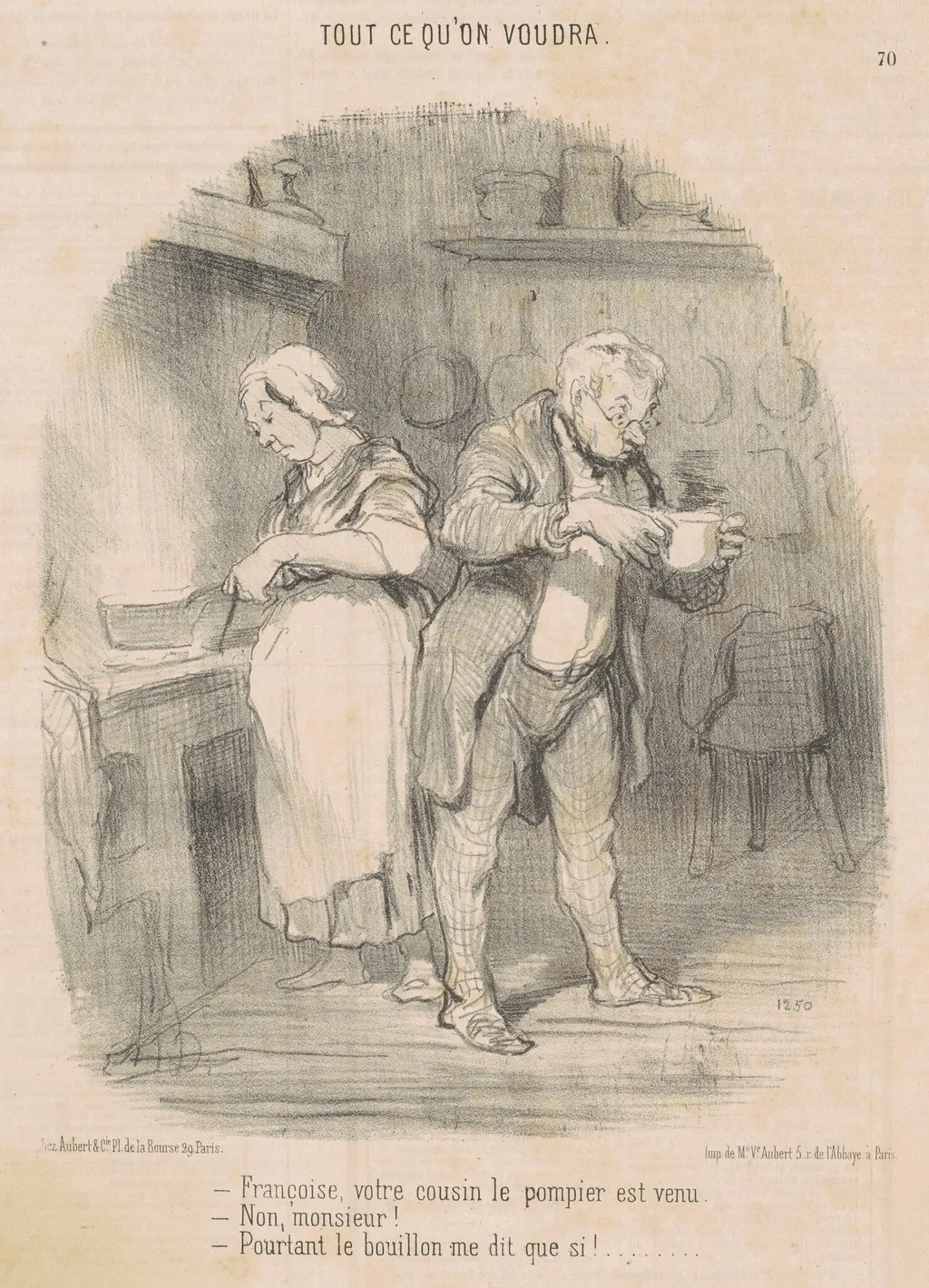
Francois, votre cousin le pompier est venu ... is an ink print by the Impressionist artist Honoré Daumier. It dates from 1851 and is held in the collection of the National Gallery of Art.
About this work
Daumier’s lithograph shows a man in glasses leaning against a kitchen wall. His arms are crossed. A woman stirs a pot at a table.
This isn’t just a quiet scene. It shows how people acted in 1851 France. Daumier often poked fun at society. Here, he highlights how men and women filled roles at home.
Look up Daumier, Honoré next.
Overview
Daumier’s choice of medium and subject reflects his interest in ordinary life, rendered with economy and subtle irony.
This lithograph by Honoré Daumier depicts a quiet interior scene in a French home, likely from the early 1850s. Two figures occupy the space: a woman engaged in domestic labor and a man standing passively against a wall. The composition avoids dramatic action, instead focusing on stillness and unspoken dynamics. Daumier’s choice of medium and subject reflects his interest in ordinary life, rendered with economy and subtle irony.
Subject & Meaning
The woman stirs a pot, embodying the expected domestic role of the period, while the man, spectacles on his nose and arms crossed, stands apart—physically and emotionally. His posture suggests detachment or introspection, contrasting with her active labor. The title, referencing a visiting firefighter, introduces an ironic distance: the man’s identity as a public servant does not translate into domestic engagement, hinting at broader social disconnections.
Technique & Style
Daumier employs lithography to achieve sharp, expressive lines with minimal detail. Forms are simplified, shadows are suggested through tonal contrasts rather than shading, and facial features are reduced to essential marks. The lack of ornamental background focuses attention on the figures’ postures and relationship. His style prioritizes psychological nuance over realism, using restraint to amplify the scene’s quiet tension.
History & Provenance
Created around 1851, the work emerged during a period of political instability in France, when Daumier frequently turned to domestic scenes to critique social norms without direct political commentary. As part of his broader output for illustrated journals, this print likely circulated among middle-class audiences. Its survival in museum collections reflects its recognition as a representative example of Daumier’s observational realism.
Context
In mid-19th century France, gender roles within the home were rigidly defined, with women managing household duties and men often occupying public or professional spheres. Daumier’s depiction subtly interrogates this division, portraying the man’s passivity not as weakness but as a product of social expectation. His work resonates with contemporary literary and artistic movements that examined the private lives of ordinary people.
Legacy
Daumier’s lithographs, including this one, helped redefine printmaking as a vehicle for social observation rather than mere illustration. His ability to convey complex human dynamics through minimal means influenced later realist and modernist artists. This piece endures not as a sentimental vignette but as a quiet, enduring record of how domestic space reflected societal structures in 19th-century France.
Artist & collection

Artist
Honoré-Victorin Daumier was a French painter, sculptor, and printmaker, whose many works offer commentary on the social and political life in France, from the Revolution of 1830 to the fall of the Second French Empire in 1870.









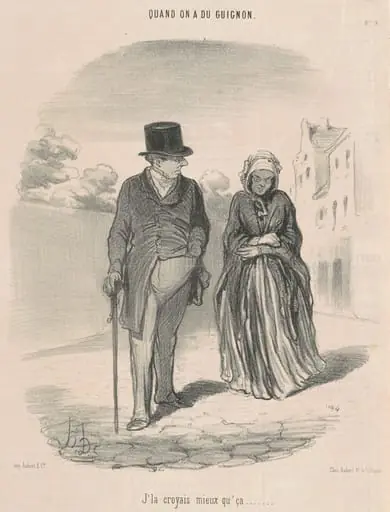 J'la croyais mieux qu'ça ...
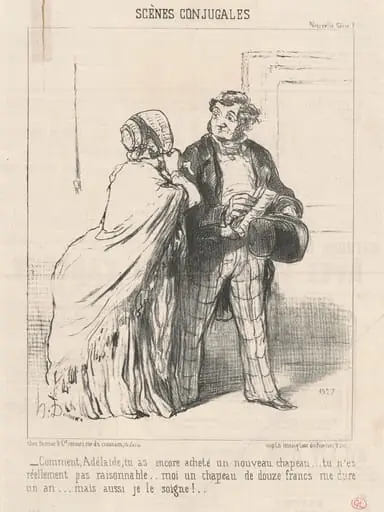 Comment ... tu as encore acheté un ... chapeau ...
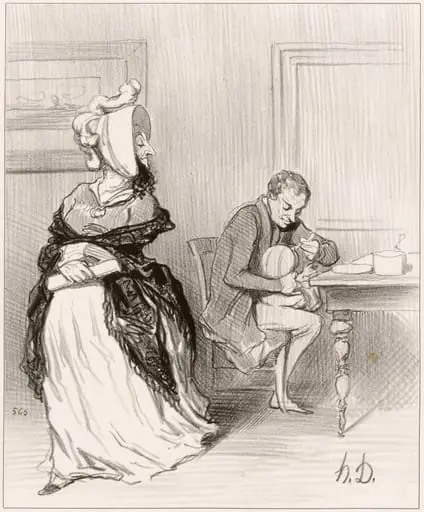 Adieu, mon cher, je vais chez mes éditeurs...
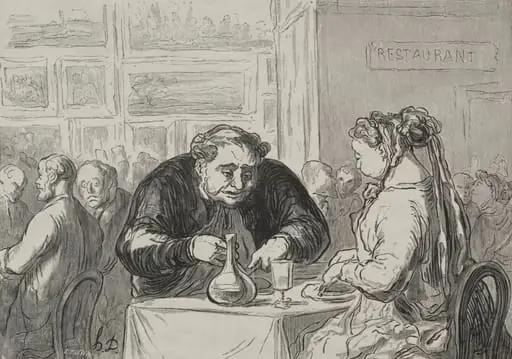 The Restaurant of the Great Art Exhibition: Love for the arts and the cutlet.
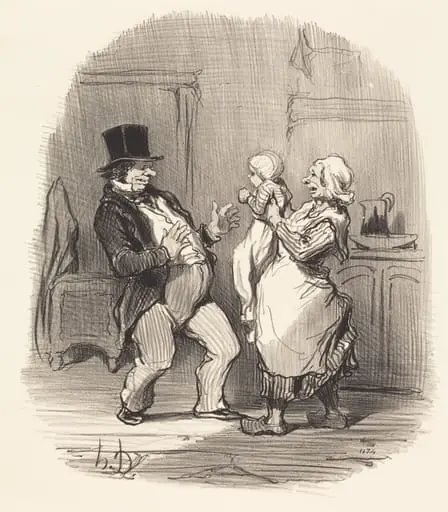 Ah! monsieur... faut pas lui rire comme ça...
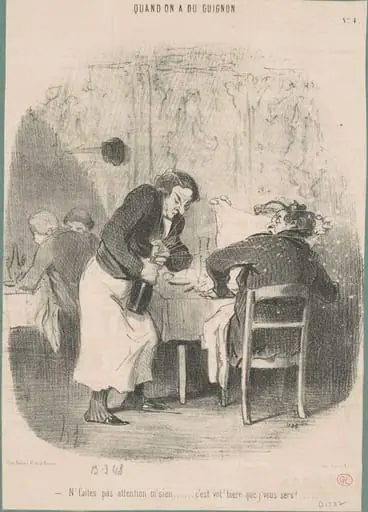 N'faites pas attention m'sieu ...
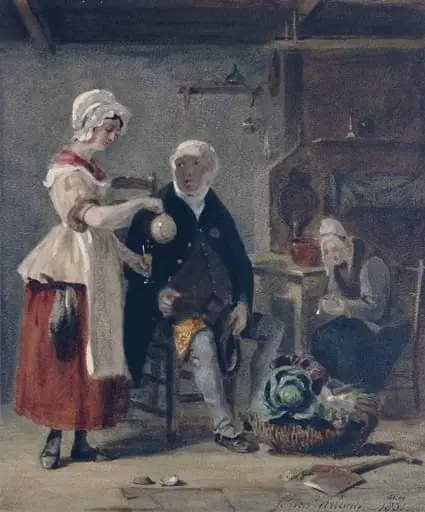 Rustic interior: figures of an old man and woman and a girl
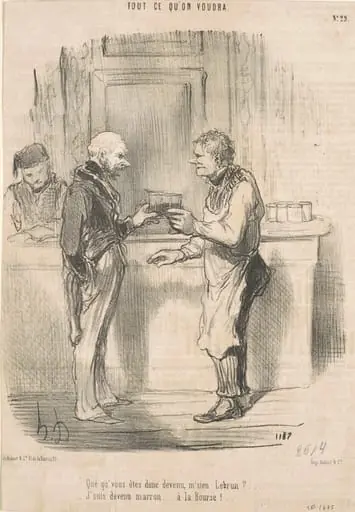 Qué qu'vous êtes ... devenu, m'sieu Lebrun? ...