Artwork
J'en aurais fait un boucher ...
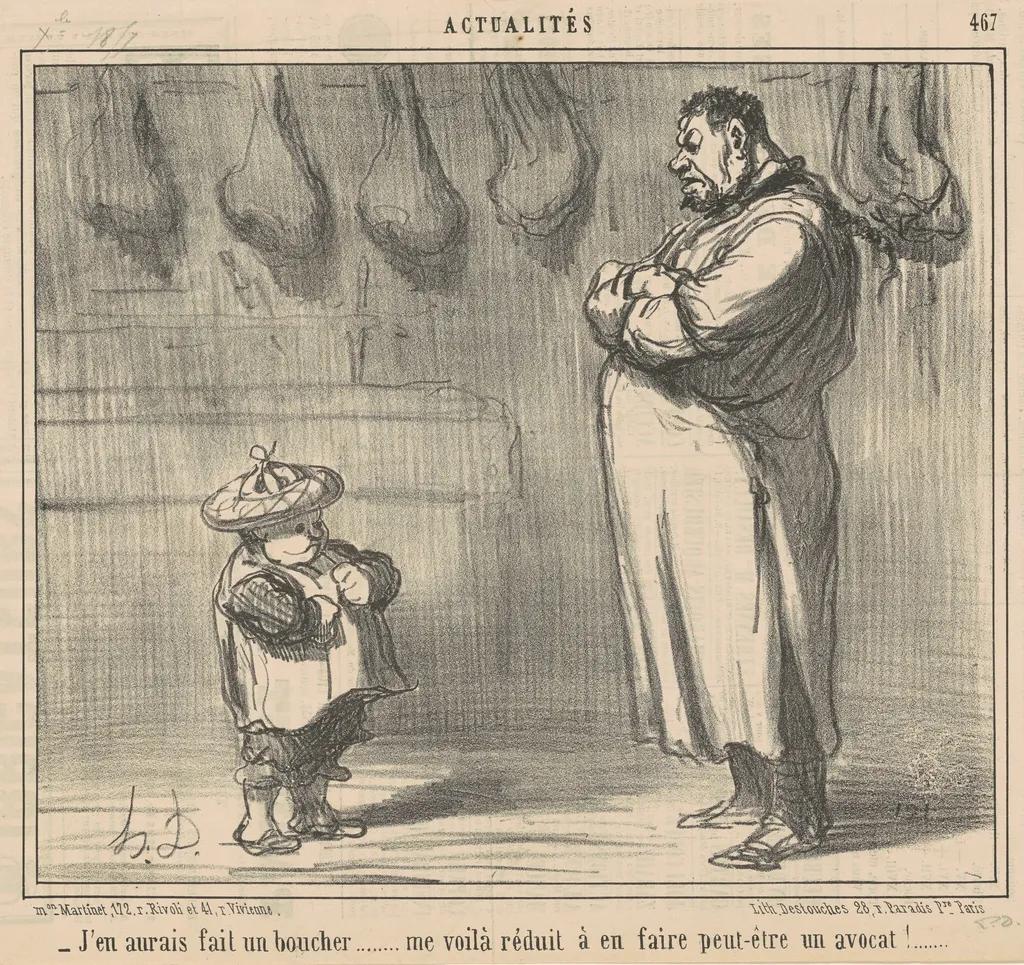
J'en aurais fait un boucher ... is an ink print by the Impressionist artist Honoré Daumier. It dates from 1857 and is held in the collection of the National Gallery of Art.
About this work
This 1857 lithograph shows a young man in everyday clothes facing a butcher in a bloodstained apron.
This 1857 lithograph shows a young man in everyday clothes facing a butcher in a bloodstained apron. The butcher holds a cleaver over a counter piled with meat. Daumier packs politics into this quiet scene.
Daumier used lithography to protest class divides. The sharp contrast between the two men mirrors his sharp views on labor and pay. His ink prints could spread fast, reaching more people than oil paintings.
Look up lithography to see how Daumier’s rough style gave his prints punch.
Overview
Created in 1857, this lithograph by Honoré Daumier presents a quiet but pointed encounter between two men: a working-class youth and a butcher. Rendered in monochrome ink, the scene unfolds against a wall of suspended meat, transforming a mundane market moment into a commentary on social hierarchy. Daumier’s choice of lithography allowed for wide distribution, making his critiques accessible beyond elite art circles.
Subject & Meaning
The young man, dressed plainly, observes the butcher, whose heavy apron is stained with blood and whose cleaver rests above a pile of carcasses. The contrast in their postures and attire suggests a silent judgment—perhaps on the brutality of labor or the moral cost of sustenance. Daumier implies that the butcher’s trade, though essential, carries a dehumanizing weight, while the observer represents the broader public’s complicity or indifference.
Technique & Style
Daumier employed lithography for its immediacy and reproducibility, using bold, gestural lines to convey texture and tension. His rough, expressive inkwork avoids refinement, emphasizing rawness over polish. The dense background of hanging meat is rendered with minimal detail yet maximum impact, creating a claustrophobic atmosphere that reinforces the scene’s thematic weight without overt symbolism.
History & Provenance
This print was produced during a period of heightened social unrest in France, when Daumier regularly contributed to satirical journals. It likely appeared in a periodical such as Le Charivari, where his images reached a broad urban readership. Unlike gallery-bound paintings, lithographs like this one circulated widely, functioning as visual journalism that challenged class assumptions through accessible imagery.
Context
In mid-19th-century Paris, the butcher’s trade symbolized both necessity and moral ambiguity. Daumier, himself from a modest background, often depicted laborers and tradespeople with unflinching honesty. The image reflects broader debates about industrialization, the dignity of work, and the invisible hierarchies embedded in everyday commerce, aligning with the realist movement’s focus on ordinary life.
Legacy
Daumier’s lithographs, including this one, helped redefine printmaking as a vehicle for social critique. His ability to distill complex class dynamics into a single, stark image influenced later generations of political illustrators and cartoonists. The work endures not for its aesthetic polish, but for its unvarnished observation of power, labor, and the quiet tensions of urban existence.
Artist & collection

Artist
Honoré-Victorin Daumier was a French painter, sculptor, and printmaker, whose many works offer commentary on the social and political life in France, from the Revolution of 1830 to the fall of the Second French Empire in 1870.