Artwork
Je vous en prie, rentrez dans votre boite...
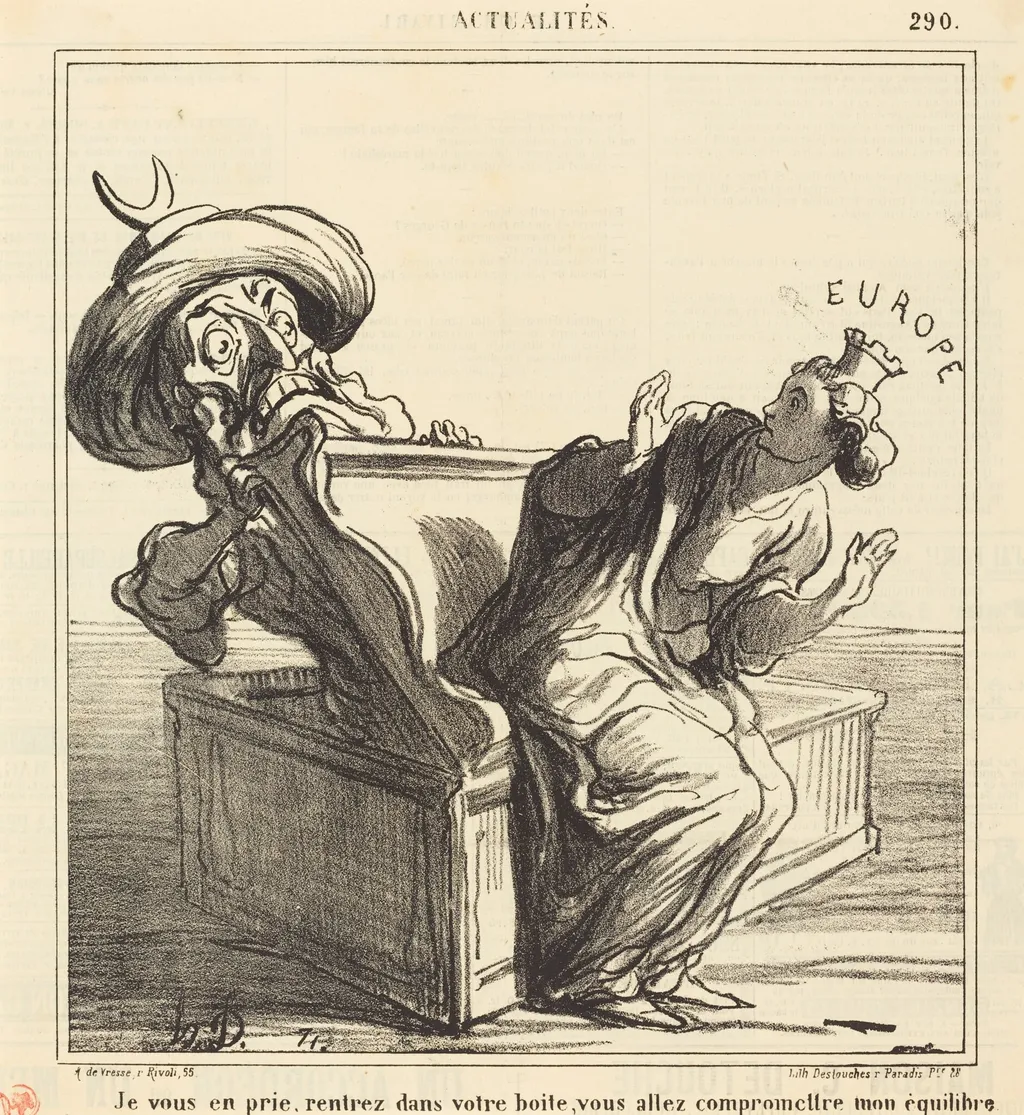
Je vous en prie, rentrez dans votre boite... is an ink print by the Impressionist artist Honoré Daumier. It dates from 1869 and is held in the collection of the National Gallery of Art.
About this work
Overview
The work targets the instability of European power structures during the waning years of the Second Empire, using humor to expose the fragility of authority.
Created in 1869, this lithograph on newsprint is one of many political satires by Honoré Daumier, produced for Parisian illustrated weeklies. It reflects his decades-long engagement with public discourse through accessible print media. The work targets the instability of European power structures during the waning years of the Second Empire, using humor to expose the fragility of authority. Its ephemeral material—newsprint—underscores its immediacy and intended public circulation.
Subject & Meaning
The image depicts two distorted figures: one slumped in a chair, clutching a crown, while another, wearing a box-shaped hat, looms over them. The title, 'I beg you, get back in your box,' mocks the notion of rulers confined by their roles. The label 'EUROPE' above suggests a broader commentary on the theatricality and absurdity of monarchical power across nations. The figures’ exaggerated postures imply collapse, not control, reducing sovereignty to farce.
Technique & Style
Daumier employed lithography on newsprint, a technique allowing rapid, low-cost reproduction for mass audiences. His line work is swift and economical, using minimal strokes to suggest form and motion. Figures are rendered with caricatural distortion—limbs elongated, proportions skewed—to emphasize absurdity. The lack of detail and tonal variation heightens the sense of chaos, reinforcing the satirical tone without relying on elaborate composition.
History & Provenance
The print emerged during a period of political tension in France, as Napoleon III’s regime faced growing dissent. Daumier, long associated with *Le Charivari*, had been producing political cartoons since the 1830s, often facing censorship. This piece was likely published in the late 1860s, when public skepticism toward monarchy intensified. Its survival in collections today reflects its historical resonance, though its original print run was intended for temporary, widespread distribution.
Context
Daumier’s work responded to the collapse of revolutionary ideals and the rise of authoritarian spectacle in mid-19th-century Europe. The image draws on contemporary caricature traditions, where rulers were depicted as clowns or puppets. The box-shaped hat may reference both confinement and the artificiality of titles. In an era of rising literacy and illustrated press, such images shaped public perception of power beyond formal political discourse.
Legacy
Daumier’s prints influenced later generations of political illustrators and cartoonists by demonstrating how visual satire could critique authority with clarity and wit. Though created for daily newspapers, his works gained enduring recognition for their psychological insight and formal economy. This lithograph remains a touchstone for understanding how art can distill complex political anxieties into a single, resonant image.
Artist & collection

Artist
Honoré-Victorin Daumier was a French painter, sculptor, and printmaker, whose many works offer commentary on the social and political life in France, from the Revolution of 1830 to the fall of the Second French Empire in 1870.









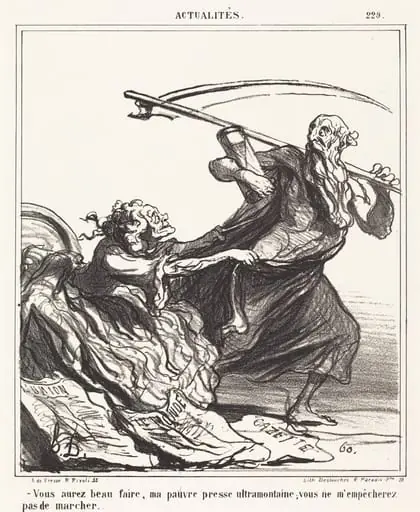 Vous aurez beau faire, ma pauvre presse...
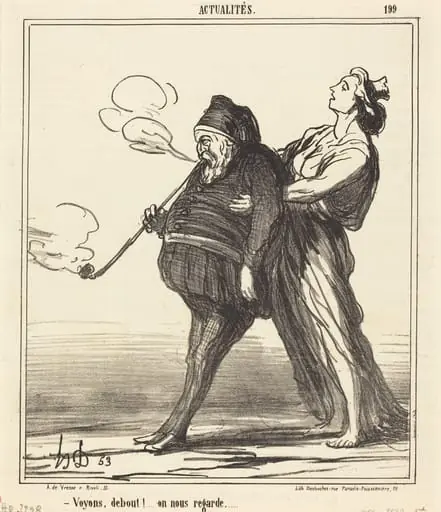 Voyons!... debout, on nous regarde
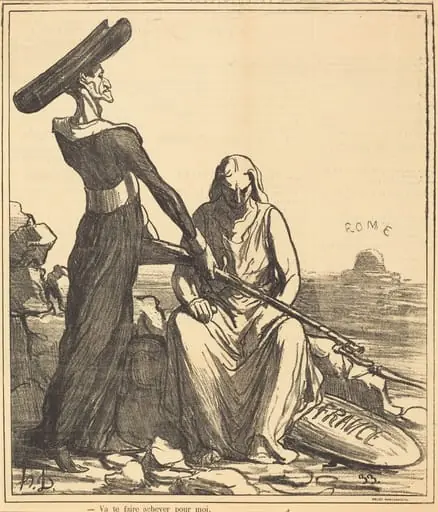 Va te faire achever pour moi
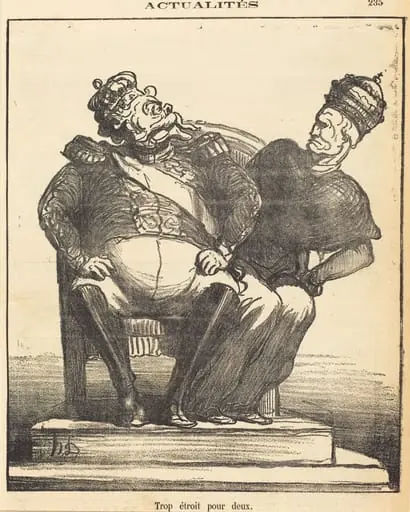 Trop étroit pour deux
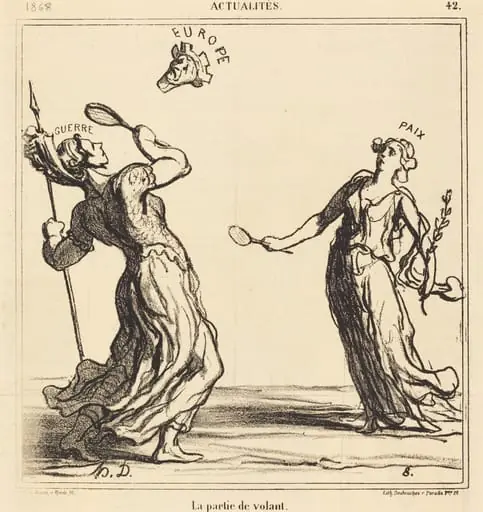 La Partie de volant
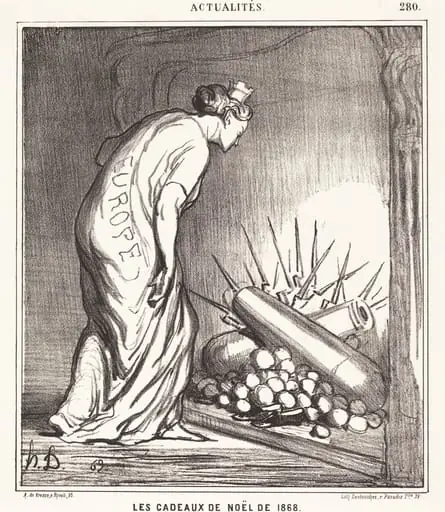 Les Cadeaux de Noël de 1868
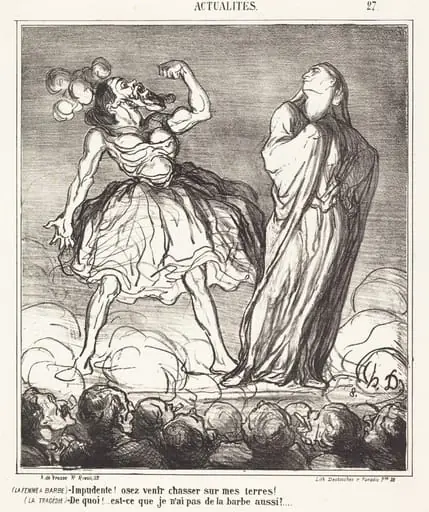 La Femme a barbe
 Par suite de la maladie de la vigne
 Une rencontre de jouyeauz augures
 Croyez-moi! prenez mon bras...
 Attendez... il faut encore ceci...
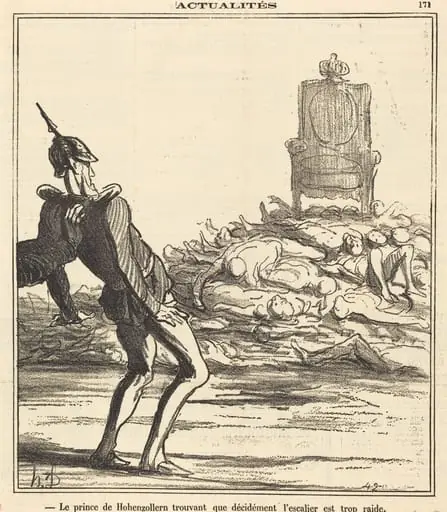 Le Prince de Hohenzollern...