Artwork
Va te faire achever pour moi
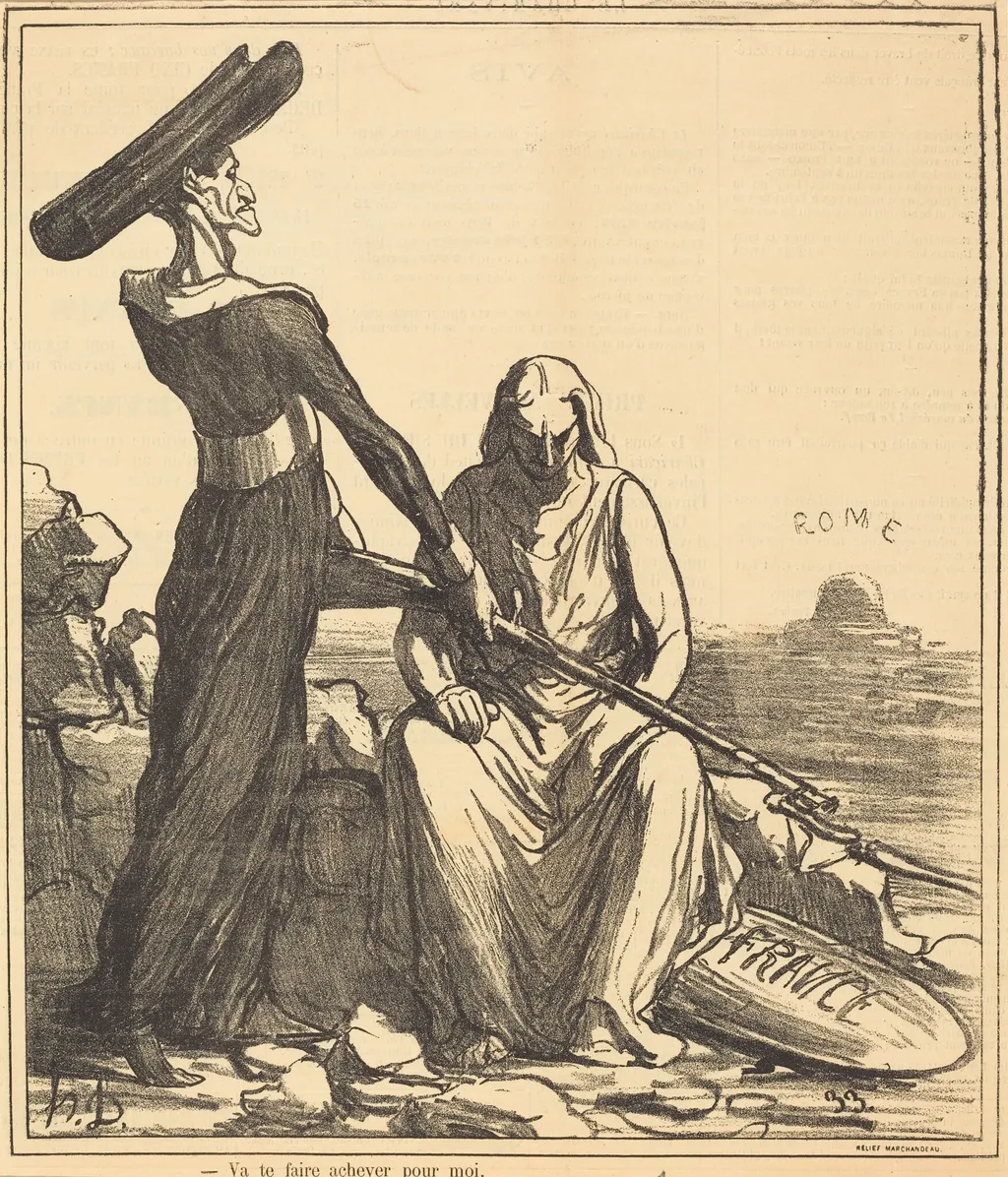
Va te faire achever pour moi is a print by the Impressionist artist Honoré Daumier. It dates from 1871 and is held in the collection of the National Gallery of Art.
About this work
Overview
Executed during the turbulent aftermath of the Paris Commune, the work exemplifies Daumier’s commitment to printmaking as a vehicle for social commentary.
Created in 1871, this gillotype on newsprint by Honoré Daumier captures a moment of confrontation between two figures in a barren landscape. Executed during the turbulent aftermath of the Paris Commune, the work exemplifies Daumier’s commitment to printmaking as a vehicle for social commentary. Its rough, immediate quality reflects the urgency of its message and the limitations of mass-produced illustration at the time.
Subject & Meaning
The image depicts a standing figure, armed with a club-like staff, confronting a seated individual in a tattered robe who offers a hand in supplication. The tension between aggression and surrender suggests a power imbalance, possibly alluding to state violence or the betrayal of revolutionary ideals. The distant boat and monument hint at escape or memory, adding layers of ambiguity to the scene’s political subtext.
Technique & Style
Daumier used the gillotype process to achieve bold, fluid lines and stark contrasts on inexpensive newsprint. His minimal shading and expressive contours emphasize emotional intensity over detail. The rough texture of the paper and the immediacy of the brushwork lend the image a raw, almost journalistic quality, reinforcing its role as a swift, unfiltered critique of contemporary events.
History & Provenance
Produced in the wake of the Franco-Prussian War and the suppression of the Paris Commune, the print emerged during a period of intense political repression. Daumier, long censored for his caricatures in *Le Charivari*, had ceased regular publication by this time but continued producing private works. This piece likely circulated among republican circles, preserving his voice amid state-sanctioned silence.
Context
Daumier’s career spanned decades of French political instability, from the July Monarchy to the Third Republic. His prints often targeted the hypocrisy of authority figures, using satire to expose injustice. By 1871, with the monarchy long gone and revolutionary hopes crushed, his imagery grew darker—less comedic, more somber—reflecting a society grappling with disillusionment and loss.
Legacy
Though not widely exhibited in his lifetime, Daumier’s prints gained recognition in the 20th century as foundational to modern social realism. His ability to distill complex political tensions into visceral, human moments influenced generations of illustrators and graphic artists. This work stands as a quiet testament to the enduring power of the printed image as a tool of dissent.
Artist & collection

Artist
Honoré-Victorin Daumier was a French painter, sculptor, and printmaker, whose many works offer commentary on the social and political life in France, from the Revolution of 1830 to the fall of the Second French Empire in 1870.









 Voyons, monsieur Réac...
 Belle dame voulez-vous ... accepter mon bras?
 Par suite de la maladie de la vigne
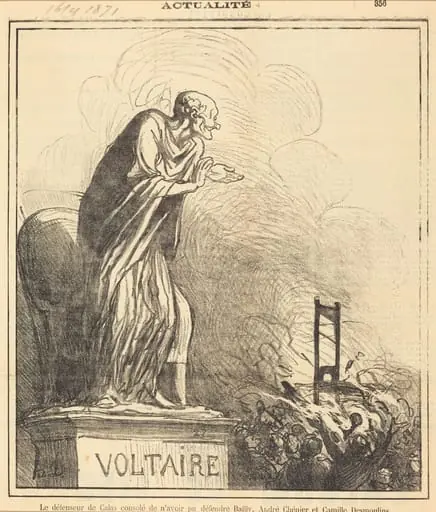 Le défenseur de Calas consolé...
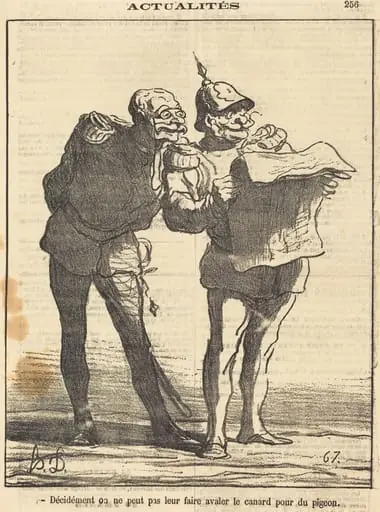 Décidément on ne peut pas...
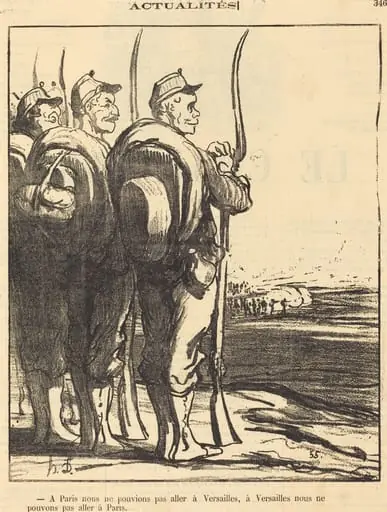 A Paris nous ne pouvions... aller a Versailles...
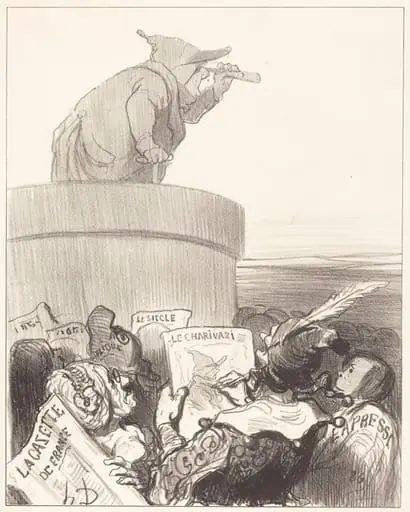 Le Constitutionnel contemplant l'horizon politique
 Eh bien! Mon brave anglais ...
 Ou Venise commence a espérer
 Croyez-moi! prenez mon bras...