Artwork
L'idéal de certains journaux
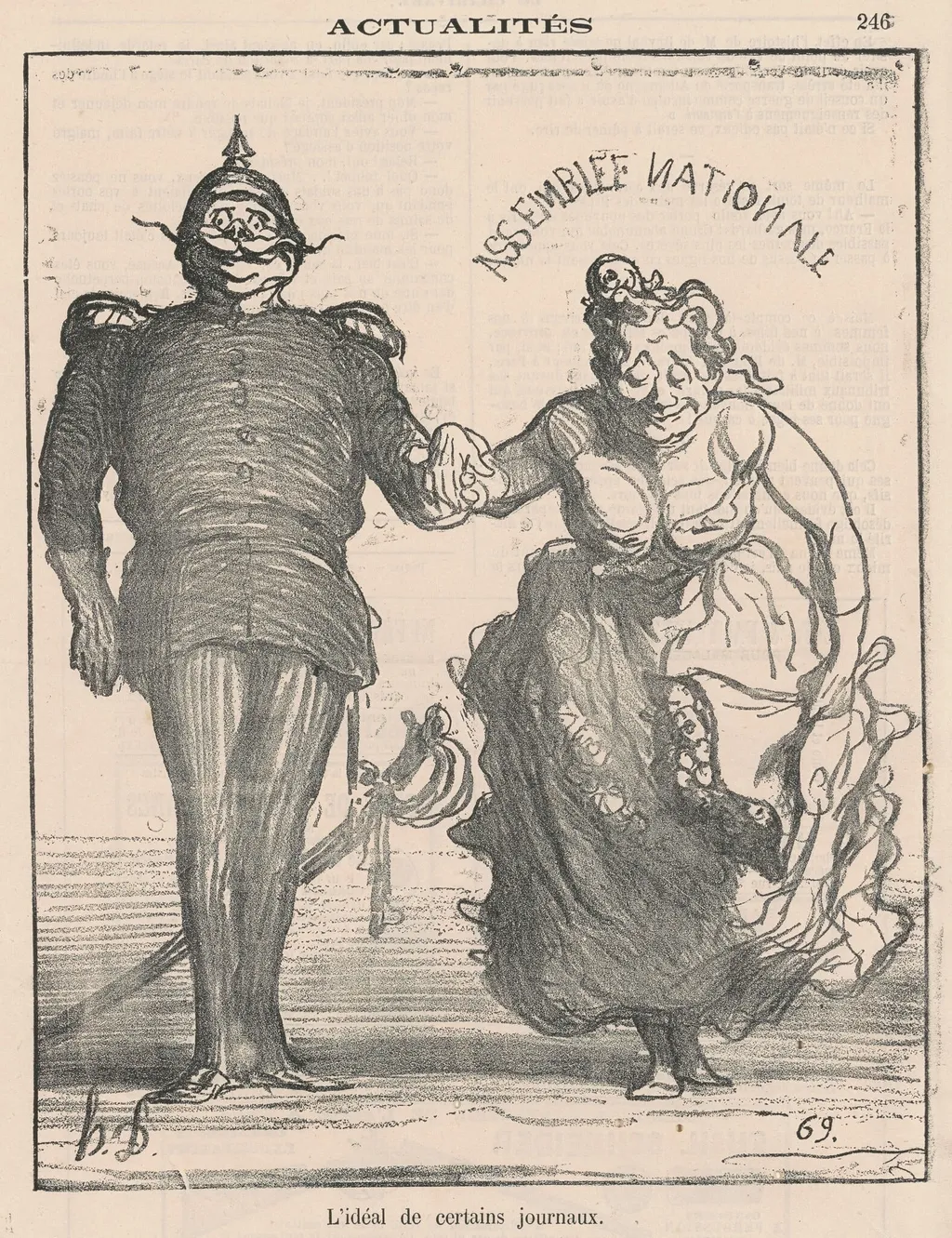
L'idéal de certains journaux is an ink print by the Impressionist artist Honoré Daumier. It dates from 1870 and is held in the collection of the National Gallery of Art.
About this work
Daumier’s sharp lines turn their partnership into a joke about power and press.
This lithograph shows a soldier and a draped woman linked arm-in-arm. The woman’s head wears a skull like a hat, and a newspaper lies at their feet. Daumier’s sharp lines turn their partnership into a joke about power and press.
He made this in 1870 to mock how papers twist facts. Newspapers often pushed flashy lies back then. The skull isn’t just decoration—it’s his way of saying “look closer.”
See how the ink blurs on the paper? That’s a sign of lithography, a fast print method. Try Daumier, Honoré next.
Overview
Honoré Daumier’s lithograph *L’idéal de certains journaux* presents a soldier and a draped female figure whose arms are linked. The woman wears a skull as a headdress, and a newspaper rests at their feet. Rendered in stark black lines, the composition juxtaposes military authority with a macabre emblem, inviting a satirical reading of contemporary media.
Subject & Meaning
The entwined figures suggest a partnership that is both intimate and absurd, hinting at the collusion between power and the press. The skull atop the woman’s head functions as a visual pun, urging viewers to consider the mortality of truth under sensationalist reporting. Daumier’s title, referencing “the ideal of certain newspapers,” reinforces the critique of journalistic distortion.
Technique & Style
Executed as a lithograph in 1870, the work displays Daumier’s characteristic bold line work and economical use of ink. The medium’s capacity for rapid reproduction suits the piece’s commentary on mass‑produced news. Slight smudging of the ink along the edges reflects the lithographic process, while the exaggerated proportions heighten the caricatural tone.
History & Provenance
Created amid the Franco‑Prussian War, the print was produced at a time when French newspapers were notorious for sensationalism. Daumier, known for his political caricatures, likely distributed the image through his own workshop or via contemporary print sellers. The work later entered public collections, illustrating his enduring engagement with media criticism.
Context
The 1870s in France were marked by political upheaval and the rise of a press eager to shape public opinion. Daumier’s lithograph responds to this climate, employing satire to expose the manipulation of facts. By pairing a soldier—a symbol of state authority—with a newspaper, the artist comments on how information serves as a tool of power.
Artist & collection

Artist
Honoré-Victorin Daumier was a French painter, sculptor, and printmaker, whose many works offer commentary on the social and political life in France, from the Revolution of 1830 to the fall of the Second French Empire in 1870.