Artwork
La partie de saute-mouton
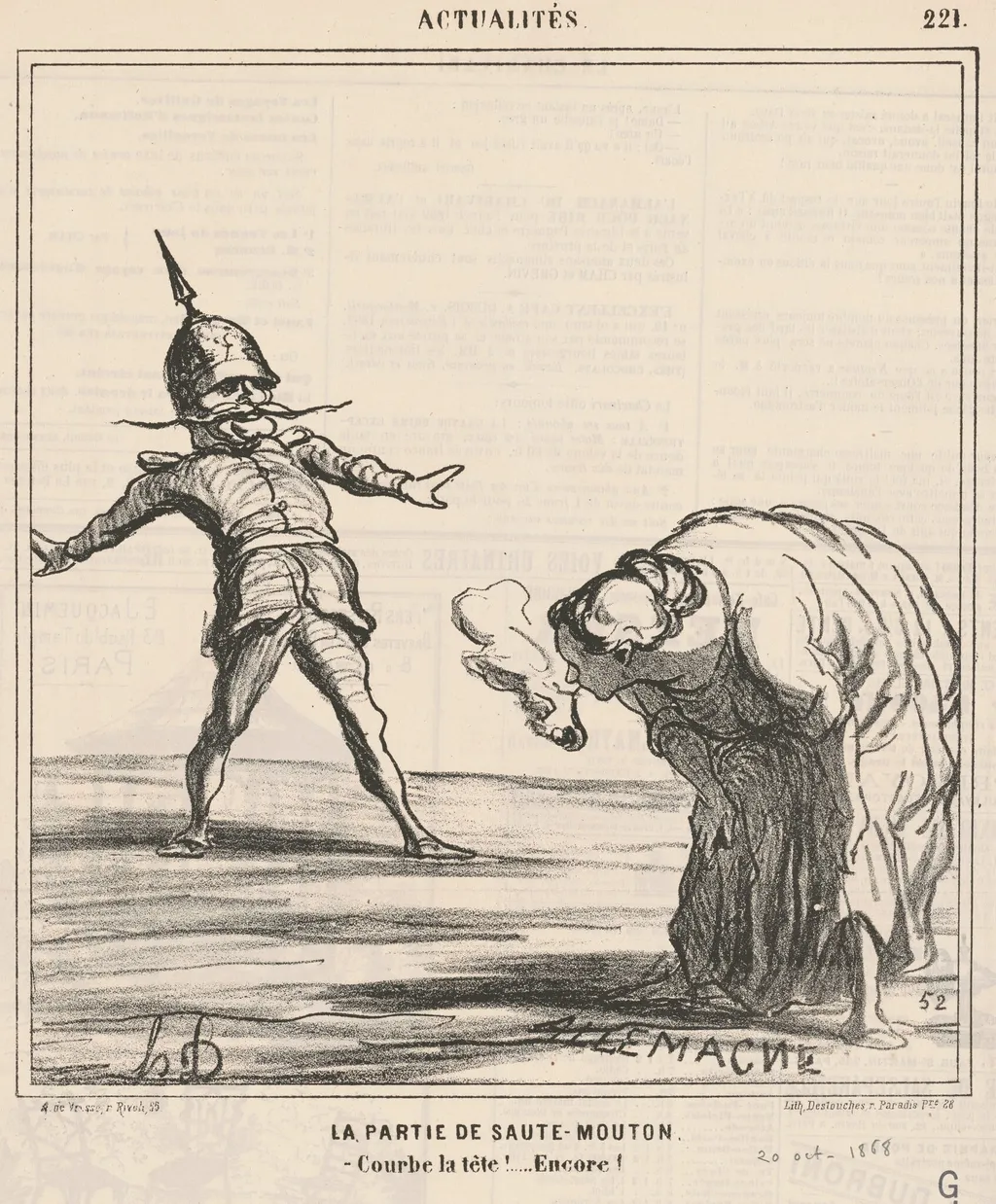
La partie de saute-mouton is an ink print by the Impressionist artist Honoré Daumier. It dates from 1868 and is held in the collection of the National Gallery of Art.
About this work
Overview
Honoré Daumier’s 1868 lithograph titled La partie de saute-mouton presents a brief, comic tableau in which an armored soldier and a loosely draped figure are caught in a exaggerated leap‑frog pose. The image is rendered in bold, decisive lines that heighten the sense of movement and absurdity, while a caption above the scene references a playful ‘game.’
Subject & Meaning
The work juxtaposes a rigid, militaristic presence with a fluid, civilian form, creating a visual tension that hints at a critique of the relationship between armed authority and everyday life. By casting the encounter as a farcical game, Daumier invites viewers to question the seriousness of military power and its interaction with the public sphere.
Technique & Style
Executed as a lithograph, the piece relies on strong, black contours and stark contrasts typical of Daumier’s printmaking. The medium allowed for rapid production and wide distribution, and the artist’s caricatural exaggeration—particularly in the soldier’s stiff armor and the figure’s billowing drapery—underscores the satirical tone.
History & Provenance
Created in the late 1860s, a period marked by political upheaval in France, the print was part of Daumier’s broader series of socially critical works. Lithographs such as this were sold cheaply, making them accessible to a broad audience and reinforcing the artist’s reputation as a commentator on contemporary affairs.
Context
During the 1860s, France experienced frequent clashes between the military and civilian populations, especially in the wake of the Second Empire’s authoritarian policies. Daumier’s choice to depict a mock ‘leap‑frog’ game reflects the era’s satirical tradition of using humor to expose the absurdities of power structures.
Legacy
La partie de saute-mouton exemplifies Daumier’s skill in turning everyday scenes into pointed social commentary. The lithograph remains a reference point for studies of 19th‑century French political satire and the role of inexpensive print media in shaping public opinion.
Artist & collection

Artist
Honoré-Victorin Daumier was a French painter, sculptor, and printmaker, whose many works offer commentary on the social and political life in France, from the Revolution of 1830 to the fall of the Second French Empire in 1870.