Artwork
La tête branlante
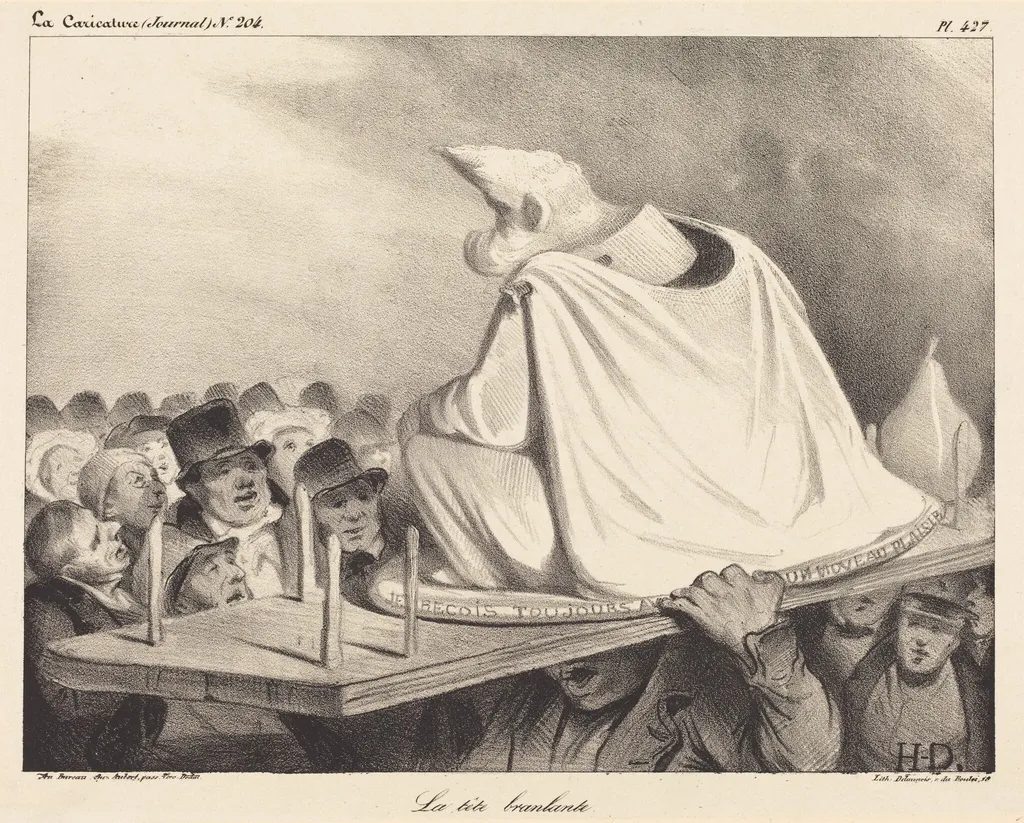
La tête branlante is an ink print by the Romanticist artist Honoré Daumier. It dates from 1834 and is held in the collection of the National Gallery of Art.
About this work
Overview
Created in 1834, *La tête branlante* is a lithographic print by Honoré Daumier. The work belongs to the artist’s extensive series of satirical images that critiqued French public life in the early nineteenth century. Executed for the popular press, the print combines a crowded street scene with a central, exaggerated figure to convey a pointed commentary on contemporary instability.
Subject & Meaning
At the heart of the composition stands a woman in an elaborate white dress and hat, her arm raised in a dramatic gesture.
At the heart of the composition stands a woman in an elaborate white dress and hat, her arm raised in a dramatic gesture. Below her a banner bears the phrase “RECOIS TOUJOURS,” inviting continual reception. The surrounding crowd leans over a railing, their faces a mixture of surprise and confusion, suggesting a collective reaction to the woman’s proclamation and hinting at the fickle nature of public opinion.
Technique & Style
Daumier employed the lithographic process, drawing directly onto a stone surface with greasy crayon before transferring the image to paper. The lines are swift and sketchy, a hallmark of the period’s political cartoons, which imparts a sense of immediacy and urgency. This loose handling emphasizes the chaotic atmosphere of the scene while retaining enough detail to identify individual expressions.
History & Provenance
The print emerged during Daumier’s prolific period of publishing caricatures in journals such as *La Caricature* and *Le Charivari*. While the exact original newspaper issue is not documented, the work circulated widely in the satirical press of the 1830s, reaching a broad readership that recognized its commentary on contemporary political and social turbulence.
Context
The early 1830s in France were marked by the aftermath of the July Revolution and ongoing debates over governance. Daumier’s prints often targeted the instability of political leaders and the hypocrisy of public discourse. *La tête branlante* reflects this climate, using the image of a wobbling head as a visual metaphor for the precariousness of authority and public sentiment.
Legacy
Although less frequently reproduced than Daumier’s later caricatures, this lithograph exemplifies his early engagement with mass‑media satire. It demonstrates how the artist harnessed the reproducibility of lithography to disseminate social critique, a practice that would influence subsequent generations of cartoonists and political illustrators.
Artist & collection
Artist
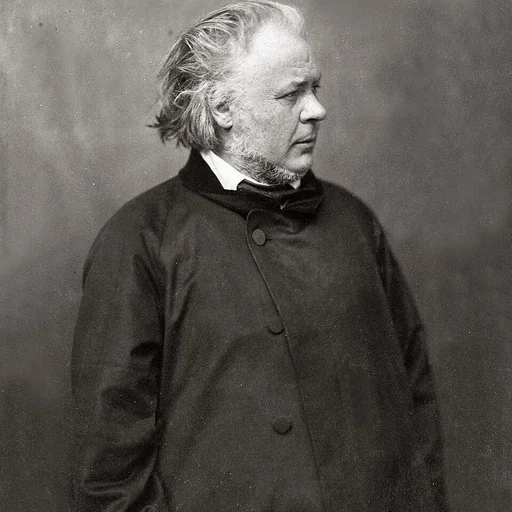
Honoré-Victorin Daumier was a French painter, sculptor, and printmaker, whose many works offer commentary on the social and political life in France, from the Revolution of 1830 to the fall of the Second French Empire in 1870.

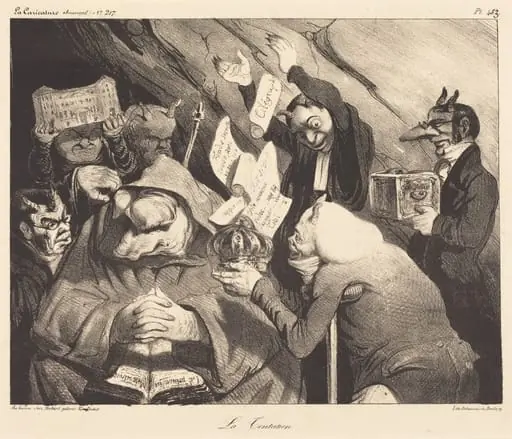 La Tentation, parodie d'une toile de Téniers
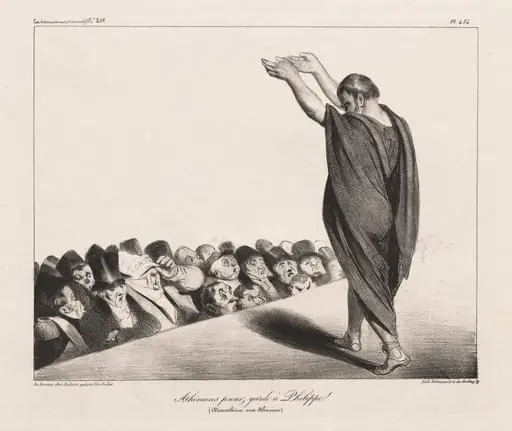 Athenians Beware of Phillip! (Demosthenes to the Athenians)
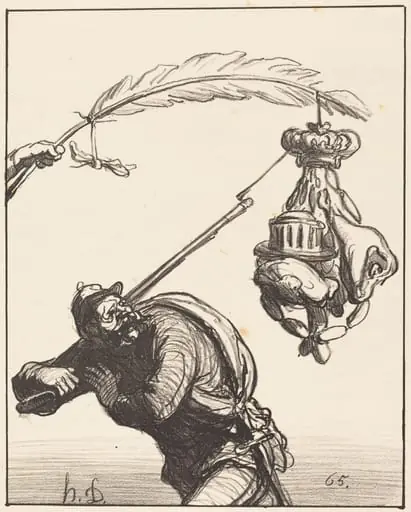 La paix a tout prix
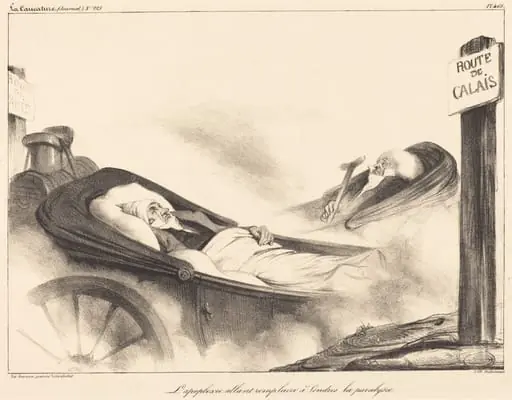 L'Apoplexie allant remplacer a Londres la paralysie
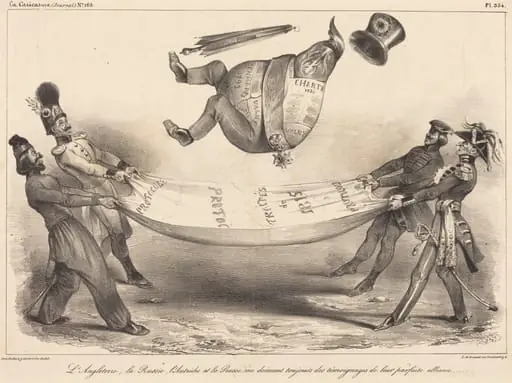 L'Angleterre, la Russie, l'Autriche...leur parfaite alliance
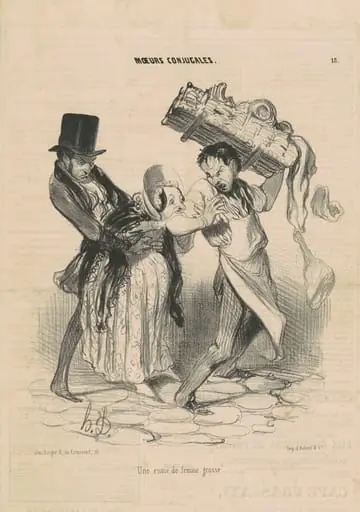 Une envie de femme grosse
 Adoration des Mages
 Ce char marchera toujours...
 Un Matamore portant une... botte...
 Le Constitutionnel contemplant l'horizon politique
 Résurrection de don Carlo...
 Promenade du Boeuf gras