Artwork
Les burgraves allant en guerre
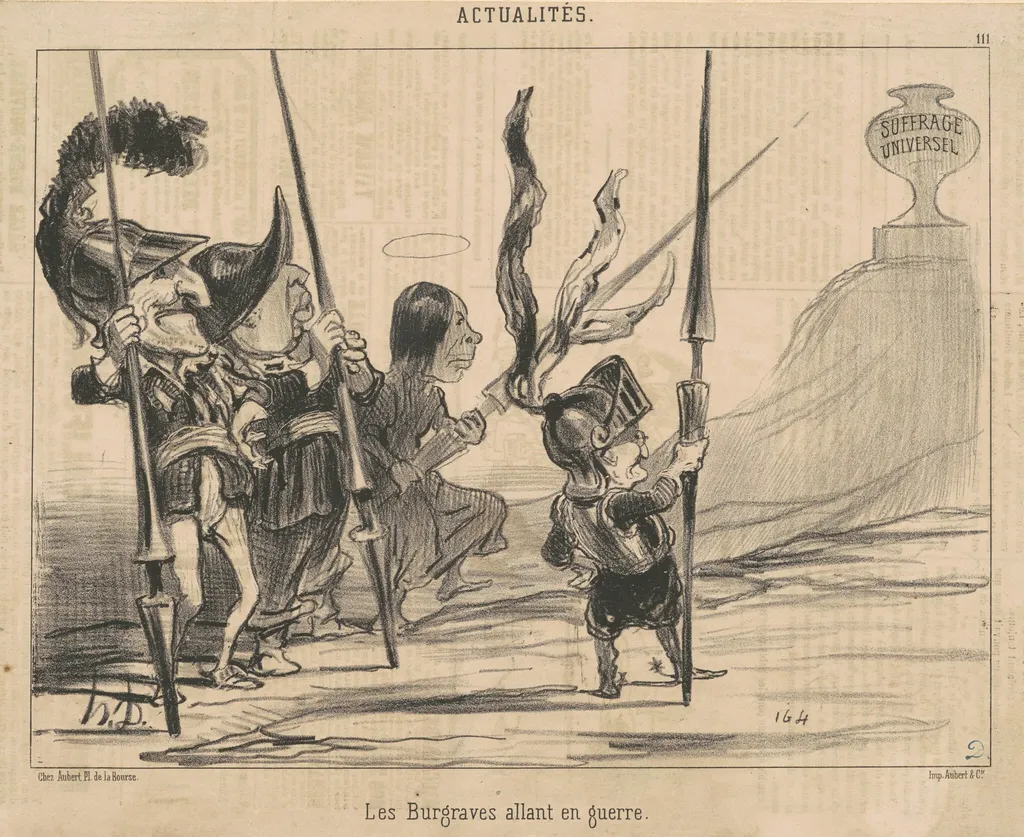
Les burgraves allant en guerre is an ink print by the Impressionist artist Honoré Daumier. It dates from 1850 and is held in the collection of the National Gallery of Art.
About this work
This lithograph shows cartoonish soldiers marching toward a big sign that says "Suffrage Universel." Their bodies look squat and wobbly, like puppets.
Daumier printed this in Paris in 1850. He used lithography—ink on stone—to make quick, sharp jokes about politics. The soldiers look silly, but the message is serious: voting rights shouldn’t be a joke.
If you like this style, try Daumier, Honoré.
Overview
Honoré Daumier’s lithograph titled *Les burgraves allant en guerre* presents a procession of exaggerated, almost puppet‑like soldiers moving toward a prominent banner that reads “Suffrage Universel.” The composition balances a light‑hearted visual tone with a pointed political observation, using caricature to draw attention to the contemporary debate over universal voting rights.
Subject & Meaning
The marching figures, rendered with distorted, squat bodies, serve as a visual satire of military pomp applied to a civic cause. By directing the troops toward the slogan for universal suffrage, Daumier juxtaposes the seriousness of political reform with the absurdity of its militaristic portrayal, suggesting that the struggle for voting rights should not be treated as a farcical campaign.
Technique & Style
Executed in lithography, the work was produced by drawing directly onto a limestone surface with greasy ink, allowing Daumier to achieve crisp lines and rapid reproduction. The style relies on bold contouring and exaggerated anatomy, hallmarks of his satirical prints, while the stark contrast between dark figures and the white background heightens the immediacy of the commentary.
History & Provenance
Printed in Paris in 1850, the lithograph emerged during a period of intense political agitation in France following the 1848 revolutions. Daumier, known for his prolific output of socially engaged prints, circulated the image among the burgeoning press and public exhibitions, where it was collected by contemporaries interested in political caricature.
Context
The image reflects the broader mid‑nineteenth‑century French discourse on expanding the electorate after the establishment of the Second Republic. Universal suffrage was a contentious issue, and Daumée’s work captures the tension between revolutionary enthusiasm and the skeptical, sometimes mocking, attitudes of the press toward the feasibility of such reforms.
Artist & collection

Artist
Honoré-Victorin Daumier was a French painter, sculptor, and printmaker, whose many works offer commentary on the social and political life in France, from the Revolution of 1830 to the fall of the Second French Empire in 1870.









![Mac-Adam [sic] et Bineau aux enfers. Par suite d'une punition terrible, mais méritée, ils sont condamnés à repaver les Champs Elysées., by Honoré Daumier](https://artifactworldgallery.com/img/honore-daumier--mac-adam-sic-et-bineau-aux-enfers-par-suite-d-une-punition-t--172799d6f631077a-w320.webp)