Artwork
Papa ... viens donc voir ce qui est ...
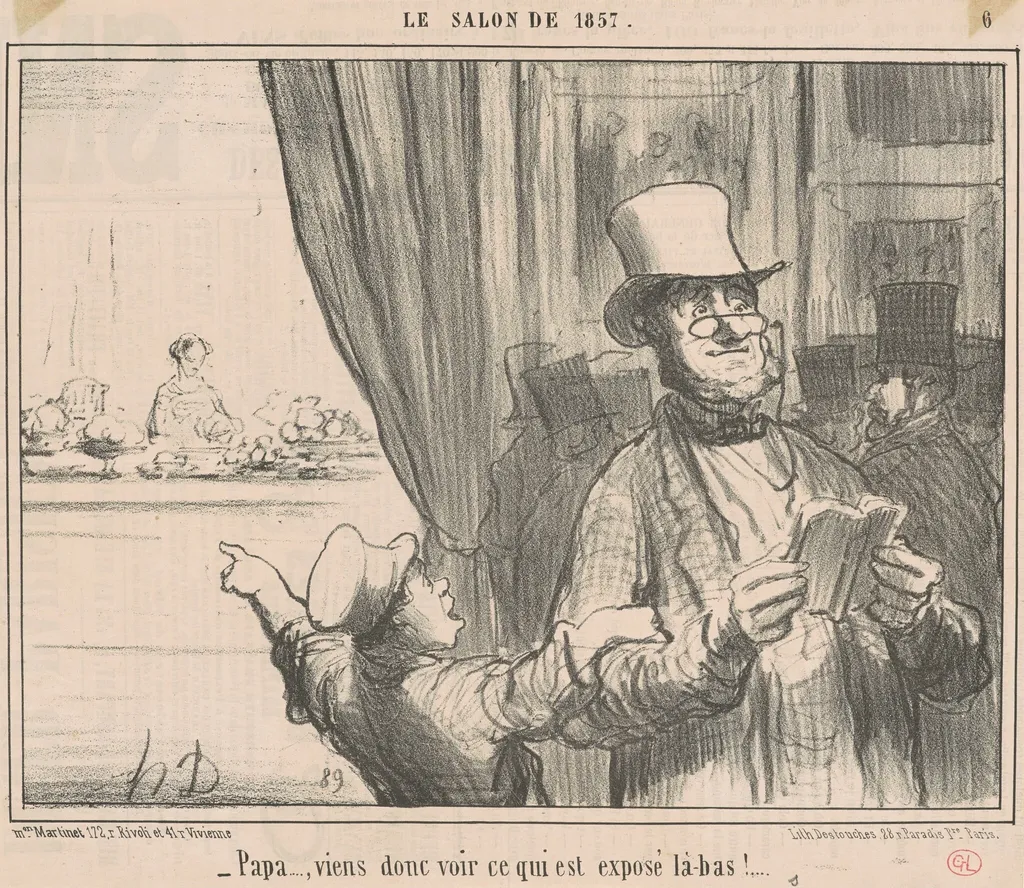
Papa ... viens donc voir ce qui est ... is an ink print by the Impressionist artist Honoré Daumier. It dates from 1857 and is held in the collection of the National Gallery of Art.
About this work
Overview
This lithograph by Honoré Daumier captures a quiet, intimate moment between a man and a boy in what appears to be an art exhibition. The scene is rendered with minimal detail, focusing on posture and gesture rather than elaborate surroundings. The title, spoken in French, suggests the boy is calling his father to observe something noteworthy, framing the image as a moment of shared discovery.
Subject & Meaning
The composition centers on the boy’s pointing gesture, which directs attention outward, beyond the frame, implying an object of interest unseen by the viewer.
The composition centers on the boy’s pointing gesture, which directs attention outward, beyond the frame, implying an object of interest unseen by the viewer. The man, holding an open book and wearing a top hat, stands passively, suggesting a role as observer or guide rather than active instructor. The image reflects themes of generational transmission—how cultural awareness is passed informally through everyday encounters.
Technique & Style
Daumier employed lithography to achieve a spontaneous, sketch-like quality. The lines are loose and expressive, with tonal contrasts created through ink washes rather than fine detail. This technique allowed rapid production and aligned with his journalistic approach, prioritizing immediacy and emotional resonance over polished finish. The lack of background detail focuses attention on the figures and their interaction.
History & Provenance
Created in the mid-19th century, this work emerged during Daumier’s prolific period producing social commentary through prints. It was likely published in a periodical, as were many of his lithographs, reaching a broad middle-class audience. Its survival as a standalone print suggests later recognition of its quiet humanism, though it was never part of a major series or exhibition during his lifetime.
Context
During the 1850s–60s, public art exhibitions in France became increasingly accessible, reflecting broader societal shifts toward cultural democratization. Daumier frequently depicted middle-class life, including scenes of leisure and education. This image aligns with his interest in ordinary moments of social interaction, subtly critiquing or affirming the emerging bourgeois engagement with art.
Legacy
Though not among Daumier’s most famous works, this lithograph endures as a gentle example of his ability to convey complex social dynamics through minimal means. It influenced later artists interested in candid, everyday scenes and remains a reference point for studies of 19th-century visual culture and the role of art in familial education.
Artist & collection

Artist
Honoré-Victorin Daumier was a French painter, sculptor, and printmaker, whose many works offer commentary on the social and political life in France, from the Revolution of 1830 to the fall of the Second French Empire in 1870.