Artwork
Perdu, monsieur... perdu sur tous les points...
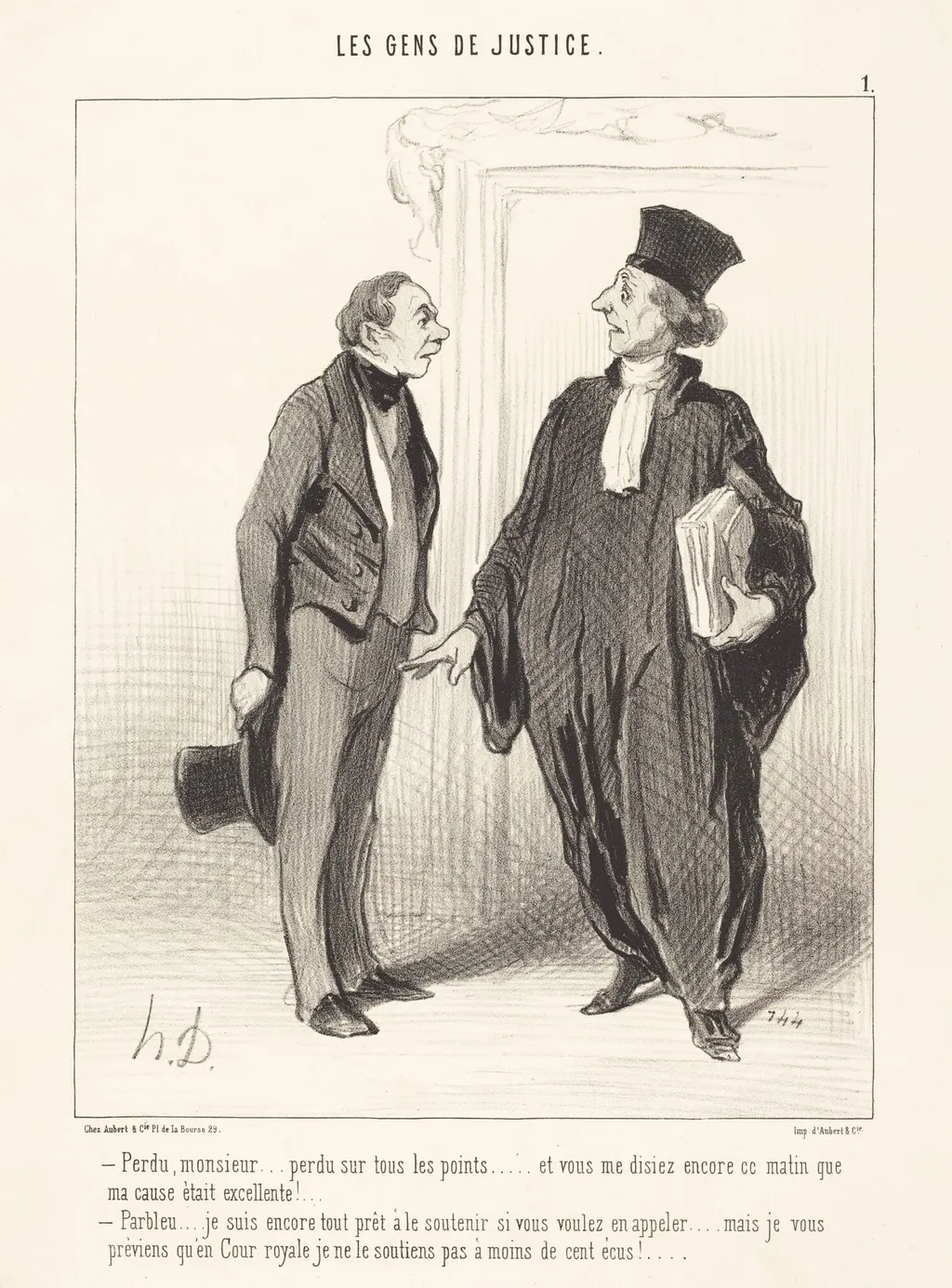
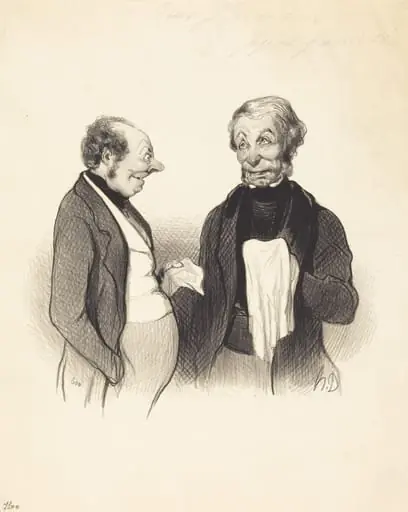
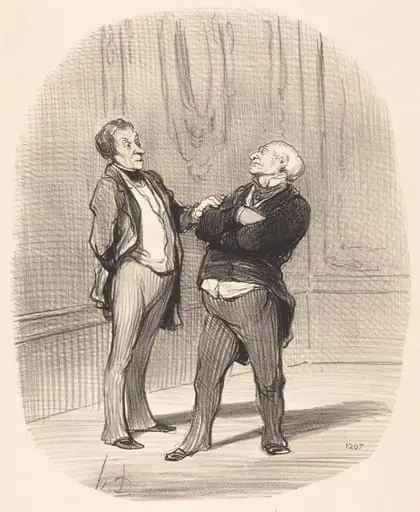
Perdu, monsieur... perdu sur tous les points... is an ink print by the Romanticist artist Honoré Daumier. It dates from 1845 and is held in the collection of the National Gallery of Art.
About this work
Overview
This piece, like many of his works, captures a quiet moment charged with unspoken social critique, relying on gesture and costume rather than overt humor.
Honoré Daumier produced this 1845 lithograph as part of his extensive body of satirical prints, created during a period of intense political and social change in France. Working primarily for illustrated journals like *Le Charivari*, he used the accessibility of printmaking to reach a broad public. This piece, like many of his works, captures a quiet moment charged with unspoken social critique, relying on gesture and costume rather than overt humor.
Subject & Meaning
Two men, one in a business suit and the other in clerical robes, engage in a tense exchange. The formal attire of both suggests institutional authority, yet their postures and expressions hint at mutual distrust or confusion. The title, translating to 'Lost, sir... lost on all points,' implies failure or disorientation, possibly mocking the ineffectiveness of both secular and religious power structures in navigating modern French society.
Technique & Style
Daumier employed lithography to achieve expressive tonal contrasts with minimal lines. Shading is applied with loose, gestural strokes that model form without detail, emphasizing facial tension and body language. The plain background isolates the figures, focusing attention on their interaction. The absence of decorative elements heightens the psychological weight of the scene, characteristic of his stripped-down, emotionally direct style.
History & Provenance
Created during Daumier’s most prolific period as a political cartoonist, this print likely appeared in a periodical between 1844 and 1846, when censorship temporarily eased after the 1843 crackdown on *La Caricature*. Though its original publication context is unconfirmed, it aligns with his broader output targeting hypocrisy and institutional decay. The work entered public collections in the late 19th century as interest in his social commentary grew.
Context
In mid-1840s France, the July Monarchy struggled with rising class tensions and public disillusionment. Daumier’s prints responded to the erosion of trust in both the state and the Church, institutions increasingly seen as out of touch. His work resonated with urban readers who recognized the absurdities of bureaucratic and clerical authority, making his lithographs a form of visual journalism that bypassed official channels.
Legacy
Daumier’s use of everyday scenes to expose systemic flaws influenced later generations of social realists and graphic artists. This lithograph exemplifies his ability to convey complex social dynamics through minimal means. Though not widely exhibited in his lifetime, his prints gained recognition in the 20th century as precursors to modern editorial illustration and psychological portraiture in print.
Artist & collection

Artist
Honoré-Victorin Daumier was a French painter, sculptor, and printmaker, whose many works offer commentary on the social and political life in France, from the Revolution of 1830 to the fall of the Second French Empire in 1870.