Artwork
Sur le point de se noyer ...
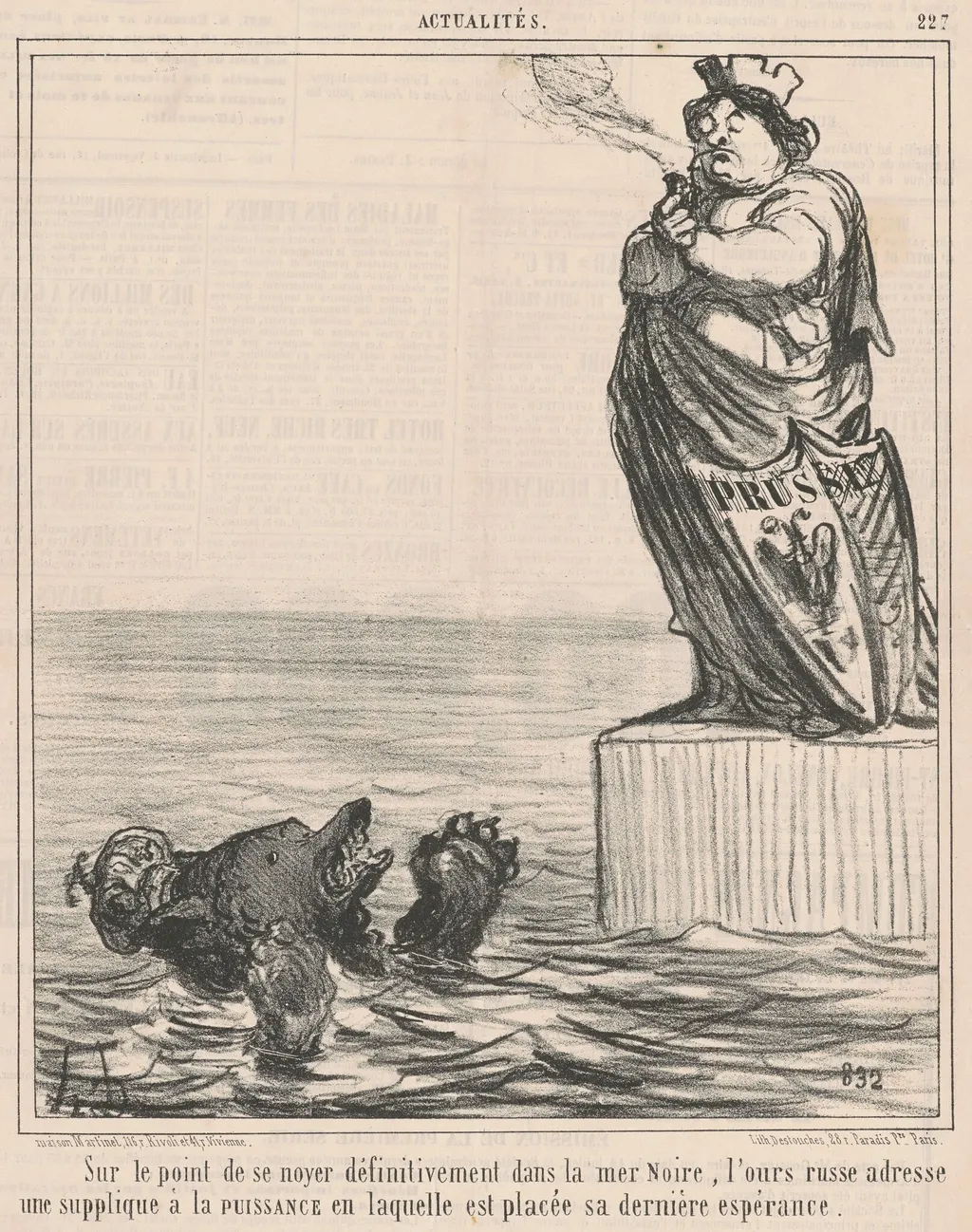
Sur le point de se noyer ... is an ink print by the Impressionist artist Honoré Daumier. It dates from 1855 and is held in the collection of the National Gallery of Art.
About this work
Overview
This lithograph by Honoré Daumier portrays a struggling, bear-like figure submerged in water, its limbs raised in a gesture of helplessness.
This lithograph by Honoré Daumier portrays a struggling, bear-like figure submerged in water, its limbs raised in a gesture of helplessness. Nearby, a composed, robed figure labeled 'PRUSSE' sits impassively. The image operates as a political allegory, using stark visual contrast to highlight neglect amid crisis. Rendered in monochrome, the work leverages the accessibility of lithography to reach a broad public audience with its critique.
Subject & Meaning
The drowning figure symbolizes a vulnerable nation or populace under duress, while the seated figure represents Prussia’s cold detachment. The label 'PRUSSE' directly ties the scene to geopolitical power dynamics of mid-19th century Europe, likely referencing Prussian inaction during uprisings or territorial conflicts. Daumier avoids literal representation, instead using animalistic form to underscore dehumanization and moral indifference in political leadership.
Technique & Style
Executed in lithography, the image relies on bold, simplified contours and high-contrast tonal shifts to convey urgency. Daumier’s loose, expressive lines emphasize movement and emotion over detail, a deliberate choice to amplify the scene’s emotional weight. The medium’s reproducibility allowed the image to circulate widely in newspapers and pamphlets, reinforcing its role as public commentary rather than fine art.
History & Provenance
Created during the 1840s, the print emerged amid rising tensions in Europe following the July Monarchy and preceding the 1848 revolutions. Daumier, known for his satirical work in Le Charivari, frequently targeted authoritarian regimes. Though exact publication details are sparse, the print aligns with his broader campaign against state neglect and foreign intervention, particularly Prussia’s influence in French affairs.
Context
In the decade before 1848, France experienced political instability and economic hardship, while Prussia emerged as a dominant conservative force. Daumier’s imagery responded to public frustration over perceived abandonment by powerful neighbors and domestic elites. The bear, a common symbol for Russia or Prussia in French caricature, here becomes the victim — reversing expectations to critique inaction rather than aggression.
Legacy
The work exemplifies Daumier’s enduring contribution to political illustration, influencing later generations of satirical artists. Its unadorned style and moral clarity helped establish lithography as a legitimate vehicle for social critique. Though not widely exhibited in galleries during his lifetime, its circulation in periodicals ensured its impact on public discourse and the evolution of modern editorial cartooning.
Artist & collection

Artist
Honoré-Victorin Daumier was a French painter, sculptor, and printmaker, whose many works offer commentary on the social and political life in France, from the Revolution of 1830 to the fall of the Second French Empire in 1870.