Artwork
Descent into the Plain of Granada
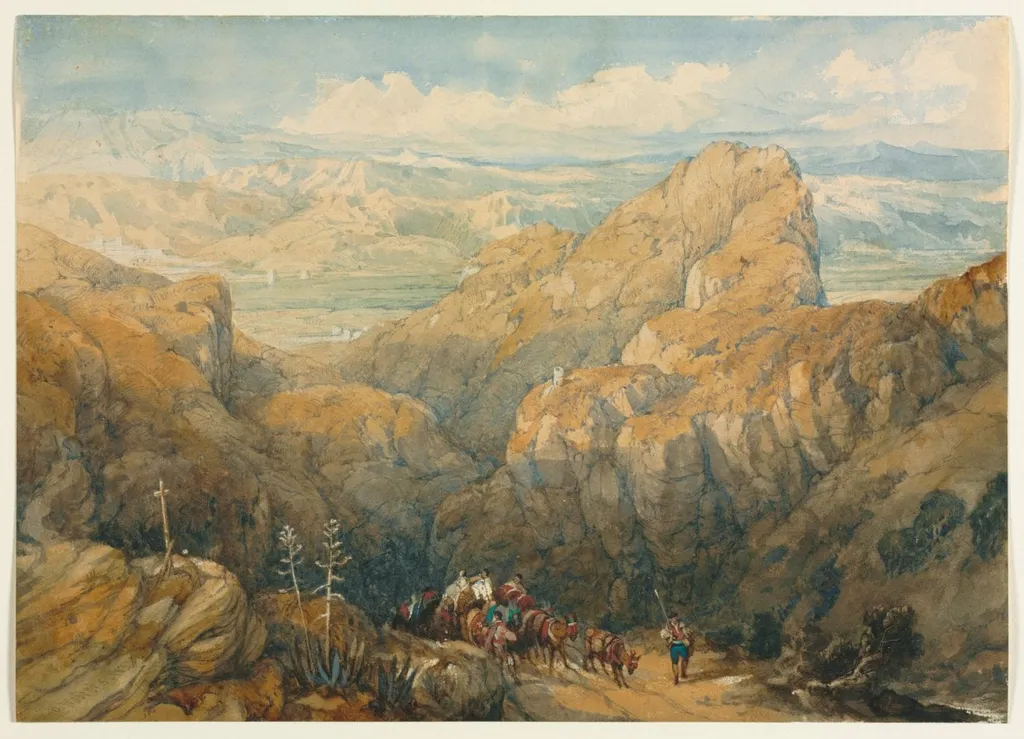
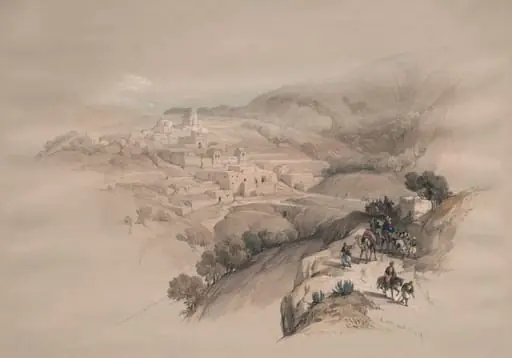
Descent into the Plain of Granada is a drawing by the Romanticist artist David Roberts. It dates from 1834 and is held in the collection of the Cleveland Museum of Art.
About this work
You see a winding road cutting through dry, rolling hills toward a distant city nestled at the base of snow-capped mountains.
You see a winding road cutting through dry, rolling hills toward a distant city nestled at the base of snow-capped mountains.
Roberts painted this on the spot during a long walk from Madrid to Granada. He carried paper, watercolors, and a small folding stool—no camera, no phone. The light feels real because it is: he sat there, mixing colors as the sun moved.
To see how other artists turned travel into pictures, look up the subject england, 19th century.
Overview
Created in 1832 during David Roberts’s first major journey abroad, this watercolor captures a moment from his overland trek from Madrid to Granada. Executed en plein air, the work reflects his direct observation of the Spanish landscape. Roberts traveled on foot for much of the journey, carrying minimal supplies—paper, pigments, and a portable stool—to record scenes as he encountered them, without the aid of mechanical devices.
Subject & Meaning
The drawing depicts a winding path through arid hills, with mules carrying loads and a solitary traveler approaching the horizon. In the distance, Granada rests beneath the snow-laden peaks of the Sierra Nevada. The scene conveys quiet movement and solitude, emphasizing the physical and visual scale of the journey. Roberts’s written account reveals his deep appreciation for the region’s natural grandeur, framing the landscape as both a challenge and a revelation.
Technique & Style
Executed in watercolor on paper, the work employs loose, observational brushwork to capture shifting light and atmospheric depth. Roberts rendered the mountains with cool, muted tones, contrasting with the warm ochres of the foreground. The absence of sharp detail in the distance enhances the sense of spatial recession, while the careful placement of figures grounds the composition in human scale and movement.
History & Provenance
The drawing originated as a personal record from Roberts’s ten-month tour of France and Spain, undertaken before his more famous travels in the Middle East. It remained in his possession until his death, later entering institutional collections. Its survival as a working sketch—rather than a polished studio piece—offers insight into his early method and the unmediated nature of his observations.
Context
In the early 1830s, travel in southern Spain remained arduous and uncommon for foreign artists. Roberts’s decision to walk long distances, sketching as he went, aligned with a growing interest in direct engagement with landscape. His approach contrasted with the idealized views common in academic painting, instead prioritizing authenticity and personal experience over theatrical composition.
Legacy
This watercolor marks the beginning of Roberts’s career as a topographical observer, laying the groundwork for his later, more systematic documentation of Egypt and the Levant. Its unembellished realism and emphasis on firsthand experience influenced a generation of travel artists who sought to record the world through direct encounter rather than studio reconstruction.
Artist & collection
Artist
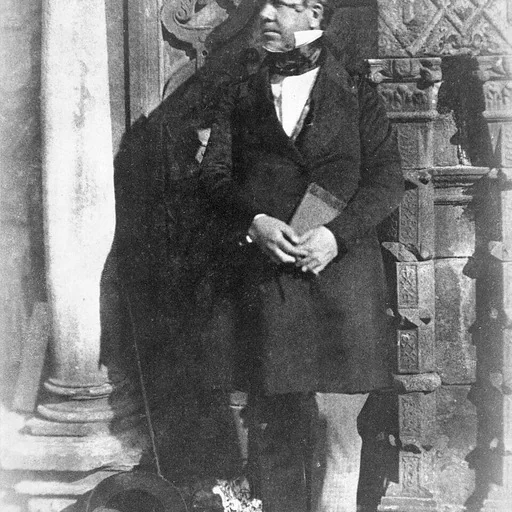
David Roberts (24 October 1796 – 25 November 1864) was a Scottish painter. He is especially known for The Holy Land, Syria, Idumea, Arabia, Egypt, and Nubia, a prolific series of detailed lithograph prints of Egypt and…