Artwork
Untitled
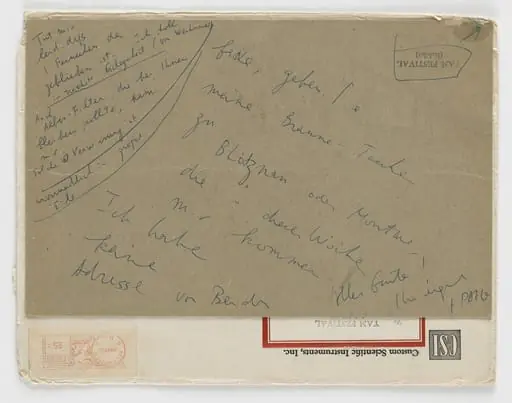
Untitled is a print by Designer Unidentified. It dates from 1966 and is held in the collection of the Museum of Modern Art. This double-sided letterpress print, dated 1966, originates from Prague and was produced by an unknown designer.
About this work
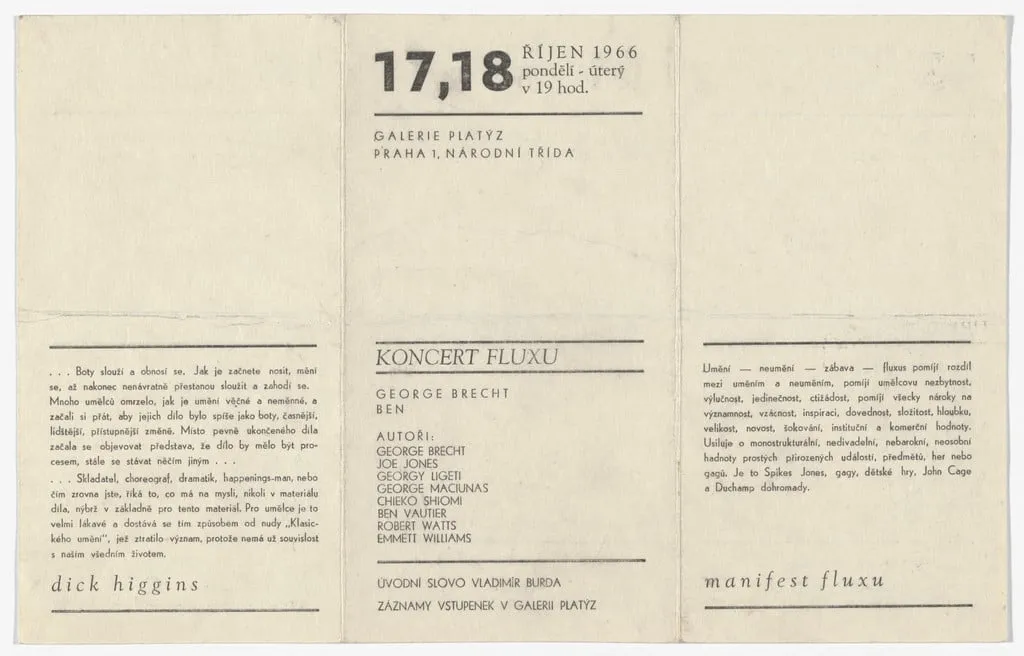
The other side lists names like George Brecht and Ben Vautier under the words *Koncert Fluxu*.
This is a folded sheet of paper with text printed on both sides. One side shows a date—*17, 18 říjen 1966*—and an address in Prague. The other side lists names like George Brecht and Ben Vautier under the words *Koncert Fluxu*. The text is in Czech and English, with a mix of short paragraphs and a bold title. The paper looks old, with a slightly yellowed, worn edge.
The names and words suggest this might be related to an event or group called *Fluxus*. The text is typed in a plain, no-frills style, with some sections underlined.
Look up The Museum of Modern Art to see where this is kept.
Overview
This double-sided letterpress print, dated 1966, originates from Prague and was produced by an unknown designer. It is held in the collection of The Museum of Modern Art in New York. The sheet is folded, with text printed on both faces in Czech and English. Its plain typewritten format, slight yellowing, and worn edges suggest it was a functional, possibly ephemeral, document rather than a fine art object.
Subject & Meaning
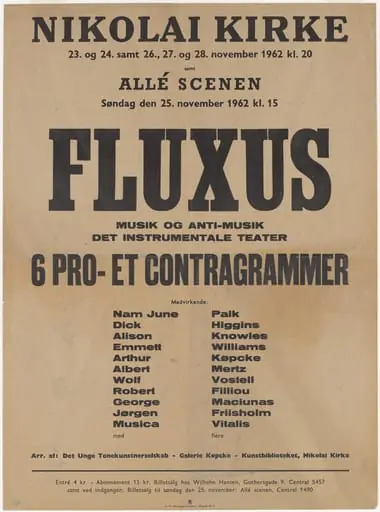
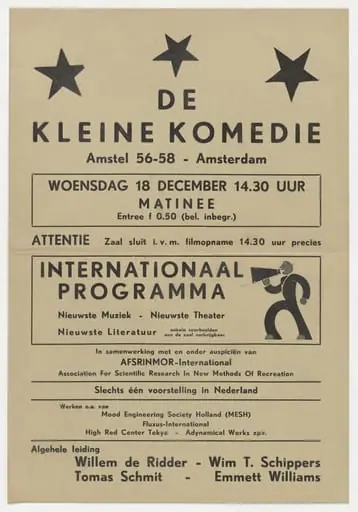
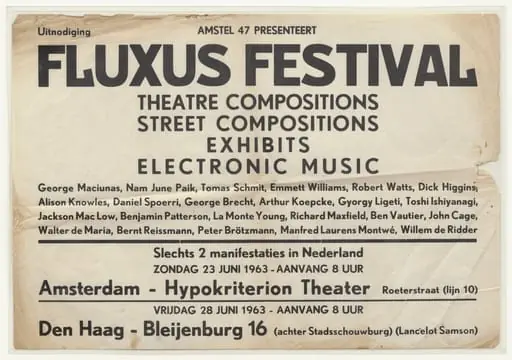
The print references a Fluxus event titled 'Koncert Fluxu,' listing participants such as George Brecht and Ben Vautier. The date—October 17–18, 1966—and a Prague address indicate a specific performance or gathering. The bilingual text reflects the international character of the Fluxus network, while the inclusion of names and location implies it served as a flyer or program for a transient, experimental arts event.
Technique & Style
The work was produced using letterpress, with a utilitarian typewriter aesthetic. Text is arranged in short blocks, some underlined for emphasis, without decorative elements. The mix of Czech and English suggests an audience spanning local and international participants. The physical condition—slightly faded, worn edges—indicates it was handled and circulated, reinforcing its role as a transient communication tool.
History & Provenance
Created in Prague during a period of heightened artistic activity under communist rule, the print likely circulated among avant-garde circles. Its survival and eventual acquisition by MoMA suggest it was preserved as a record of underground cultural exchange. The anonymity of the designer and the modest production method reflect the informal, anti-institutional ethos of Fluxus at the time.
Context
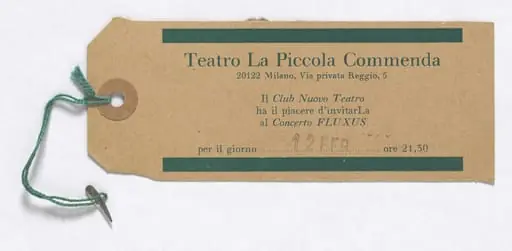
Fluxus, an international network of artists active in the 1960s, emphasized ephemeral, participatory events over traditional art objects. This print aligns with the group’s rejection of commercial art systems, using simple, reproducible formats to document performances. Its existence in Prague highlights the reach of Fluxus beyond Western Europe and the U.S., even in politically restricted environments.
Legacy
As a fragment of a forgotten event, the print now serves as historical evidence of cross-border artistic collaboration during the Cold War. Its preservation in MoMA’s collection underscores the institutional recognition of Fluxus’s impact on conceptual and performance art. It remains a quiet testament to the movement’s emphasis on process, participation, and the value of the ephemeral.
Artist & collection
Artist
She kept a rubber stamp of her own thumbprint in her desk drawer—ink it, press it on scrap paper, then scratch out the edges with a nail until the ridges blurred into something unreadable.