Artwork
Christ and the Woman of Samaria
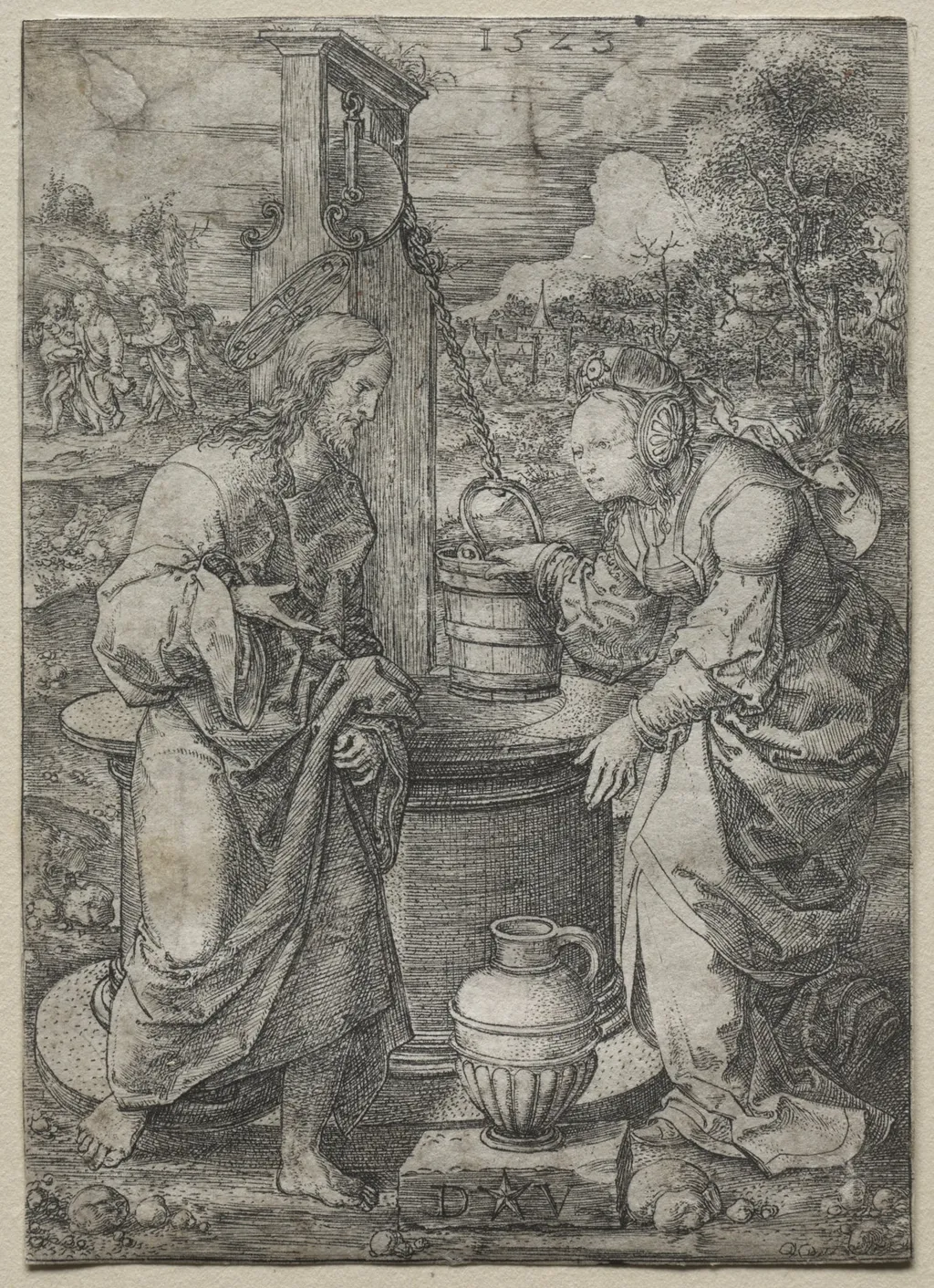
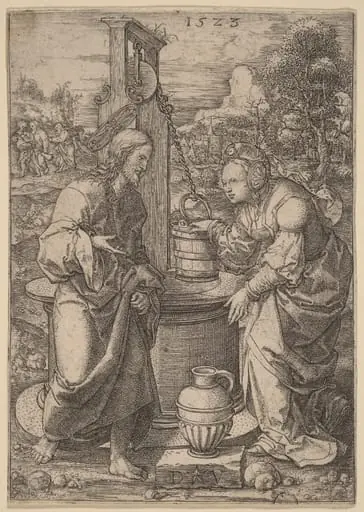
Christ and the Woman of Samaria is a print by the Renaissance artist Dirck Vellert. It dates from 1523 and is held in the collection of the Cleveland Museum of Art.
About this work
One person, dressed in flowing robes, leans on the well’s edge, while the other reaches into a large barrel.
This black-and-white print shows two figures by a well. One person, dressed in flowing robes, leans on the well’s edge, while the other reaches into a large barrel. The scene is detailed with textures—fabric folds, a chain on the well, and a small pitcher on the ground. In the background, a town and trees add depth.
The woman’s gesture toward the barrel suggests she’s offering or sharing something. The print’s date, 1523, is marked in the corner, hinting at its Renaissance roots.
Next, look up Renaissance to see how this style shaped art and ideas.
Overview
Created in 1523 by Dutch artist Dirk Vellert, this black-and-white print depicts a biblical encounter between Christ and the Samaritan woman at a well. Executed in a detailed linear style, the work belongs to the tradition of Northern Renaissance printmaking. It is currently held in the collection of The Cleveland Museum of Art, where it serves as an example of early 16th-century religious imagery rendered through engraving or etching techniques.
Subject & Meaning
The scene illustrates John 4:7–26, in which Christ speaks to a Samaritan woman, offering her living water. The woman’s gesture toward the barrel suggests her offering of water, while Christ’s posture conveys quiet authority. The well, a traditional symbol of spiritual thirst and revelation, anchors the composition. The inclusion of a small pitcher on the ground reinforces the narrative’s focus on exchange—both physical and divine.
Technique & Style
Vellert employed fine, controlled lines to render textures: the folds of garments, the metal chain on the well, and the wooden barrel’s staves. The background features a simplified town and trees, creating spatial depth without perspective distortion. The monochrome palette reflects the limitations and aesthetic priorities of printmaking at the time, emphasizing clarity and detail over color, typical of Northern European engravings of the period.
History & Provenance
The print bears the date 1523, placing it within Vellert’s active years in Antwerp, a center for religious print production. While its early ownership is undocumented, it entered the Cleveland Museum of Art’s collection through established acquisition channels in the 20th century. Its survival in good condition suggests it was carefully preserved, likely by a private collector or ecclesiastical institution before museum acquisition.
Context
Produced during the early Reformation, this print reflects the continued demand for biblical imagery even as religious authority was being challenged. Northern artists like Vellert catered to both Catholic and emerging Protestant audiences by focusing on scriptural narratives. The detailed, intimate scale of the scene aligns with the rise of domestic devotional objects, meant for private contemplation rather than public display.
Legacy
Vellert’s print exemplifies how religious themes were adapted for the print medium, allowing wider dissemination of biblical stories. Though not widely known today, works like this contributed to the visual literacy of early modern audiences. Its preservation in a major museum underscores its role as a representative artifact of Northern Renaissance print culture, valued for its craftsmanship and historical resonance.
Artist & collection


![Christ and the Woman of Samaria [verso], by German 16th Century](https://artifactworldgallery.com/img/german-16th-century--christ-and-the-woman-of-samaria-verso--b92a651572d4a24c-w320.webp)