Artwork
Riding School
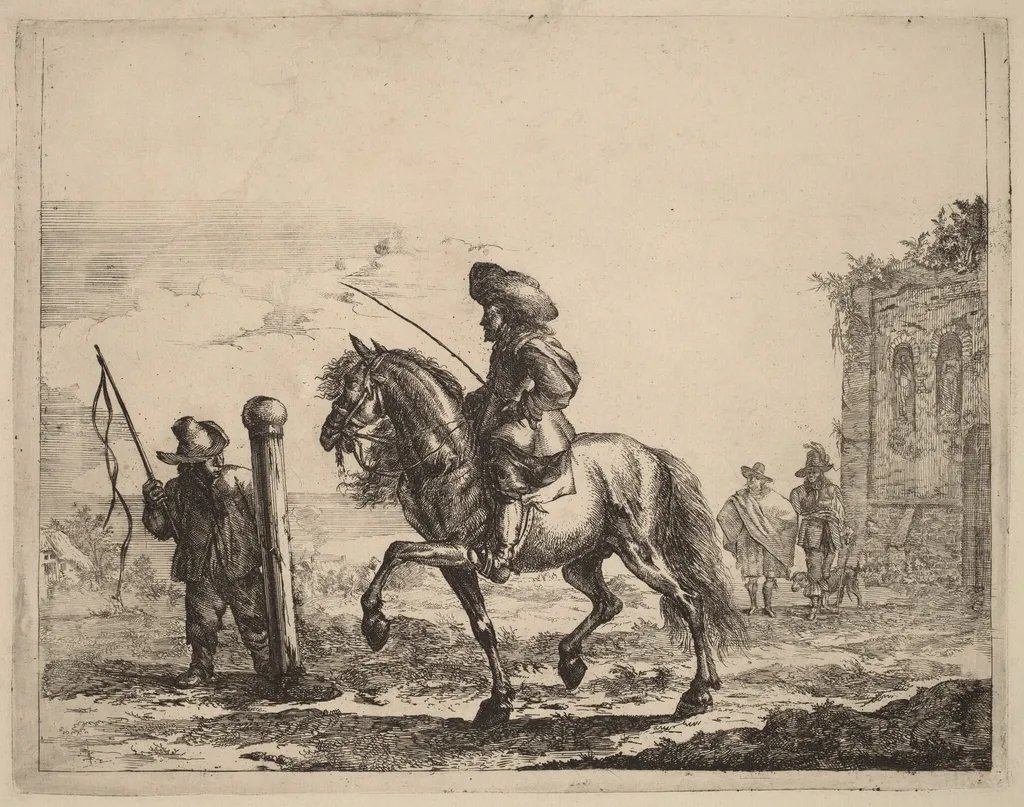
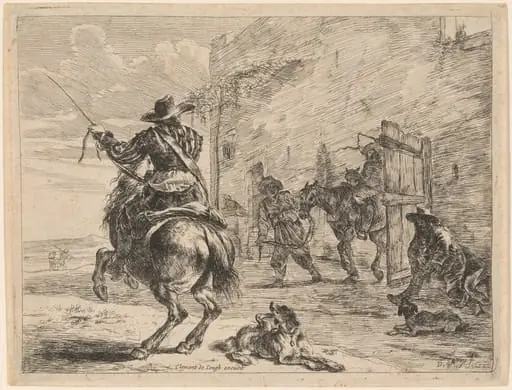
Riding School is an ink print by the Baroque artist Jacob Duck. It dates from 1634 and is held in the collection of the National Gallery of Art.
About this work
Overview
Though trained as a goldsmith, he turned to printmaking and painting, developing a niche in scenes of soldiers and equestrian training.
Jacob Duck’s 1634 etching *Riding School* captures a moment of military instruction in a quiet, open yard. Executed in fine linear detail on laid paper, the print reflects Duck’s interest in disciplined human activity. Though trained as a goldsmith, he turned to printmaking and painting, developing a niche in scenes of soldiers and equestrian training. His work, rooted in Utrecht’s artistic circles, often portrayed the routines of military life with quiet precision.
Subject & Meaning
The scene centers on a rider controlling a rearing horse, a gesture of control and training. To the left, a figure leans on a staff, observing with authority, while two others move along a distant path behind a stone wall. The composition suggests a structured environment where horsemanship is taught as part of military discipline. No overt drama or battle is shown—instead, the focus is on routine, vigilance, and the quiet mastery of skill.
Technique & Style
Duck employed etching to achieve delicate, fluid lines that convey motion and texture. The horse’s straining limbs and the rider’s flowing cloak are rendered with fine, incised strokes, typical of the medium’s capacity for detail. The background is minimized with lighter, sparser lines, directing attention to the central figures. The use of laid paper, with its subtle watermark texture, enhances the print’s tactile quality and aligns with Dutch printmaking practices of the period.
History & Provenance
Duck, born in Utrecht in 1607, began as a goldsmith before studying under Joost Cornelisz Droochsloot. He worked in Utrecht, Haarlem, and The Hague, moving within networks of artists and military patrons. *Riding School* dates from his mature period, when he focused on genre scenes of soldiers and equestrian training. The print survives in several institutional collections, though its early ownership remains undocumented beyond its association with Dutch collectors of the mid-17th century.
Context
In the 1630s, the Dutch Republic maintained standing militias and cavalry units, making military training a visible part of civic life. Artists like Duck responded to this culture, depicting drills, parades, and equestrian exercises as subjects worthy of observation. Unlike grand historical scenes, Duck’s work emphasized the mundane rhythms of service—reflecting a broader Dutch interest in everyday realism, even within institutional settings.
Legacy
Duck’s etchings contributed to a tradition of Dutch printmaking that valued precision over spectacle. While not widely celebrated in his lifetime, his focus on military discipline and quiet observation influenced later genre printmakers. His work remains a record of how ordinary moments in training were rendered with care, offering insight into the visual culture of early modern Dutch society beyond the realm of portraiture or landscape.
Artist & collection
Artist
Jacob Duck (also Ducq, Duyck, Duick, Duc) (1600 – buried 22/28 January 1667) was a Dutch painter and etcher.

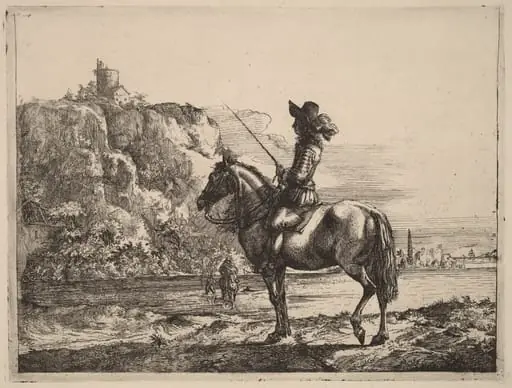 River Landscape with Horseman
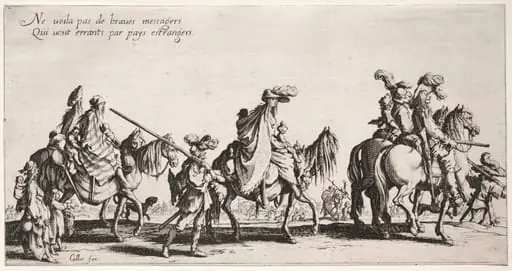 The Bohemians: The Bohemians Marching: The Vanguard
![Entry of Marie de Medici into Amsterdam [plate 2 of 6], by Pieter Nolpe](https://artifactworldgallery.com/img/pieter-nolpe--entry-of-marie-de-medici-into-amsterdam-plate-2-of-6--6a77731f69c675c9-w320.webp) Entry of Marie de Medici into Amsterdam [plate 2 of 6]
Entry of Marie de Medici into Amsterdam [plate 2 of 6]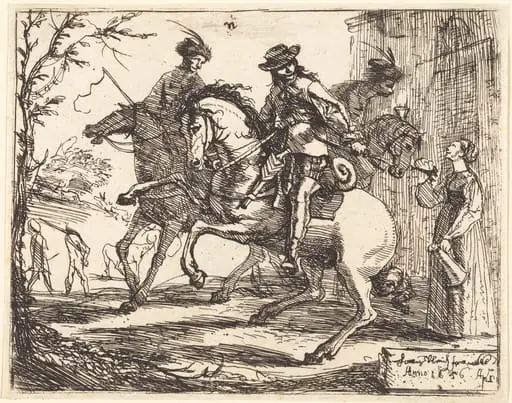 Three Riders before an Inn
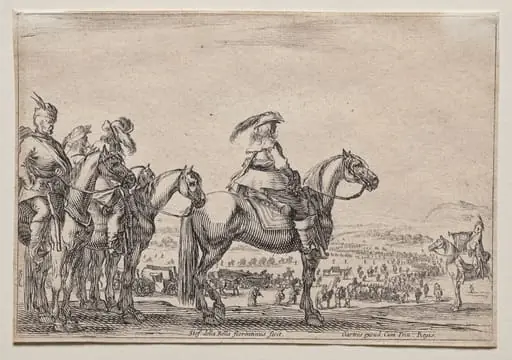 An Enemy on the March
![Entry of Marie de Medici into Amsterdam [plate 4 of 6], by Pieter Nolpe](https://artifactworldgallery.com/img/pieter-nolpe--entry-of-marie-de-medici-into-amsterdam-plate-4-of-6--689cdf6e84d84946-w320.webp) Entry of Marie de Medici into Amsterdam [plate 4 of 6]
Entry of Marie de Medici into Amsterdam [plate 4 of 6]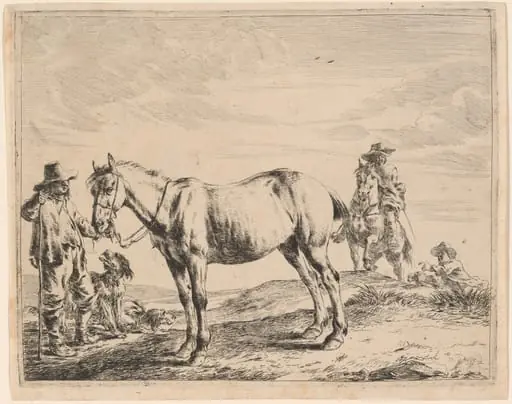 A Man Holding a Horse by His Bridle
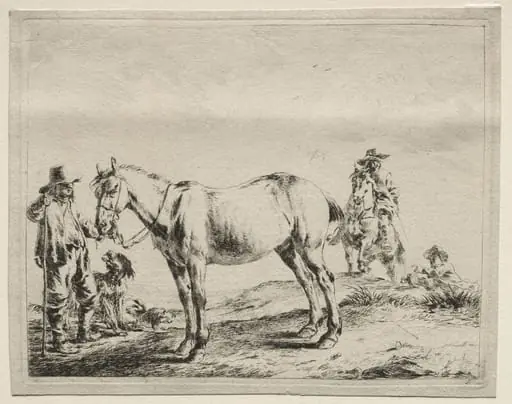 Man holding a horse by the bridle
![Entry of Marie de Medici into Amsterdam [plate 6 of 6], by Pieter Nolpe](https://artifactworldgallery.com/img/pieter-nolpe--entry-of-marie-de-medici-into-amsterdam-plate-6-of-6--5a770af49b94e5e3-w320.webp) Entry of Marie de Medici into Amsterdam [plate 6 of 6]
Entry of Marie de Medici into Amsterdam [plate 6 of 6]![Entry of Marie de Medici into Amsterdam [plate 6 of 6], by Pieter Nolpe](https://artifactworldgallery.com/img/pieter-nolpe--entry-of-marie-de-medici-into-amsterdam-plate-6-of-6--1180e5a1b81c4aa0-w320.webp) Entry of Marie de Medici into Amsterdam [plate 6 of 6]
Entry of Marie de Medici into Amsterdam [plate 6 of 6]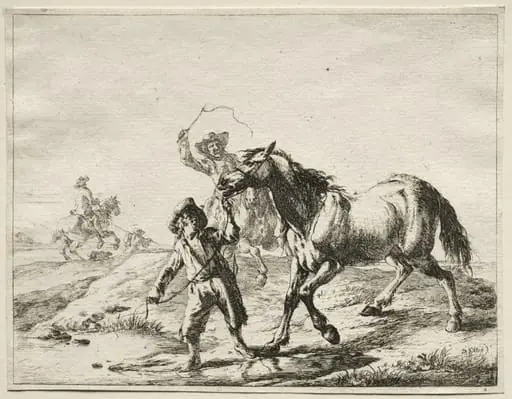 A boy taking a horse to drink
 Rearing Horse near a Stable