Artwork
Sebastian Le Clerc
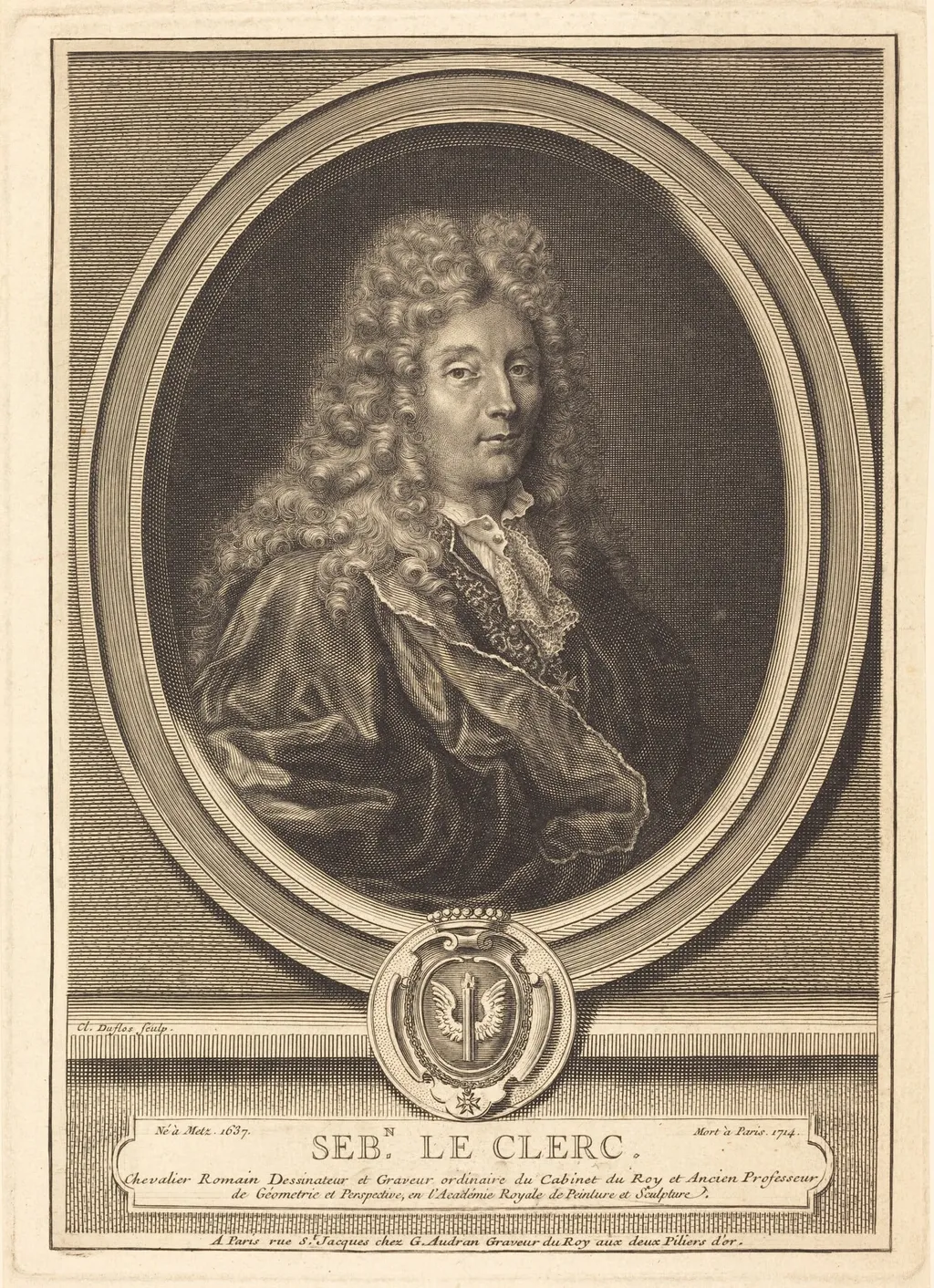
Sebastian Le Clerc is an ink print by the Baroque artist Claude Duflos. It dates from 1714 and is held in the collection of the National Gallery of Art.
About this work
Overview
This print is an engraving on laid paper, produced around 1714 by Claude Duflos. It depicts the French artist and engraver Sebastian Le Clerc, known for his technical illustrations. The work belongs to a tradition of portrait engravings that served both commemorative and professional purposes, capturing the likeness of notable figures in the arts.
Subject & Meaning
Sebastian Le Clerc is portrayed in attire typical of an earlier generation, suggesting a deliberate reference to his longstanding reputation rather than contemporary fashion. The choice of dress emphasizes his identity as a respected practitioner of his craft, positioning him as a figure of enduring influence within the printmaking community of early 18th-century France.
Technique & Style
Duflos employed fine, controlled lines to model form and texture, characteristic of engraving as a relief-based intaglio process. Cross-hatching and varied line density create subtle gradations of light and shadow, particularly in the face and fabric folds. The precision of the toolwork reflects the discipline required to translate three-dimensional presence into flat, inked impressions.
History & Provenance
The engraving was made shortly after Le Clerc’s death, likely as part of a broader effort to document leading figures in French artistic circles. It was probably circulated among academies and print collectors, reinforcing Le Clerc’s legacy through reproducible imagery. No early ownership records are widely documented, but the print survives in institutional collections today.
Context
In early 18th-century France, engraved portraits were vital for disseminating the likenesses of artists, scientists, and scholars. Le Clerc himself had produced technical engravings for military and architectural publications. Duflos’s portrait aligns with this culture of documentation, where printmaking functioned as both art and archival record.
Legacy
The portrait endures as a visual reference for Le Clerc’s appearance and professional stature. While not widely reproduced today, it remains a key example of how engravers honored their peers through meticulous craftsmanship. It illustrates the interconnectedness of French printmakers, who both created and were depicted by one another.
Artist & collection