Artwork
Décroteur et Ramoneur (Scraper and Chimney Sweep)
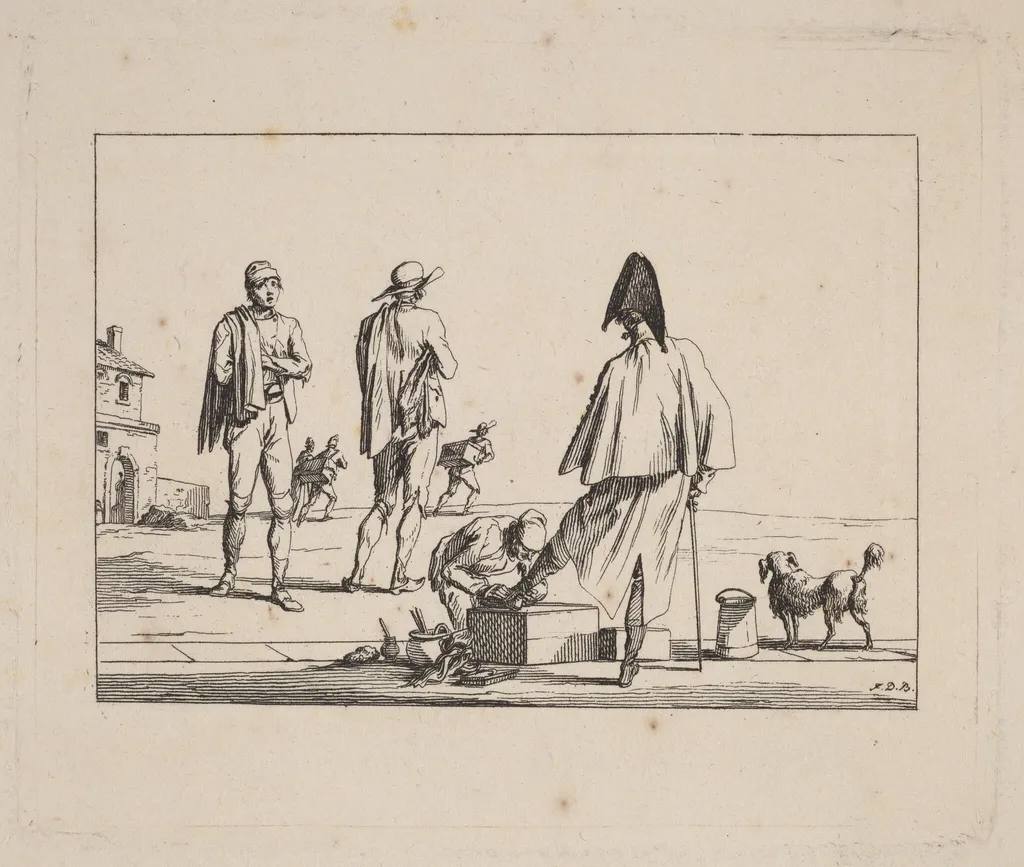
Décroteur et Ramoneur (Scraper and Chimney Sweep) is an ink print by the Romanticist artist Jean Duplessis-Bertaux. It dates from 1802 and is held in the collection of the National Gallery of Art.
About this work
Overview
Executed on wove paper as a proof before the addition of lettering, it presents four figures engaged in ordinary activities along a street.
Created in 1802 by Jean Duplessis-Bertaux, this etching captures a quiet urban moment in Paris. Executed on wove paper as a proof before the addition of lettering, it presents four figures engaged in ordinary activities along a street. The composition avoids theatricality, focusing instead on unadorned gestures and spatial relationships, reflecting the artist’s interest in documenting daily life through printmaking.
Subject & Meaning
The scene depicts laborers and passersby in a working-class neighborhood. A man with crossed arms observes, another walks away with a cane, a figure crouches near a barrel—possibly cleaning—while a hooded individual stands with a leashed dog, gazing downward. No narrative is imposed; the image suggests the rhythm of routine existence, where labor and stillness coexist without sentimentality or moral judgment.
Technique & Style
Duplessis-Bertaux employed fine, linear etching to define forms with minimal detail. The figures are rendered in simplified silhouettes, their clothing and postures suggested rather than elaborated. The absence of shading or ornamental elements emphasizes clarity and immediacy. The technique aligns with documentary printmaking traditions, prioritizing observation over embellishment.
History & Provenance
This impression is a proof state, made before the addition of inscriptions typically found in published prints. Such proofs were often retained by the artist or used for review prior to final editioning. Its survival offers insight into Duplessis-Bertaux’s working process and the circulation of prints in early 19th-century France, though its specific ownership history remains undocumented.
Context
Produced during the post-Revolutionary period, the work reflects a broader cultural shift toward depicting ordinary life. While academic art favored grand themes, printmakers like Duplessis-Bertaux turned to street scenes, trades, and common people. This image aligns with emerging interest in social realism, though it avoids overt political commentary, focusing instead on quiet presence.
Legacy
Though not widely exhibited or reproduced, this etching contributes to a lesser-known body of French printmaking that documented urban labor. Its restrained aesthetic anticipates later 19th-century interest in everyday subjects, influencing artists who sought truth in unidealized scenes. It remains a quiet example of how printmaking could serve as a medium for social observation without spectacle.
Artist & collection


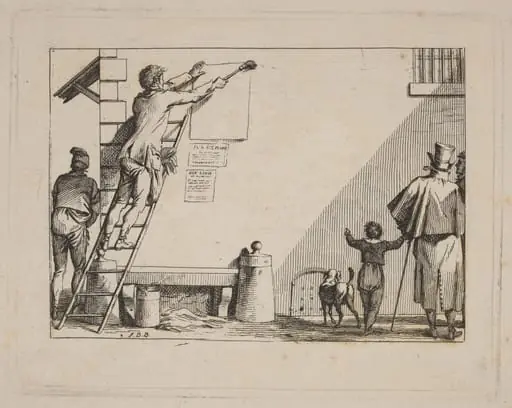 Colleur (Billposter)
 Various Caprices: The Young Man Seated, Leaning Against an Urn
 The Large Miseries of War: The Beggars and the Dying
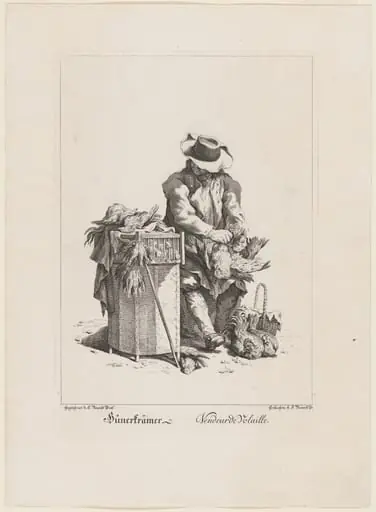 Hünerträmer (Poultry Seller)
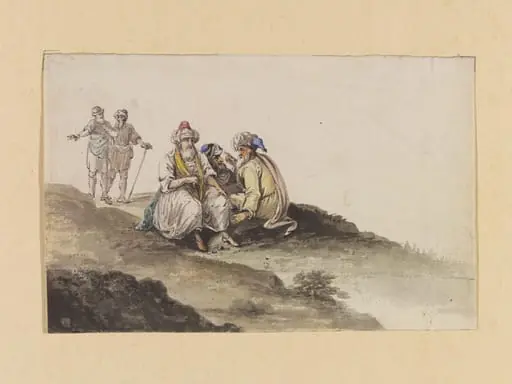 A Group of Turks
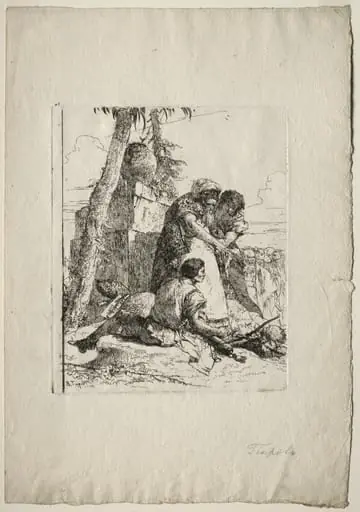 Scherzi di Fantasia: Magician Pointing Out a Burning Head to Two Youths
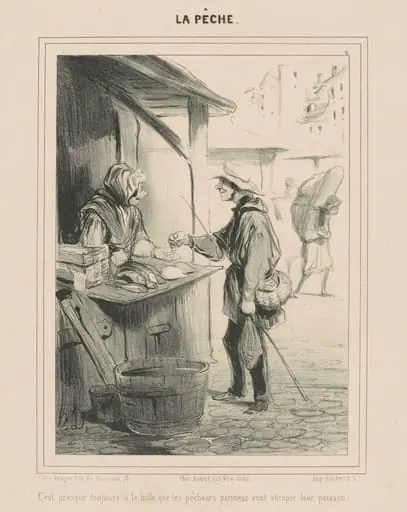 C'est pesque toujours a la halle ...
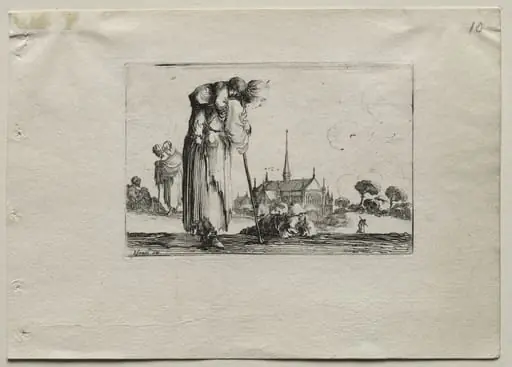 Caprices: Standing Beggar Woman Carrying a Child on her Back
![[Merchant in his stall with children playing], by Auguste Brouet](https://artifactworldgallery.com/img/auguste-brouet--merchant-in-his-stall-with-children-playing--87482c59251c2c9c-w320.webp) [Merchant in his stall with children playing]
[Merchant in his stall with children playing]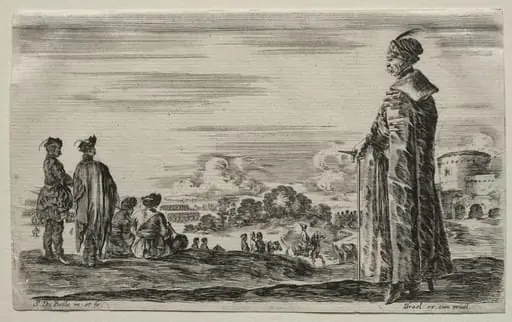 Various Figures and Landscapes: A Group of Polish Gentlemen
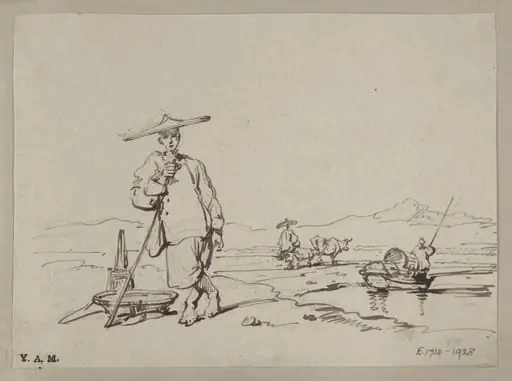 A Chinese man leaning on a staff
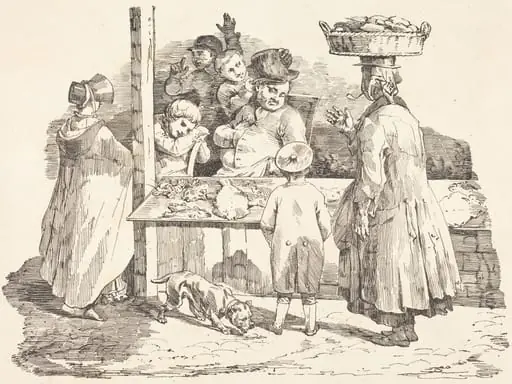 The Dozing Fishmonger (Le marchand de poissons endormie)